
A damaged car usually sits longer than anyone expects. It ends up in the back corner of a yard, behind a workshop, beside a factory wall, or inside a municipal depot because nobody wants to deal with the paperwork, the towing, the valuation argument, and the risk of getting it wrong.
That delay costs money. The vehicle takes up operating space, ties up a recoverable asset, and creates a compliance problem if fluids, loose parts, or unsafe access become part of the picture. For a private owner, it’s a frustration. For a business, contractor, or municipality, it becomes an avoidable admin and risk issue.
Your Damaged Car Is More Than an Eyesore
A damaged vehicle is rarely just “an old wreck”. In practice, it’s one of three things. It may be a repair candidate, a parts donor, or a metal recovery item. The mistake most sellers make is treating all damaged cars as if they belong in the same category.
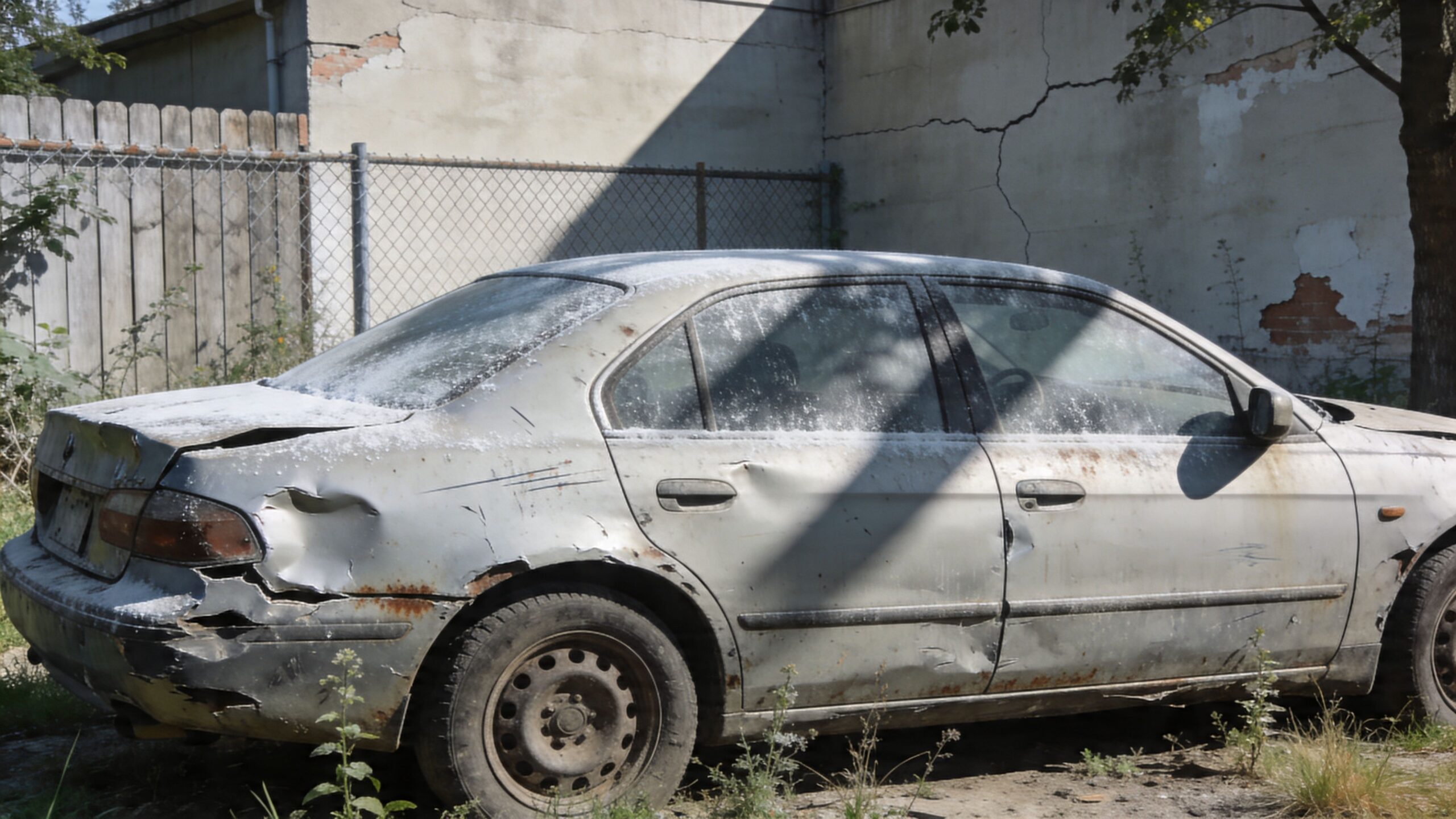

In South Africa, that distinction matters because disposal isn’t only about convenience. It touches vehicle ownership records, waste handling, transport arrangements, and the difference between selling a unit for resale value versus selling it for recoverable material value. If you’re searching for “we buy damaged cars”, you’re usually trying to solve a practical problem fast. The right answer depends on what the vehicle still contains, what paperwork exists, and how quickly it must leave site.
Why waiting usually makes the problem worse
A vehicle that stands for months tends to deteriorate beyond the original damage. Weather gets in. Wiring disappears. Glass breaks. Fluids leak. Tyres collapse into the ground. What could have been sold as a viable parts unit often drops into scrap territory because the condition becomes harder to verify and harder to transport safely.
For commercial sites, the issue is wider than the car itself. Security teams have to monitor access. Facility managers need the area cleared. EHS staff may flag the vehicle if it’s leaking or obstructing movement. If the vehicle sits inside a broader clean-up or shutdown project, it also interferes with sequencing.
Practical rule: Treat a damaged vehicle as part of your site recovery plan, not as a side issue to handle later.
A lot of online advice misses this because it’s written for US consumer sellers, with pricing examples and state-based processes that don’t fit local conditions. US-focused damaged car guides often ignore South African legal and operational realities. That gap matters even more when a damaged vehicle forms part of a larger scrap, demolition, or decommissioning workflow.
A local disposal decision, not a generic internet problem
South African sellers need a more grounded approach. Key questions are straightforward:
- Can the car still be rebuilt? If yes, you’re not dealing with a pure scrap transaction.
- Does ownership documentation exist and match the vehicle? If not, disposal gets slower and riskier.
- Is the vehicle part of a broader waste stream? That changes who should handle it.
- Do you need immediate removal from site? Logistics can be as important as price.
Where vehicle disposal forms part of a broader metals clearance job, it often helps to think in terms of integrated scrap metal removal services rather than a once-off car sale. That’s especially true for factories, contractors, transport operators, and public entities that need one accountable removal process instead of several fragmented collections.
How to Accurately Value Your Damaged Vehicle
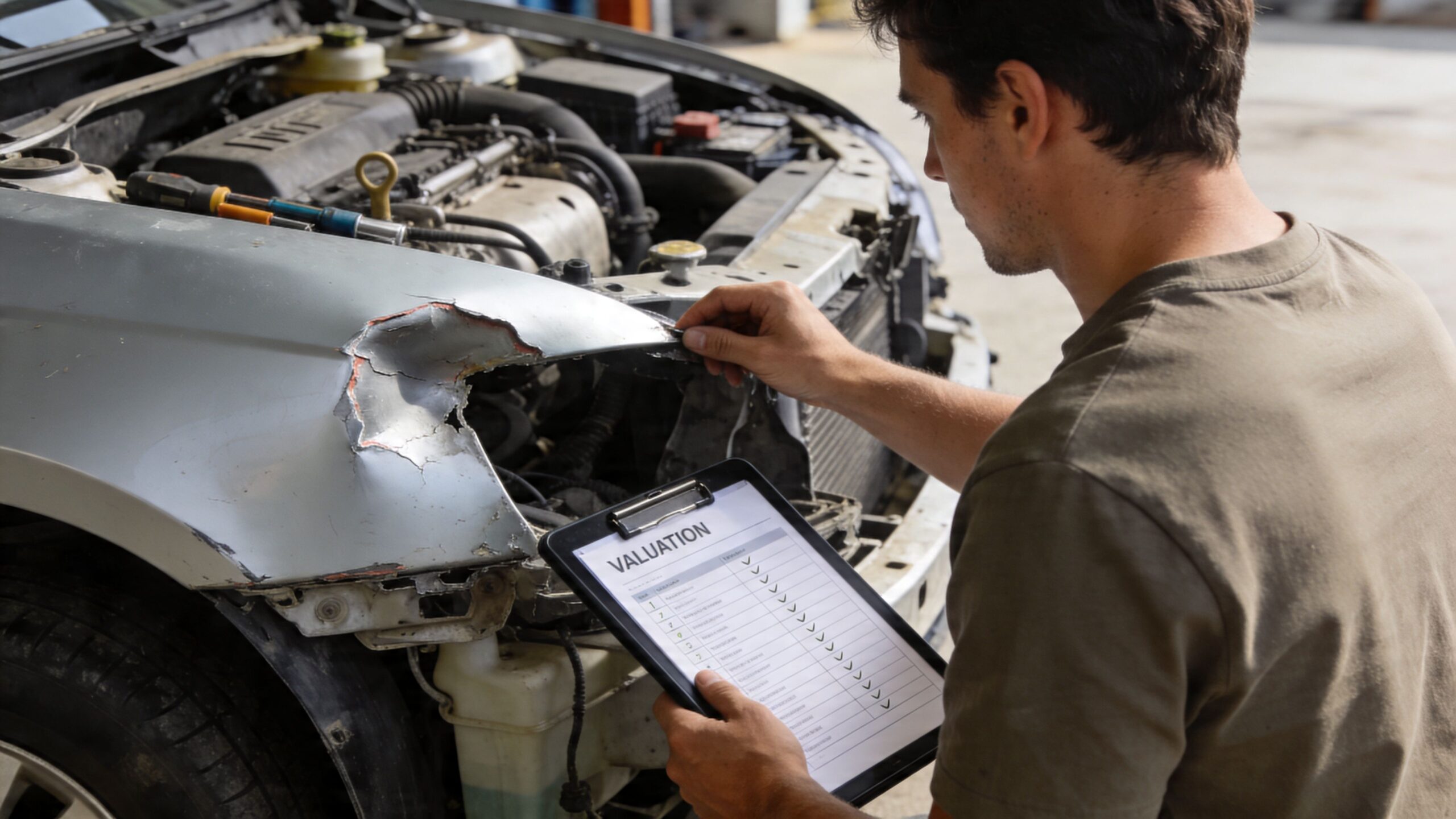
Most bad deals start with bad assumptions. Sellers either overvalue a wreck because they remember what the car used to be worth, or undervalue it because it “looks finished”. Buyers who know the trade work from a different method. They don’t just look at the badge and the accident damage. They assess what can still be recovered, reused, dismantled, or sold into metal channels.
Start with the vehicle identity, not the damage story
Before anyone can value the unit properly, they need the basic identifiers. That includes the make, model, year, VIN, registration details, and whether the vehicle is complete. A seller who says “it was running before the accident” isn’t providing usable valuation information. A buyer wants to know whether the engine is present, whether major assemblies are intact, and whether the shell has suffered structural deformation.
A practical intake list usually includes:
- Vehicle identity details such as VIN, registration number, make, model, and year
- Damage type including front-end impact, rear-end impact, rollover, burn damage, flood exposure, theft recovery, stripped condition, or non-runner mechanical failure
- Completeness of parts such as engine, gearbox, catalytic converter, battery, wheels, seats, loom, radiator pack, and body panels
- Location and access because a vehicle in a basement, a muddy site, or a restricted depot costs more to remove than one on open hardstanding
Understand the three value layers
Professionals usually separate damaged vehicle value into three layers. That keeps negotiations realistic.
| Value layer | What the buyer looks at | Typical seller takeaway |
|---|---|---|
| Rebuild value | Structural repair potential, model demand, completeness | Higher upside, but fewer suitable buyers |
| Parts value | Usable components that can be removed and sold | Better return than scrap in some cases, but slower |
| Scrap value | Ferrous and non-ferrous recovery after processing | Fastest route when the car is beyond viable repair |
This is why two damaged cars of the same model can produce very different offers. One may have severe panel damage but intact driveline and electronics. Another may look cleaner from outside but have fire damage, missing wiring, and paperwork issues. On paper they’re similar. In the yard they’re not.
How professional scrap valuation works
In South Africa, damaged vehicle valuation can follow a structured recovery method rather than guesswork. One trade method starts with an assessment against ISRI specifications, including categories such as HMS 1&2 for ferrous structural steel from car bodies and ISRI 236/238 for heavy turnings from engines. It then moves into a compliance check under the NEM: Waste Act, and finally a market valuation using LME ferrous and non-ferrous benchmarks adjusted for local logistics. Using that method, recovery can come in at 65 to 75% of total metal value, and a mid-size damaged car can average R8,000 to R15,000 at a scrap yard according to the cited trade summary at Long Island Recyclers’ damaged car valuation overview.
That same valuation summary notes that ferrous material may account for roughly 70 to 80% of vehicle weight, with non-ferrous material at 10 to 15%, and that an average sedan may carry around 800 to 1200kg of ferrous material within the total unit. Those numbers matter because scrap buyers don’t pay for sentiment. They pay for recoverable output, less labour, handling, contamination, and transport.
A seller doesn’t need to memorise every ISRI code. It helps to know that serious buyers are classifying material, not estimating by eye.
For a broader sense of what metal streams buyers are trying to recover, this guide to common scrap metal categories that can be recycled for cash is useful background.
What lowers an offer fast
Several issues drag a valuation down immediately:
Missing documents
If ownership can’t be verified, the buyer’s risk rises. That changes the offer or stops the deal entirely.Contamination inside the vehicle
Builders’ rubble, household waste, waterlogged interiors, and mixed non-metal material slow processing.Stripped components
Sellers often ask based on a “complete car” value after removing battery, wheels, loom, or engine parts. That never holds.Poor access for collection
If the buyer needs special lifting equipment, extra labour, or time-consuming site coordination, that cost gets built into the number.
After you’ve seen the logic, this walk-through gives a useful visual of the inspection mindset buyers apply before making an offer:

A fair damaged vehicle offer is easier to recognise when you can separate resale potential from metal recovery potential.
What sellers should prepare before asking for a price
Don’t send one blurry photo and expect a serious number. Provide enough detail for the buyer to classify the vehicle correctly.
Use this checklist:
- Take clear photos from all sides, plus engine bay, interior, odometer, VIN area, and the worst damage points
- State whether it starts or rolls because a non-runner and a seized unit are different removal jobs
- List any removed parts up front
- Declare paperwork status clearly before collection is booked
- Mention hazards such as fluid leaks, fire damage residue, or a vehicle trapped behind other assets
That level of detail won’t guarantee the highest offer, but it usually leads to a cleaner one. There’s less room for re-negotiation at pickup, and fewer disputes about condition.
Navigating South African Paperwork and Legalities
The physical car is only half the transaction. The other half is the paper trail. If the ownership side is handled badly, the vehicle may leave your property while the liability stays attached to your name or organisation.
The documents that matter most
In practice, the key issue is proving that the seller has authority to dispose of the vehicle. For a private owner, that usually means matching identity and ownership records. For a company or municipality, it often means internal asset approval, disposal authority, and documented sign-off from the person allowed to release the unit.
You also need to think beyond the sale itself. If the vehicle is no longer roadworthy, beyond economic repair, or destined for dismantling, the disposal path should line up with lawful deregistration and scrapping procedures where applicable. The exact forms and process can vary depending on the vehicle’s status and where the admin is being handled, so the safest approach is to verify the current local requirements before release.
Why ownership clarity comes first
The biggest operational problem isn’t usually the damaged chassis. It’s incomplete records. Vehicles change hands informally. Company fleets get shuffled between divisions. Municipal depots hold equipment for years without a clean disposal file. Then, when removal is finally needed, nobody can produce a complete document set.
That creates three risks:
- Future liability risk if the vehicle remains linked to the wrong owner on record
- Payment delays because compliant buyers won’t process a questionable transaction quickly
- Reduced value where the buyer has to carry additional admin or legal uncertainty
Compliance note: If you can’t prove authority to sell, the smart buyer won’t treat the deal as routine.
The same discipline applies when the damaged car is just one item in a larger site clearance project. A mixed load of vehicles, machinery, structural steel, and general waste needs a coordinated disposal record, not piecemeal handovers. That’s why many facilities fold vehicle disposal into a broader total waste management programme rather than letting separate departments handle scrap, vehicles, and waste in isolation.
Practical checks before handover
A clean legal handover usually includes internal verification before the tow truck arrives. Such a process allows experienced sellers to save time.
| Check | Why it matters |
|---|---|
| Ownership record available | Confirms legal authority to dispose |
| VIN matches records | Prevents disputes over identity |
| Keys present or absent declared | Affects collection planning |
| Vehicle status understood | Helps route it to rebuild, parts, or scrap channels |
| Release authority signed | Protects organisations during audit or review |
If the vehicle belongs to a business, add one more layer. Confirm who can sign disposal paperwork and who can authorise payment details. Collection crews often arrive on time while internal admin doesn’t. That mismatch causes avoidable delays.
What not to do
A few habits create unnecessary trouble:
- Don’t rely on verbal assurances that “the papers will follow later”
- Don’t release the vehicle before confirming who is buying it
- Don’t assume a damaged car can be handled like ordinary scrap metal
- Don’t ignore internal disposal policy if you’re acting for a company or public entity
Where the transaction is legitimate and documented, disposal is straightforward. Where records are vague, the vehicle usually sits longer, offers get weaker, and everyone’s time gets wasted.
Choosing Your Buyer Scrappers Rebuilders and Parts Sellers
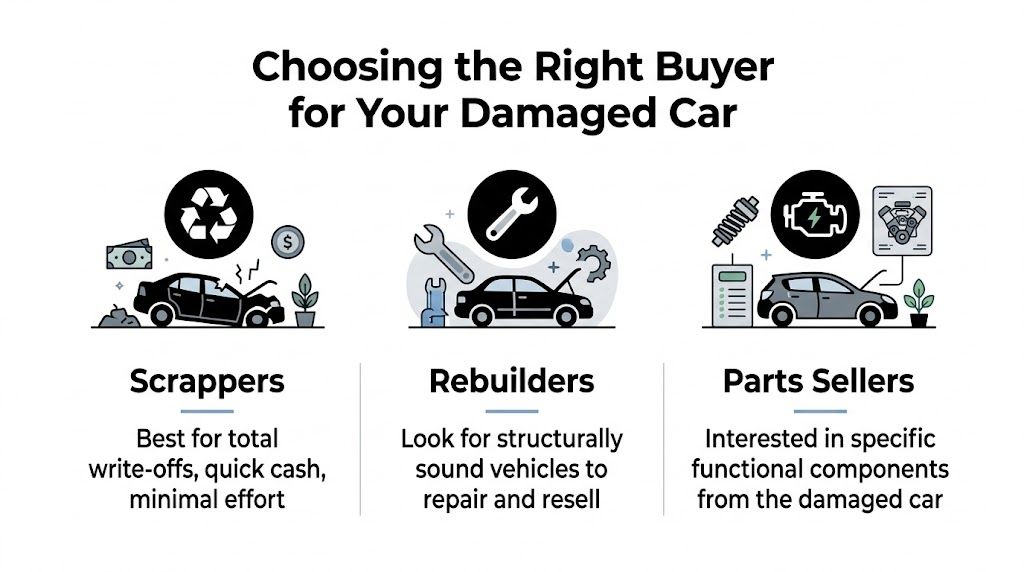
The best buyer depends on the condition of the car and on your tolerance for effort. Some sellers need the vehicle gone this week. Others will accept a slower process if they think more value can be extracted. There isn’t one right answer for every damaged unit.

Scrappers when speed and certainty matter
A scrap buyer is usually the cleanest option for a total loss, a shell, a burnt-out unit, a long-standing non-runner, or a vehicle with little realistic resale potential. The attraction is simplicity. The buyer is interested in recoverable metal and processable material, not in polishing the story around the vehicle.
This route works well when:
- The car is structurally beyond sensible repair
- You want one collection and one payment process
- The site needs immediate clearance
- The vehicle is part of a wider scrap disposal exercise
The trade-off is obvious. If the vehicle still contains good resale components or is rebuildable, a pure scrap route may leave money on the table. But many sellers overestimate those possibilities and underestimate the time and labour needed to realise them.
If your vehicle is already in the scrap category, it helps to understand how local scrap transactions are usually handled. A practical starting point is this overview of selling scrap metal locally.
Rebuilders when the shell still makes sense
A rebuilder is looking for a different opportunity. They want a vehicle with repairable damage, usable structure, and enough market demand to justify the work. A smashed bumper and front-end hit doesn’t automatically kill rebuild potential. A twisted shell, severe fire damage, or major water exposure often does.
A rebuilder may pay more than a scrapper if the following are true:
| Condition factor | Why it helps |
|---|---|
| Main structure still viable | Repair work remains commercially possible |
| Driveline mostly intact | Less replacement cost |
| Vehicle is relatively complete | Fewer sourcing headaches |
| Model has parts demand | Easier resale path after repair |
The downside is that rebuild buyers are selective. They reject cars quickly, negotiate hard, and often want to inspect in person before confirming a number. If your timeline is tight, that can be frustrating.
Parts sellers when you have time, skill, and storage
Breaking a damaged car for parts can produce the best total return in some cases. It can also turn into a drawn-out mess. This option suits people or businesses that have secure space, dismantling ability, a clear buyer network, and patience.
What usually works in favour of parts selling:
- High-demand components are still intact
- You know how to identify and remove parts properly
- You can store parts safely and label them
- You can handle repeated small sales over time
What usually works against it:
- Cash comes in slowly
- Unsold leftovers remain your problem
- Admin and buyer communication take real time
- You still need to dispose of the shell at the end
Decision shortcut: If you don’t already have the setup to dismantle and sell parts, you probably won’t enjoy becoming a parts seller just because one damaged car arrived in your yard.
A simple way to choose
If you’re unsure, ask three questions:
Do I need the vehicle removed quickly?
If yes, scrappers usually make the most sense.Is the shell realistically repairable?
If yes, test rebuilder interest before defaulting to scrap.Am I prepared to manage a small dismantling project?
If not, don’t chase parts value you won’t realise.
For businesses, there’s another factor. Internal time has a cost. A fleet manager, workshop supervisor, or facilities team member can spend far more effort on a slow disposal route than the extra value is worth. In commercial settings, certainty often beats theoretical maximum value.
Finalising the Deal Negotiation and Vehicle Removal
Once the buyer type is right, the last stage should be mechanical. In reality, deals often wobble at this point. Price changes at pickup, missing documents, bad access, and unclear payment terms cause most of the friction.
Negotiate from facts, not frustration
A seller in a hurry often tells the buyer too much too early. “I just need it gone today” is useful operational information, but it weakens your negotiating position if that’s the first thing you lead with. Start with the vehicle facts. Condition, completeness, documentation status, and collection location should drive the discussion.
Keep the negotiation practical:
- State what the vehicle is instead of arguing what it used to be worth
- Share photos and known defects early
- Ask whether the offer is subject to on-site inspection
- Confirm whether collection costs are included
- Get payment method agreed before pickup
If the buyer revises the number, ask exactly why. Sometimes the reason is legitimate. The car may be less complete than described, inaccessible, or contaminated. Sometimes it’s just a pressure tactic because the truck is already at your premises.
Don’t hand over keys, documents, or site access on the assumption that payment details will be sorted out afterwards.
Make removal easy for the right reasons
Good removals are planned, not improvised. The collection team needs to know whether the vehicle rolls, steers, has inflated tyres, or requires lifting. Site access matters too. A suburban driveway, a mine workshop, and a municipal impound yard all create different loading conditions.
A clean pickup checklist looks like this:
| Item to confirm | Why it matters on the day |
|---|---|
| Collection window | Prevents wasted standby time |
| Contact person on site | Gives the crew one accountable point of access |
| Vehicle movement condition | Determines towing or lifting method |
| Paperwork ready | Stops release delays |
| Payment trigger | Avoids disputes after loading |
Payment and handover discipline
The safest handovers are boring. The paperwork is ready. The vehicle matches the description. The buyer verifies the unit. Payment clears through the agreed method. Then the vehicle leaves.

For organisations, add internal controls. Record who released the asset, when it left, what reference was used for payment, and which documents were handed over. That protects finance and operations later.
Common mistakes at the finish line
These are the errors that cause avoidable losses:
- Accepting a vague offer with no clarity on inspection adjustments
- Failing to disclose missing parts and then acting surprised when the price changes
- Allowing collection before all approvals are signed
- Ignoring access restrictions such as escorts, permits, or loading-hour rules
- Treating removal as separate from disposal records
A sound deal feels ordinary because all the uncertain parts were handled before the truck arrived. That’s usually the difference between a professional transaction and a scramble.
A Tailored Solution for Industrial and Municipal Clients
Consumer-style damaged car buying doesn’t translate neatly into industrial yards, public depots, transport fleets, factory shutdowns, or municipal clear-outs. Those environments don’t only need someone who says “we buy damaged cars”. They need a disposal partner who can work inside procurement rules, safety procedures, access controls, audit trails, and mixed-waste conditions.
Why B2B vehicle disposal is different
A private seller usually deals with one car, one title, one pickup, and one payment. A business or municipality may be dealing with multiple damaged vehicles, incomplete fleet records, redundant equipment, scrap steel, contaminated waste streams, and site-specific safety controls at the same time.
That changes the buying criteria. According to the industry gap identified in this review of consumer-oriented damaged car content, industrial clients and municipalities look for bulk purchasing capability, environmental compliance, BEE and ISO-related procurement fit, and integration with wider waste management contracts. That’s a different brief from an individual motorist who wants quick collection from home.
What commercial clients should insist on
In a B2B setting, the right disposal arrangement usually includes more than a price per vehicle. It should address process risk.
Key requirements often include:
- Bulk handling capability for fleet retirements, insurance write-offs, or depot clear-outs
- Site logistics planning so removal doesn’t disrupt operations or active works
- Traceable documentation for finance, internal audit, and asset disposal records
- Environmental discipline where vehicles sit alongside oils, batteries, mixed metals, and general waste
- One accountable point of contact instead of multiple ad hoc buyers entering site
Where integrated disposal works better than one-off sales
This is especially clear during decommissioning and demolition work. A site may contain damaged bakkies, forklifts, stripped fleet vehicles, old plant, structural steel, cable, and mixed ferrous and non-ferrous material. Splitting those streams across unrelated buyers often creates confusion over site responsibility, scheduling, and compliance.
An integrated approach is usually more useful when:
| Site condition | Better disposal approach |
|---|---|
| Mixed vehicle and metal waste | Single managed recovery stream |
| Restricted operating site | Coordinated collection planning |
| Fleet disposal with approvals | Centralised documentation |
| Decommissioning or demolition | Combined project sequencing |
What works in practice
The practical model is simple. Start with an asset and waste review. Separate rebuildable units from scrap-grade vehicles. Confirm ownership and disposal authority. Plan access and lifting. Then align vehicle removal with the rest of the site’s metal and waste movement so the job is documented and staged properly.
Time savings are a key benefit for many organisations. Not because the disposal itself is complicated, but because fragmented disposal creates repeated admin. Every separate buyer means another induction, another collection booking, another invoice path, another compliance question, and another handover record.
Bulk damaged vehicle disposal works best when it is treated as an operations task with compliance inputs, not as an isolated buying enquiry.
For public entities and large private operators, the strongest solution is rarely the one with the most aggressive promise. It’s the one that can remove assets safely, document the transaction cleanly, and fit inside a wider recovery or waste strategy without creating new risk.
If you need a practical South African partner for damaged vehicle disposal, fleet clear-outs, scrap recovery, demolition support, or integrated waste handling, contact D7 Capital Partners (Pty) Ltd. The team works with industrial, commercial, and municipal clients that need compliant removals, reliable logistics, and a single point of accountability across the full disposal process.
- Your Damaged Car Is More Than an Eyesore
- How to Accurately Value Your Damaged Vehicle
- Navigating South African Paperwork and Legalities
- Choosing Your Buyer Scrappers Rebuilders and Parts Sellers
- Finalising the Deal Negotiation and Vehicle Removal
- A Tailored Solution for Industrial and Municipal Clients