Trying to pin down the price of a steel structure in South Africa can be a real headache. You’ll often see figures ranging from ZAR 2,500 to over ZAR 5,500 per square metre, while the raw, fabricated steel itself might cost between ZAR 25 and ZAR 45 per kilogram. These numbers aren't random; they’re shaped by your project's complexity, the grade of steel used, and other critical factors like transport and on-site erection.
Your Quick Guide to Steel Structure Pricing
Figuring out the costs for a new steel structure can feel like you're trying to hit a moving target. The final number on your quote isn't a simple sticker price. It's a careful calculation based on weight, design complexity, and even your site's location. Getting a handle on these variables is the first step to building a realistic budget for your industrial, commercial, or agricultural project.
This guide is here to give you the straightforward answers you need to start planning. We'll break down the typical price ranges you can expect and clarify the key factors that drive your total spend. Think of it as the financial blueprint for your project, empowering you to make smart decisions right from the start.
Understanding the Market Context
South Africa’s appetite for strong, long-lasting frames for factories, offices, and infrastructure is a huge driver of the local market. The numbers tell the story. In 2024, the structural steel market hit a revenue of USD 325 million, with non-residential projects making up over 53.17% of that total. With infrastructure spending and urbanisation on the rise, the market is projected to grow to USD 430.3 million by 2030. You can explore these trends in more detail in the full research from Grand View Research.
Key Factors Influencing Your Initial Quote
Before getting into the nitty-gritty, it’s important to know the main elements that shape those initial quotes. Each one plays a big role in the final investment you’ll need to make.
- Steel Grade and Weight: It's simple—higher-grade steel or thicker profiles will cost you more per tonne. The total weight of your structure is the single biggest factor affecting the price.
- Fabrication Complexity: A standard, rectangular warehouse will always be cheaper per square metre than a building with complex architectural designs, custom connections, or unique features.
- Logistics and Transport: How far is your construction site from the fabrication workshop? That distance directly impacts your final bill, especially if you have large or oversized components that need special transport.
Don’t just look at the upfront cost; you have to consider the total lifecycle value. A well-built steel structure offers incredible durability with low maintenance, and its parts hold significant value as scrap metal, which can offset costs down the line. This long-term thinking is how you measure your true return on investment.
The Four Pillars Driving Your Project's Cost
Ever looked at a quote for a steel structure and wondered where those numbers actually come from? It’s rarely a single line item. The final price is a sum of several distinct parts, and knowing what they are gives you a much better handle on your budget.
Think of it like getting a bespoke suit made. You’re not just paying for the finished garment; you’re paying for the quality of the fabric, the complexity of the tailor’s work, getting it delivered, and the final fitting. A steel structure is no different. The total cost is built on four key drivers.
The infographic below breaks down how costs are viewed—from the initial price per square metre and per kilogram to the long-term value the steel provides.
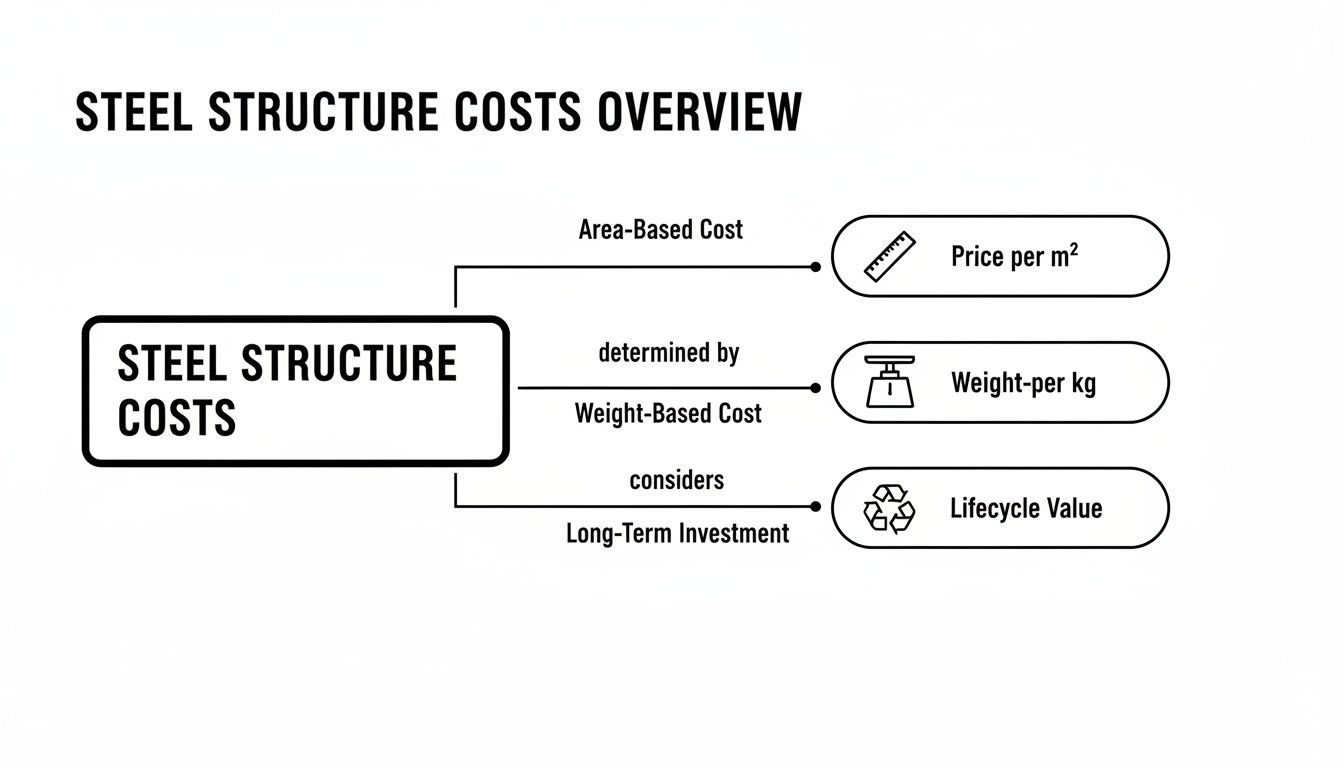
While the first two metrics are great for initial estimates, it's the lifecycle value—its durability and recyclability—that shows the true financial picture over time.
Raw Material Costs
First up is the steel itself. This is the "fabric" for your project and is easily the biggest line item, often making up 40-60% of the total cost before it even gets to your site. Steel is a commodity, priced per tonne, and its value swings with global supply and local demand.
The specific grade of steel you need also plays a huge role. High-strength grades or specialised steel designed to withstand corrosive environments will naturally come at a premium compared to standard structural steel. This is the foundation of your budget.
Fabrication Complexity
Next, we have fabrication. This is the stage where raw steel beams and plates are cut, drilled, welded, and coated to become the exact components for your building. It’s where your engineer’s drawings become a reality.
The complexity of the design is the single biggest factor here. A simple, rectangular warehouse with standard connections is far less labour-intensive than a structure with sweeping curves, custom trusses, or intricate architectural details. Every non-standard cut, weld, and angle adds to the fabrication bill.
This is the "tailoring" of your suit. More detailed and custom work takes more time and a higher level of skill, which you’ll see reflected in the price.
Logistics and Transport
Once the pieces are fabricated, they need to get from the workshop to your construction site. This third cost driver, logistics, is a major one that often gets underestimated, especially in a country as large as South Africa.
Several things feed into transport costs:
- Distance: It’s simple—the further the site is from the fabrication plant, the more you'll pay in fuel and labour.
- Component Size: Oversized or "abnormal" loads are a whole different ball game. They require special permits, escort vehicles, and carefully planned routes, all of which add significant expense.
- Site Accessibility: Is your site out in the bundu with poor road access? You might need specialised vehicles just to get the components delivered, pushing costs up.
Moving tonnes of steel across provinces isn't a simple delivery; it's a major logistical operation. For a deeper look into this journey, you can learn more about the complete life cycle of metal from mine to market.
Erection and Labour
The final piece of the puzzle is the on-site erection and labour. This is the "final fitting," where skilled crews assemble the steel components according to the engineering plans. This phase requires specialised equipment like cranes and cherry pickers, plus a certified team of steel erectors who know exactly what they’re doing.
Labour costs are shaped by the complexity of the assembly, the conditions on-site, and the necessary safety protocols. A clear, well-prepped site means the team can work efficiently. A challenging or congested site will slow things down and add to the cost. This is the stage that brings your project to life, ensuring it's built safely and in line with all South African National Standards (SANS).
How Market Forces Shape Steel Prices
Have you ever gotten a quote for a steel structure, only to see the price jump just a few months down the line? It’s a common story. The price of steel isn’t set in stone; it moves with the daily rhythm of global and local markets, making it a seriously dynamic part of your project budget.
Knowing what drives these shifts is the key to smart financial planning. The cost of your structure is tied to a lot more than just the raw material. It’s tangled in a complex web of global supply chains, currency swings, and what’s happening right here on our doorstep. For anyone planning a major construction project in South Africa, getting your head around these big-picture forces is vital for timing your buys and keeping your budget in check.
The Global Ripple Effect
Steel is a global commodity, plain and simple. Its price is hammered out on the world stage, which means events happening thousands of kilometres away can directly affect the steel structures prices South Africa quotes you receive. A major disruption in a key mining country or a shift in another nation’s manufacturing output sends ripples right through the supply chain.
It’s a bit like the price of petrol. What happens with global oil production and politics dictates what you pay at the pump. In the same way, international demand, production levels, and trade policies set a baseline price for steel that local suppliers have to work from.
This global connection means South Africa is largely a price-taker, not a price-maker. The value of steel is set by a huge, interconnected market, and that forms the starting point for all local pricing.
Local Factors That Drive Volatility
While the global market sets the stage, a few local and regional factors add another layer of complexity to steel pricing in South Africa. These are the things that can cause real price swings from one month to the next.
Here are the key local drivers:
- Currency Fluctuations: The Rand-to-Dollar exchange rate is a massive factor. Steel is traded internationally in USD, so when the Rand weakens, it costs more to bring in raw materials and finished products. That cost gets passed on, pushing local prices up.
- Import Duties and Tariffs: Government taxes on imported steel are there to protect our local producers, but they also directly inflate the final cost. Any change in these tariffs can cause a sudden, sharp price adjustment for certain steel types.
- Logistical Costs: The price of fuel, the state of our transport infrastructure, and labour costs all have a role to play. Moving huge steel sections from a mill in Gauteng to a construction site in the Western Cape isn't cheap, and that expense is baked into your quote.
The South African steel market is not just big; it's growing. It was valued at USD 6.82 billion in 2024 and is projected to hit USD 9.48 billion by 2033. Much of this is fuelled by government infrastructure drives, but rising costs for raw materials like coking coal have also pushed up production expenses. You can read more on these market dynamics and projections from IMARC Group.
The Impact of Demand Surges
Local demand can create short-term but intense price spikes. Think about what happens when the government kicks off large-scale infrastructure projects—new power stations, bridges, or transport networks. Suddenly, there’s a massive, immediate demand for structural steel.
This kind of surge can put a real strain on the capacity of local steel mills and fabricators. With more projects fighting for the same limited resources, suppliers can—and do—raise their prices. For a private developer, it means a project planned during a national infrastructure push might face much higher material costs than one planned during a quieter period.
Understanding these cycles can help you time your project for better cost efficiency. To stay ahead of the curve, it pays to be aware of the top trends in metal supply that could shape future prices.
Building a Realistic Project Budget From Scratch
This is where the rubber meets the road. Moving from high-level ideas about market prices to a concrete financial plan is the moment your steel structure project starts to feel real. Building a budget from scratch isn’t about plucking numbers from thin air; it’s a methodical process.
You need to get granular, assigning real-world costs to every phase of the project. A well-built budget is your single best defence against the kinds of unexpected costs and delays that can derail even the most promising ventures. It’s the financial blueprint that keeps everything on track before a single spade of dirt is turned.
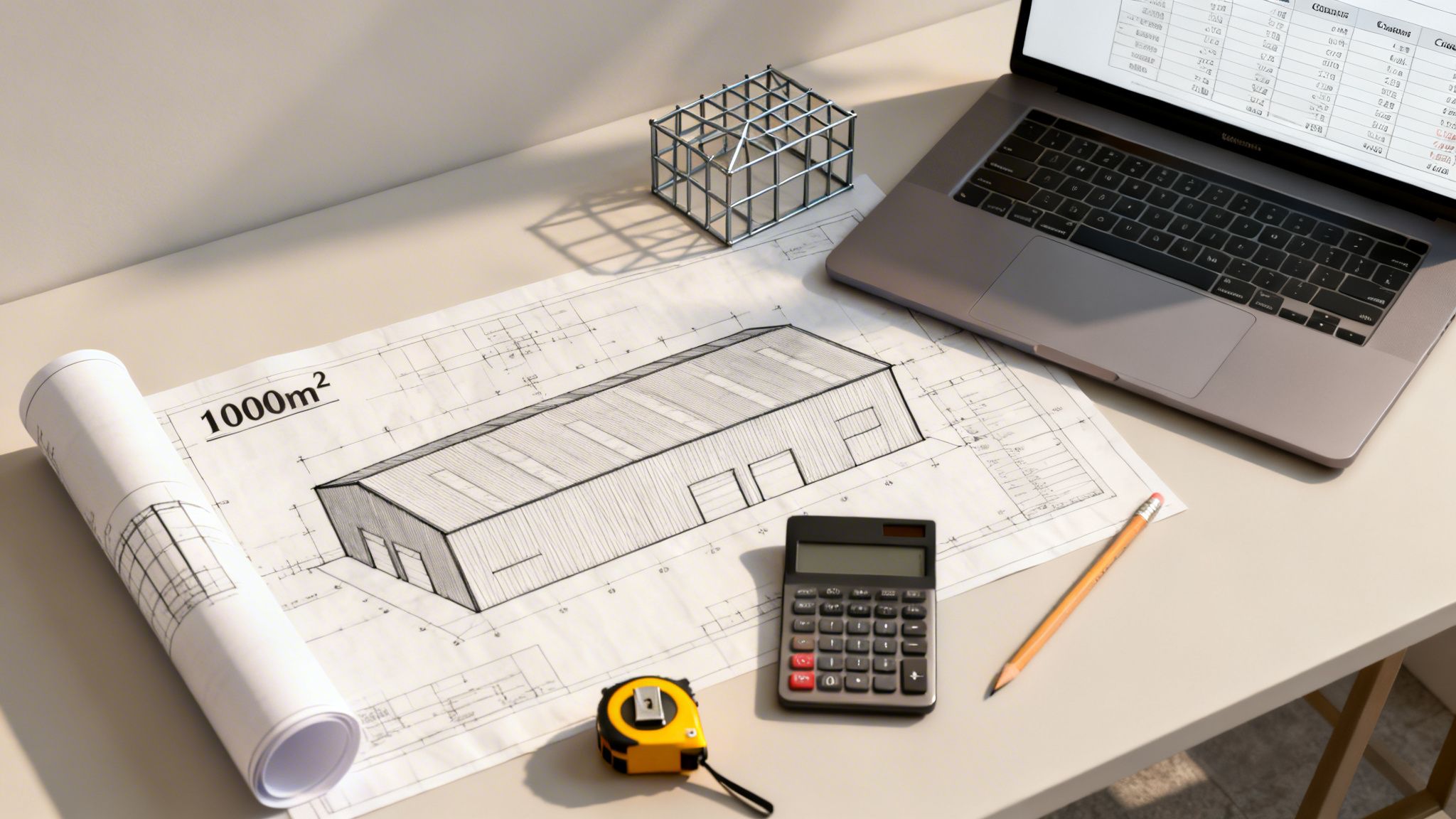
A Sample Cost Breakdown for a Warehouse
To make this tangible, let's break down the costs for a very common project: a standard 1,000m² steel warehouse. By looking at the budget as a set of percentages, you get a much clearer picture of where your money is actually going.
Imagine your total project cost comes in at ZAR 3,000,000. The table below shows a typical way those funds would be carved up. Of course, every project is unique, but this gives you a fantastic starting point for your own estimates.
Sample Cost Breakdown for a 1000m² Steel Warehouse
| Cost Component | Estimated Percentage of Total Budget | Notes and Considerations |
|---|---|---|
| Raw Materials | 45% – 55% | This is the biggest slice of the pie, covering every beam, column, and purlin. The final figure here is heavily tied to the current steel structures prices South Africa is seeing. |
| Fabrication & Coatings | 15% – 20% | This is the workshop cost—the labour and machinery needed to cut, weld, drill, and paint the steel. The more intricate your design, the more this percentage will climb. |
| Logistics & Transport | 5% – 10% | Getting the fabricated steel from the workshop to your site costs money. This will increase with distance, especially if abnormal-load permits and vehicles are needed. |
| Erection & Labour | 10% – 15% | This covers the on-site crew, crane hire, and all the gear needed to assemble the structure safely and to specification. |
| Foundation & Civils | 10% – 15% | Don't forget what the structure stands on. This is a critical cost for the concrete foundations and any earthworks needed to get the site ready. |
This table serves as a foundational guide. Adjust these percentages based on your specific project’s complexity, location, and engineering requirements to build a more accurate financial picture.
Uncovering the Hidden Costs
One of the most common traps in budgeting is to focus only on what you can see—the steel, the cranes, the workers—while completely missing the "soft" costs. These behind-the-scenes expenses are just as real and can sink a poorly planned budget.
Many projects go over budget not because the price of steel went up, but because of all the expenses nobody mentioned in the initial meetings. Accounting for professional fees, permits, and site prep isn't optional; it's essential.
Think of these as non-negotiable costs. They’re required for legal compliance, safety, and the long-term success of your structure. Trying to skimp on them is a surefire way to create major financial headaches later on.
Key Ancillary Costs to Include
To craft a budget that’s truly bulletproof, you have to factor in these additional expenses. Many of them pop up before a single piece of steel arrives, but they are absolutely fundamental to moving your project forward.
Here are the most common "hidden" costs you need to build into your financial plan:
- Professional and Engineering Fees: This is what you pay the architect for the design and the structural engineer for the certified drawings. You cannot get council approval or build safely without these legally required plans.
- Council Submission and Permits: Every municipality in South Africa demands that building plans be submitted and approved before you start. These fees change depending on the municipality and project scale, but they are always mandatory.
- Site Preparation: This is a broad category that can include anything from clearing vegetation and levelling the ground to conducting geotechnical surveys to test soil stability. In some scenarios, it might even involve demolishing an old building.
- Contingency Fund: No project in history has ever gone exactly to plan. It is incredibly wise to set aside an extra 5% to 10% of your total budget as a contingency fund. This buffer covers you for unforeseen problems—like discovering bad ground conditions, sudden material price hikes, or weather delays—without bringing the entire project to a halt.
Turning Old Steel into New Savings
When you’re budgeting for a new steel structure, it’s easy to focus only on the future expenses. But what if your project site already holds a hidden financial asset that could significantly reduce your total cost? A demolition site isn't just a hurdle to clear; it's a potential source of valuable raw materials just waiting to be recovered.
This flips a major expense right on its head. Instead of just paying for demolition, you can strategically dismantle an old building and recover the scrap metal to create a direct revenue stream. Think of it like a large-scale trade-in on your old structure, where the value of the recovered steel gets credited against your new project’s bills.
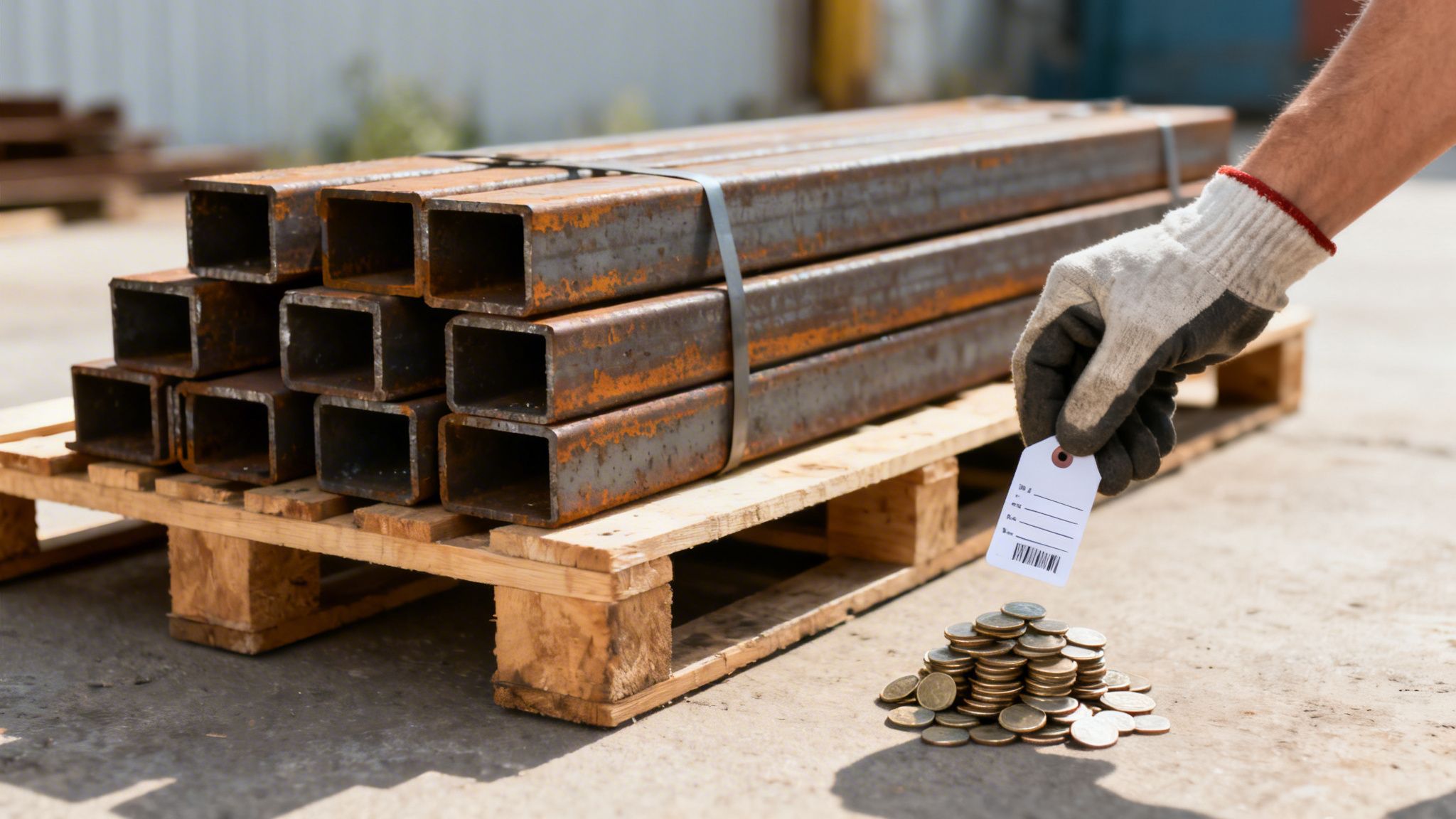
It’s a smart approach that creates a circular economy right on your property. Financially, the old becomes the new, delivering a return that lowers your net cost while also championing sustainability.
The Scrap Recovery Process Explained
Turning old beams and columns into a cash credit isn't as simple as just knocking a building down. It’s a methodical process that demands real expertise to get it right. This isn’t about indiscriminate destruction; it's a careful deconstruction designed to preserve the value locked inside those materials.
To get the best return, the process usually follows three key stages:
- Safe and Strategic Demolition: The first step is a controlled demolition focused on material preservation. The structure is taken apart in a way that keeps steel sections as intact and clean as possible.
- Efficient On-Site Recovery: As the structure comes down, a dedicated team immediately gets to work sorting the materials. Steel beams, rebar, and plates are separated from concrete, brick, and other rubble.
- Professional Sorting and Grading: This is where you really maximise your return. The recovered steel is categorised by internationally recognised grades, such as HMS 1 & 2 (Heavy Melting Steel). Proper sorting ensures the scrap can be sold at the highest possible market price.
How Scrap Offsets Your Project Costs
The value you reclaim is tied directly to the current market price for scrap metal, which can be a huge plus in a volatile market. For example, recent data on South African iron and steel market trends shows that export prices for raw steel and pig iron in South Africa jumped by 30% to USD 493 per ton in 2024. For project managers, this means the scrap recovered from demolition is more valuable than ever, offering a much-needed buffer against rising new material costs.
By partnering with a scrap recycling specialist, materials from a demolished site can be processed into valuable specifications like manganese rolls or PNS. This not only generates a direct financial credit for your project but also feeds high-quality materials back into the local supply chain, reducing reliance on imports.
This financial mechanism turns what was a sunk cost into an active asset. The money generated from selling your scrap can be directly applied to the steel structures prices South Africa quotes you receive, effectively lowering your final invoice. It's a powerful and practical way to make your budget stretch further. For a deeper dive, have a look at our complete guide to scrap metal recycling.
How to Get Quotes You Can Actually Trust
You’ve done the hard work of budgeting and planning. Now comes the moment of truth: getting quotes. This is where many projects go sideways. A weak, vague request will only get you a stack of confusing prices that you can’t compare properly, which is a recipe for budget blowouts and nasty surprises down the line.
The secret to avoiding this mess is to give fabricators everything they need to give you a clear, detailed, and binding offer. It’s about moving past a simple price tag to see the real value and reliability behind each number. The tool for this job is a comprehensive Request for Quotation (RFQ).
Think of the RFQ as the detailed instruction manual for your project. The more information you pack in, the sharper their pencils will be, and the more precise their quotes will become. This ensures everyone is quoting on the exact same scope of work.
Crafting a Bulletproof Request for Quotation
A solid RFQ is far more than just asking for a price; it’s a complete project brief. To get quotes you can genuinely depend on, your RFQ has to be thorough, leaving no room for a supplier to guess. When they guess, you’re the one who pays for it later.
The cheapest quote is very rarely the best value. A low price can easily hide poor-quality materials, inexperienced labour, or a complete misunderstanding of the project scope. Your real mission is to find the best value-driven partner, not just the lowest bidder.
A detailed RFQ forces every supplier to put a price on every single element of your project. That level of detail gives you the power to make a truly informed decision, because you’ll know exactly what’s included—and more importantly, what isn’t.
Your Essential RFQ Checklist
To get the crystal-clear quotes you need, your RFQ must contain a specific set of documents and information. If you leave any of these out, you’re inviting assumptions and opening the door to future cost escalations.
Here’s a checklist of what you absolutely must include in your RFQ:
- Complete Engineering Drawings: This is non-negotiable. You need to provide the full set of professionally drafted and engineer-certified structural plans.
- Steel Grade Specifications: Be specific. Clearly state the required steel grades for all parts (e.g., S355JR for columns and beams, specific grades for purlins and girts).
- Surface Coatings and Finishes: Spell out the exact needs for corrosion protection. Specify galvanising thickness or the exact type and number of layers in the paint system.
- Detailed Bill of Quantities (BOQ): A complete BOQ lists every single component, its size, and its weight. This ensures all suppliers are quoting on the identical material list.
- Project Timeline: Give them your expected start date and the firm completion date needed for both fabrication and on-site erection.
- Site Location and Access Details: Provide the full physical address and make notes of any potential access challenges, like narrow roads or remote locations that could complicate transport logistics.
Vetting Suppliers Beyond the Price Tag
Once the quotes start rolling in, the real work begins. Price is definitely a factor, but it shouldn't be the only one. A truly reliable partner brings a lot more to the table than just a competitive number. You have to dig deeper to see if they can actually deliver a safe, compliant, and high-quality structure.
When you’re weighing up potential suppliers, ask them for proof of their track record and capabilities. For example, if your project involves clearing an existing site, understanding their process for structural demolition services is critical for a smooth start.
Look for a partner who can show you:
- A Strong Safety Record: Ask to see their safety file and incident reports. A company committed to safety protects your project from expensive delays and legal trouble.
- Proven Fabrication Capacity: Can their workshop actually handle a project of your scale? Ask about their workshop size, their equipment, and their current workload to make sure they can hit your deadline.
- A Portfolio of Past Projects: Request examples of similar structures they’ve completed. Even better, ask for references you can call directly.
Ultimately, picking the right fabricator is all about finding a partner you can trust to deliver on what they promise. A meticulously prepared RFQ and a thorough vetting process are your two best defences to guarantee your project’s long-term success.
Your Top Questions About Steel Structure Pricing, Answered
Embarking on a major construction project naturally brings up a lot of questions, especially around costs and timelines. To help you move forward with your plans confidently, we’ve put together answers to some of the most common queries we hear about steel structures in South Africa.
What Is the Average Price per Kilogram for Structural Steel?
While the market is always moving, you can generally expect the price for fabricated structural steel in South Africa to fall somewhere between ZAR 25 and ZAR 45 per kilogram. This price typically covers the raw material itself and the basic fabrication.
It’s important to see this as a starting point. That number doesn't yet account for complex design work, any specialised coatings, transport to your site, or the final erection. The final per-kilo rate you'll pay is shaped by your project's specific complexity, the grade of steel needed, and what the market is doing at that moment.
How Long Does It Take to Build a Steel Structure?
Project timelines can vary quite a bit depending on the size and intricacy of the build. For a relatively straightforward, standard 1,000m² warehouse, you’re typically looking at a timeframe of 12 to 16 weeks, from the day the design is signed off to the completion of the erection.
That schedule usually breaks down into a few key phases:
- 4-6 weeks for engineering drawings and getting municipal approval.
- 6-8 weeks for the off-site fabrication of the steel components.
- 2-3 weeks for delivery and on-site assembly by the erection team.
Naturally, if your project involves more complex architectural designs or is located in a remote area with tricky access, you'll need to plan for a longer timeline.
Can I Use Recycled Steel to Build My New Structure?
This is a great question, and the answer has a bit of nuance. For any new build, the structural steel components must meet very strict South African National Standards (SANS) for safety and compliance. This almost always means using virgin steel that’s been manufactured to precise specifications.
But that’s not the end of the story. Recycled steel is a powerful tool for bringing down your net project cost. The money you get back from scrap metals recovered during the demolition of an old structure can be put directly towards the cost of the new steel. This is a smart way to lower your total capital outlay while supporting a more circular economy.
Who Is Responsible for Obtaining Building Permits?
Yes, all permanent structures in South Africa require plans to be approved by the local municipality before any construction can kick off. While the project owner holds the ultimate legal responsibility, this critical task is usually handled by your appointed architect or the main contractor.
It is absolutely vital to clarify who will be managing the permit process in your contracts right from the start. Taking this simple step helps prevent expensive delays down the line and ensures your project stays fully compliant with all municipal regulations from day one.
For expert help with scrap metal recovery, professional demolition, or integrated waste management that maximises your project’s financial efficiency, partner with D7 Capital Partners (Pty) Ltd. You can learn more about our specialised services here.