Finding the right recycling partner in South Africa usually starts with a practical problem, not a sustainability slogan. A factory has mixed scrap building up in the yard. A contractor needs steel removed during demolition without slowing the programme. A facility manager wants fewer vendors, cleaner reporting, and less risk around handling and disposal. That’s when the search for “recycling companies near me” becomes a procurement decision, not just a quick Google query.
For industrial, construction, and commercial operators, waste sits at the intersection of compliance, logistics, cost control, and recovery value. The wrong provider creates admin, delays collections, and leaves gaps in documentation. The right one helps you move material safely, recover value where possible, and keep projects running.
South Africa’s market isn’t one-size-fits-all. Some firms are built around high-volume scrap metal. Others focus on packaging streams such as paper, cardboard, and plastics. A smaller group can handle more complex scopes that combine demolition, on-site recovery, transport, processing, and disposal.
That distinction matters. If you’re managing recurring ferrous scrap, your shortlist should look different from a business dealing with hazardous residues or a mixed-site waste programme. The companies below are best assessed by specialisation first, then by operational fit. For many businesses, the strongest option is the provider that can simplify the whole chain and reduce the number of moving parts.
1. D7 Capital Partners (Pty) Ltd
A common procurement problem looks like this. A site has scrap steel, non-ferrous offcuts, demolition residue, and tight access for loading, but the business is still trying to solve it with separate contractors. D7 Capital Partners (Pty) Ltd is better assessed as an integrated operator for that kind of scope, not just as another recycler with a weighbridge.
The company combines scrap metal recycling, structural demolition, on-site scrap removal, logistics, and broader waste management in one service model. That makes it relevant for industrial manufacturers, demolition contractors, municipalities, facility managers, and buyers that need one South African partner to handle recovery, processing, and movement of material. In a market where many firms specialise by stream, D7’s position is clear. It suits businesses that want one contractor to manage the chain from site work through to final material handling.
Where D7 is strongest
Its main advantage is control across multiple work stages. On plant strip-outs, shutdown clean-outs, or demolition-linked recovery jobs, delays usually happen at the handover between crews. Combining removal, loading, transport, processing, and disposal under one operator reduces those coordination risks and gives procurement teams a single point of accountability.
The metal scope is also broad enough to matter in practice. D7 handles ferrous and non-ferrous grades including ISRI 201, 204, 236, 238, cast iron, HMS 1 and 2, manganese mill rolls, PNS, and new and old black bales. On the non-ferrous side, it works with aluminium, brass, copper, lead, stainless steel, and zinc, with project specifications built around the actual material mix.
For firms reviewing scrap metal recycling providers for industrial and commercial waste streams, that range is useful because mixed loads often create pricing disputes and avoidable rejections if the recycler cannot separate, grade, and document material properly.
Practical rule: If your site generates mixed recoverable metals, confirm grade acceptance, contamination limits, and load documentation before the first collection. A broad buying list means little if the operator cannot process mixed material efficiently.
Trade-offs to check before appointment
D7 is strongest on projects with operational complexity. It is less suited to buyers who want instant online pricing or a simple public rate card for standard loads. Quoting is done directly, which is normal for demolition, recovery, and site-clearing work where access, contamination, equipment needs, and haulage distance all affect value.
That approach has a benefit. Commercial terms can be priced around the actual job instead of forcing a generic schedule onto a site with unusual constraints.
Procurement teams should still do the usual checks. The public-facing material does not set out detailed capacity figures, certifications, or customer case studies, so buyers should request compliance documents, references, insurance details, and evidence from similar projects during tender review.
Best fit
D7 is a strong option when the waste stream is mixed and the site conditions are harder than a normal yard collection. That includes plant decommissioning, structural steel recovery, municipal clean-ups, demolition projects, and recurring industrial scrap programmes where transport and on-site execution matter as much as the end price per ton.
- Best for integrated scopes: Demolition, removal, transport, processing, and trading can sit with one contractor.
- Best for mixed metal streams: Ferrous and non-ferrous capability goes beyond standard scrap yard buying.
- Best for operational control: Fewer vendors usually means fewer handovers, fewer delays, and clearer accountability.
- Watch for due diligence: Ask for scope-specific quotations, compliance records, and relevant project references before award.
2. SA Metal Group
SA Metal Group is one of the longest-established names in Southern African metal recycling, with roots going back to 1919. That history matters less as a branding point than as an indicator of scale, buying infrastructure, and downstream market access. If you’re moving regular metal tonnage, those three things affect service reliability more than almost anything else.
This is a metal recycler first. That makes it a good option for businesses with recurring ferrous and non-ferrous scrap streams, especially where collection discipline, yard throughput, and fast settlement matter more than broader waste outsourcing.
Why industrial generators use SA Metal
SA Metal’s practical advantage is vertical depth. It collects and processes scrap, and it also has downstream steelmaking capability. That usually makes it a more dependable counterparty for firms that need regular offtake and don’t want uncertainty around whether the buyer can absorb changing monthly volumes.
It’s also a sensible fit for generators that already understand scrap grading and want a metal-focused service. Businesses comparing scrap metal recycling options in South Africa should pay attention to this distinction. A focused metal recycler can be excellent for clean, segregated loads, but it won’t replace a broader waste contractor if your site also produces hazardous, municipal, or highly mixed residues.
For consistent metal arisings, reliability beats flashy marketing. Ask how quickly the provider can place bins, clear full containers, and resolve rejected loads.
Where the limits are
SA Metal isn’t the right pick if your brief includes demolition management, total waste outsourcing, or complex non-metal streams. It’s strongest when metals are the centre of the contract. If your operation mixes scrap steel with packaging, sludge, hazardous residues, or general waste, you’ll likely need additional providers or an integrated lead contractor.
Price volatility is another practical issue. Scrap buying rates move with broader commodity conditions, so monthly fluctuations are part of the commercial reality. That doesn’t make SA Metal unusual. It just means procurement teams should build contract terms around clear grading, contamination rules, and collection triggers.
- Strong choice for high-volume metals: Good fit for manufacturers, engineering firms, and large scrap generators.
- Useful downstream position: Internal steelmaking can improve offtake certainty.
- Less suitable for mixed-waste estates: Metals are the core service.
- Commercial discipline is essential: Confirm grade specs, moisture/contamination rules, and collection SLAs up front.
3. The New Reclamation Group (Reclam)

The New Reclamation Group is another serious option for companies that generate metal scrap at industrial scale. Its strength comes from being a group structure rather than a single-yard business. In practice, that usually means access to specialist operating units, broader collection reach, and better alignment for clients with multiple sites or varied metal streams.
For plant clean-outs, recurring production scrap, and export-oriented preparation, that group capability is often more useful than a simple “nearest yard” approach.
Operational fit
Reclam works well where the waste stream is clearly recoverable and commercially tradable. Fabricators, engineering businesses, manufacturers, and decommissioning teams generally benefit most. The company’s networked structure can also help when material has to move across regions instead of being handled as a once-off local collection.
If your team is reviewing grading and resale pathways, it helps to understand the basics before issuing enquiries. This practical guide to scrap metal recycling grades and process decisions is useful background for aligning your site segregation with what metal recyclers buy.
What to check before appointing
Reclam’s metal focus is a strength and a limitation. It’s strong on buying, processing, and trading metals. It’s less likely to be your only answer if the job also involves hazardous waste, food-contaminated packaging, liquid waste, or total site waste management.
The other issue is project variability. Metal contracts are heavily shaped by grade, contamination, cut sizes, access, and collection method. That means buyers should avoid comparing quotes on headline price alone. A lower bid can disappear quickly if the provider applies deductions later for poor segregation or non-conforming material.
Field note: In metal recycling, the best quote is usually the one with the clearest grading language, not the highest opening number.
- Good for distributed metal volumes: Useful when sites or collections span different regions.
- Good for recurring industrial scrap: Better fit than ad hoc consumer-facing recyclers.
- Not a full-service waste outsourcer: Separate partners may still be needed.
- Quote comparison needs care: Ask for deductions policy and acceptance criteria in writing.
4. Mpact Recycling
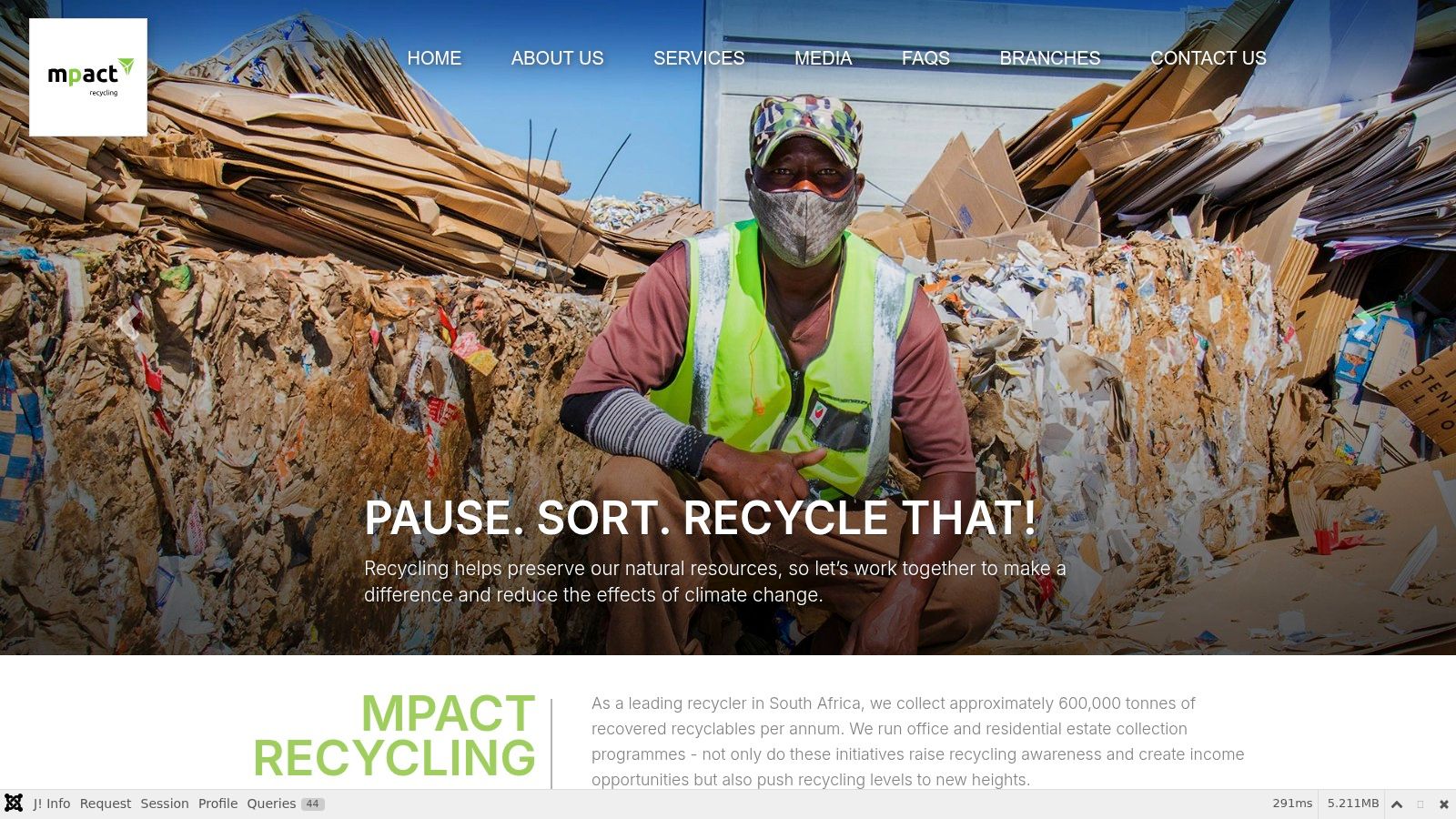
A warehouse manager trying to clear weekly cardboard, office paper, and plastic film has a different problem from a plant selling ferrous scrap. Mpact Recycling sits in that packaging category. For businesses with steady volumes of paper, board, and selected plastics, it is often a more suitable shortlist candidate than a metal recycler or a general waste hauler.
That matters for retailers, FMCG operations, distribution centres, and manufacturers running repeatable packaging waste streams across several sites. The service fit is usually strongest where material is dry, sorted, and generated in enough volume to justify scheduled collections or baling.
Packaging programmes work or fail on site discipline
Mpact’s value is less about a headline tonnage figure and more about operational fit. The company reports handling large volumes of recyclables each year, which points to established buying channels and the ability to service recurring packaging streams at business scale. For procurement teams, that usually means a provider accustomed to routine collections rather than one-off clear-outs.
The trade-off is simple. Packaging recycling performs well when segregation happens at source. It performs poorly when cardboard is mixed with food waste, liquids, shrink wrap, and general refuse.
That is why site setup matters. Clear bin layouts, trained staff, and agreed contamination thresholds will do more for rebate stability than chasing a slightly better collection rate. Teams reviewing collection routines can tighten performance with these practical waste management tips for better site segregation and handling.
Best fit, and where a second provider may still be needed
Mpact is a packaging specialist. That is useful if your main objective is to recover value from paper and board and keep recyclable packaging out of landfill. It is less useful if the same contract needs to cover hazardous waste, liquid waste, metal scrap, construction rubble, or total site waste management.
For mixed industrial sites, that gap affects supplier strategy. Some businesses appoint Mpact for clean packaging streams and use another contractor for regulated or non-recyclable waste. Others use an integrated provider such as D7 Capital Partners to coordinate multiple waste streams under one management structure, especially where reporting, vendor control, and site consistency matter more than a single-material rebate.
- Strong fit for paper and packaging streams: Well suited to cardboard, paper, and related dry recyclables.
- Useful for multi-site operations: Better aligned with standard collection schedules and repeatable waste profiles.
- Less suitable for mixed or regulated waste: Separate arrangements may still be needed for hazardous or industrial residues.
- Commercial results depend on material quality: Clean, separated loads usually produce fewer disputes and better recovery value.
5. EnviroServ Waste Management
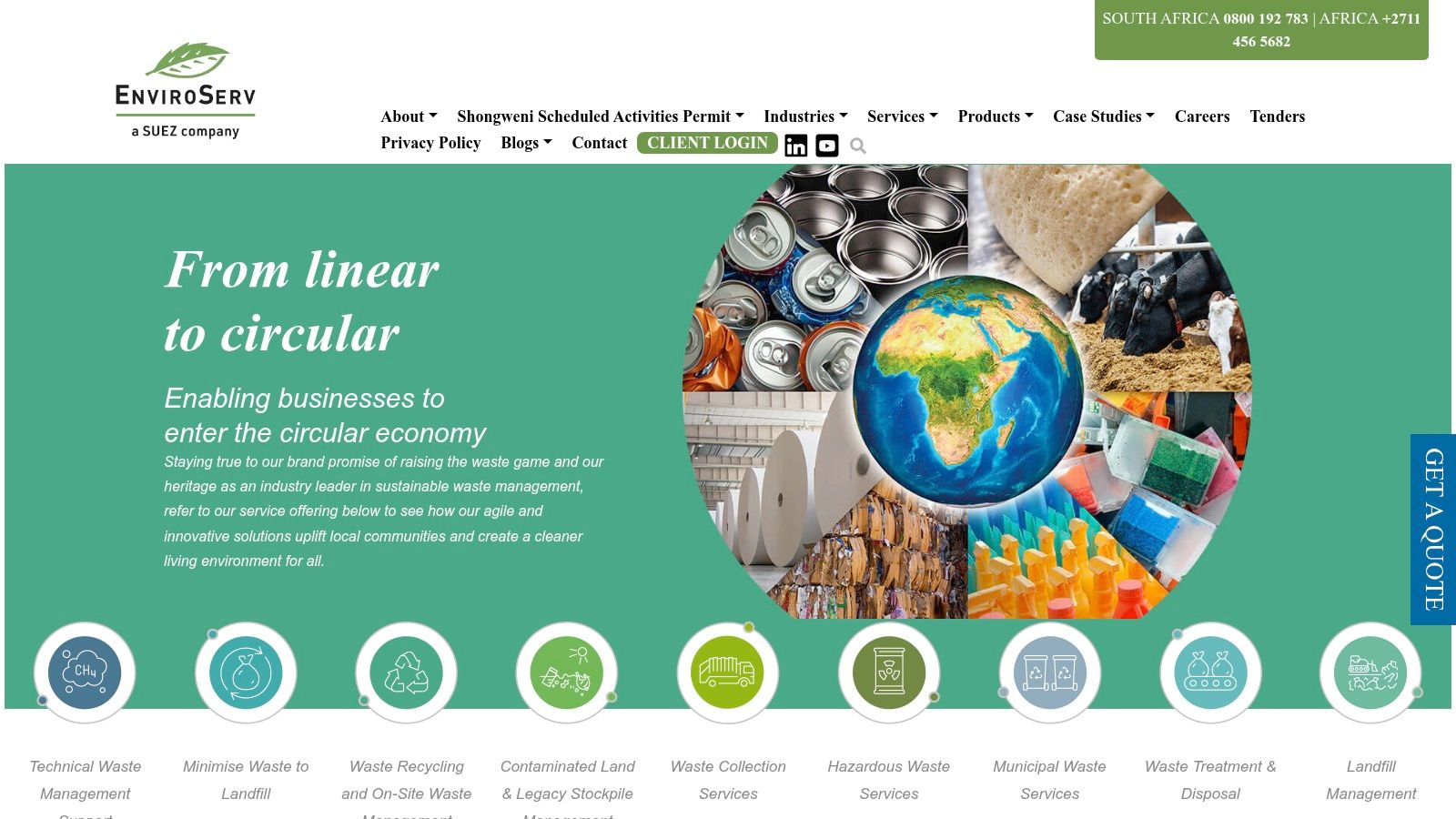
EnviroServ Waste Management serves a different buyer altogether. When the waste profile includes regulated, hazardous, or technically difficult materials, the main selection criteria shift from resale value to legal defensibility, handling controls, treatment route, and facility licensing. That’s where EnviroServ tends to enter the conversation.
For heavy industry, chemical operations, process plants, and sites with hazardous residues, this is the kind of provider that procurement and SHEQ teams often need on the panel.
Compliance first
Industrial clients in South Africa routinely ask about compliance with waste law and standards when appointing recyclers and waste contractors. That concern isn’t abstract. A verified gap in the market is that many “recycling companies near me” pages don’t explain how handling and reporting align with legal obligations, even though the Carney Environmental reference page highlights the importance of NEM:WA compliance, authorised handling, and audit trails in South African scrap and recycling work.
That’s why EnviroServ’s value is less about convenience and more about control. It offers characterisation, transport, treatment, and disposal pathways designed for regulated waste streams where paperwork and site controls matter as much as collection itself.
Practical trade-offs
Hazardous waste services are rarely simple or cheap. Classification affects packaging, transport, treatment route, emergency planning, and final disposal. Businesses should expect waste-specific quoting, and they should be wary of any provider willing to price complicated hazardous streams without a site assessment or supporting documentation.
EnviroServ also sits in a part of the market where stakeholder management matters. Some facilities in the broader hazardous waste sector have faced community scrutiny over time, so clients should ask direct questions about site selection, legal permissions, and contingency planning.
A useful baseline for site teams is to pair specialist hazardous support with stronger internal controls. These waste management tips for South African businesses are a good operational starting point before bringing in any external contractor.
Hazardous waste contracts fail when the generator treats classification as the contractor’s problem. The generator must document the waste properly and verify the route.
- Best for regulated waste streams: Strong fit for hazardous and technically complex waste.
- Useful for industrial services: Better aligned to plant environments than consumer-facing operators.
- Expect process-heavy procurement: Waste type and compliance documents drive the quote.
- Not the first choice for simple recyclables: Overkill for clean cardboard or straightforward scrap metal.
6. Interwaste
Interwaste is worth considering when the business objective goes beyond collection and into landfill diversion strategy. It covers collection, on-site waste management, material recovery, hazardous solutions, and alternative pathways such as refuse-derived fuel. For manufacturers and multi-site operators, that broad toolkit can be more valuable than finding the nearest recycler with a truck.
The strongest fit is usually a site with mixed waste, internal ESG pressure, and a need for reporting that can support procurement, sustainability, and operations at the same time.
Why Interwaste can work well
Interwaste is useful where a business produces recyclable streams plus residual materials that don’t fit standard recycling markets. In those cases, the provider’s ability to create a hierarchy of recovery, diversion, treatment, and disposal matters more than a single material rebate.
That’s particularly relevant in construction and industrial settings where logistics and disposal routes are fragmented. One verified market signal is the emerging focus on demolition-integrated recovery in Gauteng and wider South Africa. The provided data notes that annual construction and demolition waste nationally is significant, with Johannesburg carrying a large share and recycling rates still low, while integrated on-site approaches are gaining attention in circular economy projects, according to the parallelproducts.com reference page used in the verified data set.
Limits and decision points
Refuse-derived fuel and co-processing routes aren’t universal solutions. Acceptance depends on material composition, preparation quality, moisture, contamination, and regional offtake. Businesses should treat diversion proposals as technically conditional, not automatic.
Interwaste is therefore strongest when it can audit the site first and design a route around actual waste generation. If you need a plug-and-play buyer for clean steel or cardboard only, a specialist recycler may be simpler. If you need a national programme that handles mixed residues intelligently, Interwaste becomes more compelling.
- Good for diversion-led strategies: Useful where landfill reduction is a major target.
- Good for mixed waste portfolios: Stronger than single-material recyclers in complex environments.
- Needs site validation: Alternative fuel pathways depend on spec compliance.
- Best suited to contract programmes: More strategic than transactional.
7. WastePlan
A facilities manager takes over a busy mall or logistics site and finds the same pattern every week. Recyclables are mixed with general waste, tenants follow different rules, and collection data is too weak to show where disposal costs can be cut. WastePlan is built for that operating problem.
WastePlan works inside the client’s site, with staff, segregation systems, and reporting at the point where waste is generated. That sets it apart from providers whose role starts once material leaves the premises. For shopping centres, campuses, factories, hospitality groups, and large commercial properties, that model can improve control over contamination, recovery performance, and contractor accountability.
Its strength is operational discipline.
The company’s value sits in day-to-day execution: bin systems, staff supervision, sorting routines, data capture, and site-specific processes that hold up across multiple departments or tenants. If the main problem is poor source separation, inconsistent staff behaviour, or weak reporting, an on-site managed service often delivers better results than a collection-only contract. Businesses comparing providers in this category should also weigh whether they need a broader total waste management approach for industrial and commercial sites or a narrower on-site programme.
WastePlan has also published a client case study reporting high diversion performance, which is more useful as evidence of what the model can achieve on a well-run site than as a standard outcome for every contract.
What buyers should assess
Commercially, this is usually a labour-and-systems proposal, not just a transport rate. Cost will be shaped by headcount, shifts, equipment, floor plan, tenant mix, reporting requirements, and the cleanliness of the incoming waste stream. That means procurement teams need to compare scope carefully. A cheaper quote with less on-site supervision can produce weaker segregation and higher downstream disposal costs.
WastePlan is a stronger fit for managed environments with recurring mixed waste than for businesses that want the best price for metal, cardboard, or another single material. It also sits in a different lane from hazardous waste specialists. If your waste streams include chemicals, contaminated materials, or regulated industrial residues, you may still need another provider alongside the on-site programme.
Selection rule: If waste is being lost because staff, tenants, or departments do not separate it properly at source, an on-site operator can outperform a lower-cost collection contract.
- Best for managed commercial sites: Strong fit for malls, campuses, hospitality, factories, and logistics operations.
- Best for improving source separation: Daily supervision and reporting help reduce contamination.
- Less suited to single-stream procurement: Businesses selling clean scrap or fibre may prefer a material-specific recycler.
- Needs a proper site audit: Staffing, layout, and waste composition drive the commercial case.
Top 7 Local Recycling Companies Comparison
| Provider | 🔄 Implementation Complexity | ⚡ Resource Requirements | 📊 Expected Outcomes | Ideal Use Cases | ⭐ Key Advantages / 💡 Tip |
|---|---|---|---|---|---|
| D7 Capital Partners (Pty) Ltd | Moderate, integrated single‑point project management for demolition and recovery | Moderate, site access, processing & logistics capacity; scalable per project | High material recovery and regulatory focus; sustainability outcomes | Decommissioning, structural demolition, industrial scrap removal | Integrated end‑to‑end services; request quotes, certifications and references |
| SA Metal Group | Low–Moderate, standard large‑scale scrap workflows | High, buying yards, processing plants and in‑house steelworks | Reliable offtake and price discovery for bulk volumes; exposure to market indices | High‑volume industrial generators and regular scrap suppliers | Bankable partner with downstream mill; prices follow global scrap indices |
| The New Reclamation Group (Reclam) | Moderate, networked group operations across regions | Moderate, regional collection and export‑prep capacity | Strong market access and competitive buying power | Plant clean‑outs, recurring scrap streams, export‑grade preparation | Wide buying power and international reach; may need partners for non‑metal wastes |
| Mpact Recycling (Mpact Group) | Low, established collection programmes and buy‑back model | Moderate, national branch/dealer network and buy‑back centres | Scalable diversion for packaging streams; good reporting and compliance support | Paper, cardboard and plastics for manufacturers, retail and distribution centres | Large-scale packaging recycling with downstream integration; service fees vary by contamination |
| EnviroServ Waste Management | High, hazardous and regulated waste workflows with licensed facilities | High, engineered landfills, specialised fleets and treatment plants | Robust compliant disposal and engineered controls for regulated streams | Heavy industry, chemical sectors, projects with complex compliance needs | Strong compliance framework and national capability; stakeholder management may be required |
| Interwaste (Séché Environnement) | Moderate–High, tailored stream strategies and RDF/co‑processing integration | Moderate–High, MRFs, RDF production and treatment capacity | Credible landfill diversion and alternative‑fuel outcomes for suitable wastes | Manufacturers seeking landfill diversion, co‑processing and multi‑site contracts | RDF/co‑processing expertise; RDF viability depends on kiln specs and audits |
| WastePlan | Low–Moderate, on‑site staffing and operational models to maximise segregation | Low–Moderate, trained staff, bins and reporting systems per site | High diversion rates and measurable KPI reporting (site dependent) | Campuses, factories, malls, logistics parks pursuing zero‑to‑landfill | Effective on‑site discipline and flexible staffing; hazardous disposal usually outsourced |
How to Choose the Right Recycling Partner in 2026
Choosing among recycling companies near me gets easier when you stop comparing brands in the abstract and start matching providers to the waste you generate. Most poor appointments happen because the buyer asks one company to solve several different problems at once. Scrap recovery, packaging recycling, hazardous handling, and on-site segregation are related, but they aren’t the same service.
Start with a proper waste stream audit. Break your waste down by type, how it is generated, how clean or contaminated it is, and whether it appears as a steady monthly stream or a once-off project. Ferrous and non-ferrous metals need one kind of partner. Cardboard and plastics need another. Hazardous liquids, contaminated solids, and process residues require a contractor with documented treatment and disposal routes.
Licensing and compliance come next. Ask for waste transport permissions, facility licences where relevant, and proof that the provider can legally handle the materials in your scope. If you’re appointing a scrap or recycling company for industrial work, don’t rely on a website summary. Request references, acceptance criteria, chain-of-custody documentation, and examples of reporting that your SHEQ or ESG team can effectively use.
Then test logistics. A provider can look strong on paper and still fail on site. Confirm container types, collection frequency, turnaround times, escalation contacts, and what happens when material is rejected or access is restricted. For demolition, plant strip-outs, and factory clean-outs, ask who controls the full sequence of removal, loading, transport, processing, and disposal. That answer tells you how many operational gaps you’ll be managing yourself.
Reporting is now part of the service, not an extra. Even where hard public benchmarks aren’t available, your contractor should still be able to show what was recovered, what was diverted, what was disposed of, and how loads were classified. If they can’t document the route, you’ll struggle to defend the programme internally.
For many industrial and construction clients, integrated service providers offer the strongest operational value. One contractor that can manage demolition, on-site recovery, transport, processing, and final waste routing is usually easier to govern than four separate vendors with overlapping responsibilities. That’s especially true where safety, programme timing, and recovery value all matter at once.
The best recycling partner in 2026 isn’t the closest yard or the highest quoted rebate. It’s the provider whose capabilities match your waste profile, compliance exposure, and site reality. If your operation needs metal recycling only, choose a metal specialist. If it needs packaging recovery, choose a packaging specialist. If it needs one accountable partner to manage complex scopes end to end, choose an integrated operator with the equipment, experience, and project control to do it properly.
If you need a practical partner for scrap metal recycling, structural demolition, or end-to-end waste management, speak to D7 Capital Partners (Pty) Ltd. The team works with industrial, commercial, municipal, and construction clients across South Africa, with solutions built around safe execution, compliant handling, and maximum recovery value.