You’ve finished your qualification, cleaned up your CV, and started searching. Most of what you find looks broad, repetitive, or aimed at large public programmes. That’s where many applicants lose momentum.
Private industrial employers don’t hire OHS interns for paperwork alone. We look for people who can walk into a noisy yard, a live factory, or a demolition boundary and stay observant, calm, and useful from day one. In occupational health and safety internships in south africa, that difference matters.
Understanding the Critical Role of OHS Interns in South Africa

An OHS intern in a high-risk business isn’t there to “observe safety”. They help hold the line on it.
Between 2001 and 2019, South Africa’s general industry reported 3,852,071 occupational accidents to the Compensation Fund, a figure discussed in this occupational health and safety analysis of South African industry. In practical terms, that tells you the work is not administrative theory. It’s daily risk control.
What the job looks like on the ground
In industrial settings, interns often support work that includes:
- Hazard spotting: Identifying blocked walkways, poor stacking, unsafe lifting behaviour, damaged PPE, exposed moving parts, and weak housekeeping.
- Inspection support: Assisting with checklists, site walkabouts, permit files, induction records, toolbox talk registers, and corrective action logs.
- Training follow-through: Helping supervisors confirm that workers understood instructions, not just signed attendance sheets.
- Incident support: Gathering initial facts, securing records, and helping track repeat issues.
- Compliance admin that matters: Filing is part of the job, but the core purpose is traceability. If an action is assigned, someone must check that it was closed out.
That matters in sectors tied to waste handling, heavy industry, and logistics, where daily operations can involve shifting loads, vehicle movement, cutting, sorting, and contractor activity. Anyone considering industrial safety work should understand how waste streams and operational controls connect in practice, which is why broad service environments such as total waste management operations are useful to study.
Practical rule: If you treat the internship like office admin, you’ll struggle. If you treat it like frontline risk work supported by admin, you’ll fit in faster.
Why private industrial employers value interns
In strong teams, interns extend capacity. They help supervisors and safety officers keep eyes on routine risks that often get ignored because production pressure is real.
What works is simple:
- Interns who ask precise questions
- Interns who notice patterns
- Interns who can write a clean report
- Interns who don’t freeze around operations staff
What doesn’t work is the candidate who knows legislation titles but can’t explain why a loose cable, an unstable pile, or poor segregation of work areas creates immediate danger.
The responsibility is bigger than the title
In high-risk workplaces, the intern role carries a serious trust. Workers want to know that the person raising a safety point understands the site and respects the work.
That’s why the best occupational health and safety internships in south africa are valuable. They put you close to real controls, real failures, and real decisions. If you use the opportunity properly, you don’t leave with just experience. You leave with judgement.
Essential Qualifications for OHS Internship Applicants
A weak application usually fails long before the interview. The problem isn’t always a lack of potential. It’s often a poor foundation.
Private sector employers want to see that you can enter a regulated workplace and understand the language of safety, compliance, and operational discipline. Your qualification opens the door. Your supporting credentials tell us how seriously you take the field.
The baseline we expect
For most OHS internships, the essential starting point is a relevant tertiary qualification or current study path in safety, environmental health, risk, engineering, or a closely related discipline.
That tells us you’ve covered core subjects such as hazard identification, legal duties, incident reporting, and basic control methods. It doesn’t prove site readiness, but it shows you’ve started in the right place.
Essential vs desirable OHS credentials
| Credential | Type | Why It Matters for an Internship |
|---|---|---|
| National Diploma or Degree in Safety Management, Environmental Health, or related field | Essential | Shows formal grounding in OHS principles, documentation, and workplace risk concepts |
| Academic modules in OHS law and compliance | Essential | Helps you read procedures, understand duties, and follow legal structures without guesswork |
| Valid identification, academic transcripts, and proof of qualification or enrolment | Essential | Employers need clean verification before placing any intern on a site |
| SAMTRAC or similar recognised safety training | Desirable | Signals extra commitment and gives practical terminology many site teams already use |
| NEBOSH IGC or equivalent international safety study | Desirable | Useful where employers deal with mixed standards, contractors, or multinational expectations |
| First aid, fire safety, or incident reporting exposure | Desirable | Supports site readiness and shows you’ve engaged with practical response work |
| Driver’s licence | Desirable | Helpful when sites, yards, or plants are spread across multiple locations |
What adds weight to your profile
Extra certifications help, but only when they make practical sense. If you’ve just qualified and have no site exposure, piling on certificates can make you look academic rather than usable.
What stands out more is a clean combination:
- Relevant qualification
- One or two practical add-ons
- Evidence you understand industrial risks
If your interest is in manufacturing, metals, demolition, or recycling, your learning should reflect that. Reading operational material in specialised sectors helps you write and speak with more accuracy. A useful example is this industry-focused overview of scrap metal recycling operations.
A candidate with fewer certificates but stronger hazard awareness often beats a candidate with a crowded CV and shallow understanding.
What does not impress hiring managers
Some applicants bury the important details under design-heavy CVs and long lists of soft skills. That doesn’t help.
We notice these problems quickly:
- Unclear qualification details: If we can’t see what you studied and when, we move on.
- No legal awareness: You don’t need to be a lawyer, but you must show that compliance matters in how work is done.
- Generic certificates with no context: Listing training without explaining relevance adds little.
- No sign of industrial interest: If your CV could fit any office internship, it won’t carry enough weight.
The strongest applicants are organised, specific, and honest about where they still need exposure. That honesty is often a strength. It tells us you’re teachable.
How to Prepare Your OHS Internship Application

A generic application is easy to spot. It usually says the candidate is “passionate about safety”, “hardworking”, and “willing to learn”, then stops there.
That isn’t enough in a crowded market. South Africa’s youth unemployment rate was 45.5% in Q4 2025, and the same labour material notes that private OHS opportunities are less visible than government programmes, which makes a customized application necessary in a competitive field, as outlined on the Department of Employment and Labour OHS information page).
Write for the site, not for a classroom
Your CV should show that you understand how risk appears in an industrial environment. Even if your experience comes from projects, simulations, campus assignments, or practical modules, frame it around site relevance.
Instead of writing this:
- Bad example: Assisted with safety assignment on hazard management.
Write this:
- Better example: Completed hazard identification assignment covering moving equipment, manual handling, housekeeping failures, and unsafe access routes, then documented control actions and reporting steps.
That change matters because it shows you can observe, classify, and communicate risk.
What your CV must make easy to find
Hiring managers often scan first and read later. Make these details obvious:
- Qualification details: Institution, course, completion status, and dates.
- Practical exposure: Site visits, lab work, projects, safety inspections, contractor coordination, or incident exercises.
- Relevant software or systems: If you’ve used Excel for tracking actions, report templates, or digital forms, say so plainly.
- Licences and short courses: Keep them visible, but don’t let them dominate the page.
Your CV should read like someone preparing for a live workplace, not someone collecting keywords.
Your cover letter should prove intent
A useful cover letter answers one question quickly. Why this sector?
If you want to work in demolition, recycling, manufacturing, or waste operations, say so directly and tie your motivation to the work itself. Mention your interest in contractor safety, mobile plant interaction, housekeeping control, permit systems, traffic flow, lockout procedures, or material handling. Those are the details that show you’ve done your homework.
The best cover letters don’t sound polished. They sound informed.
A strong opening can be simple: you’re applying for an OHS internship in a high-risk environment because you want practical exposure to compliance, inspections, and hazard control in operational settings.
Mistakes that sink good candidates
Some applications fail for reasons that are completely avoidable:
- One CV for every employer: If the wording never changes, it tells us you’re applying blindly.
- Overstated responsibility: Don’t claim you “managed compliance” if you only assisted with coursework or observation.
- Ignoring the sector: A recycling yard and an office park do not present the same risks.
- Messy attachments: Wrong file names, missing transcripts, and incomplete documents create doubt about your attention to detail.
The application stage is your first safety test. We’re already asking whether you follow instructions, present information clearly, and understand the environment you want to enter.
Finding OHS Internships in Industrial Sectors
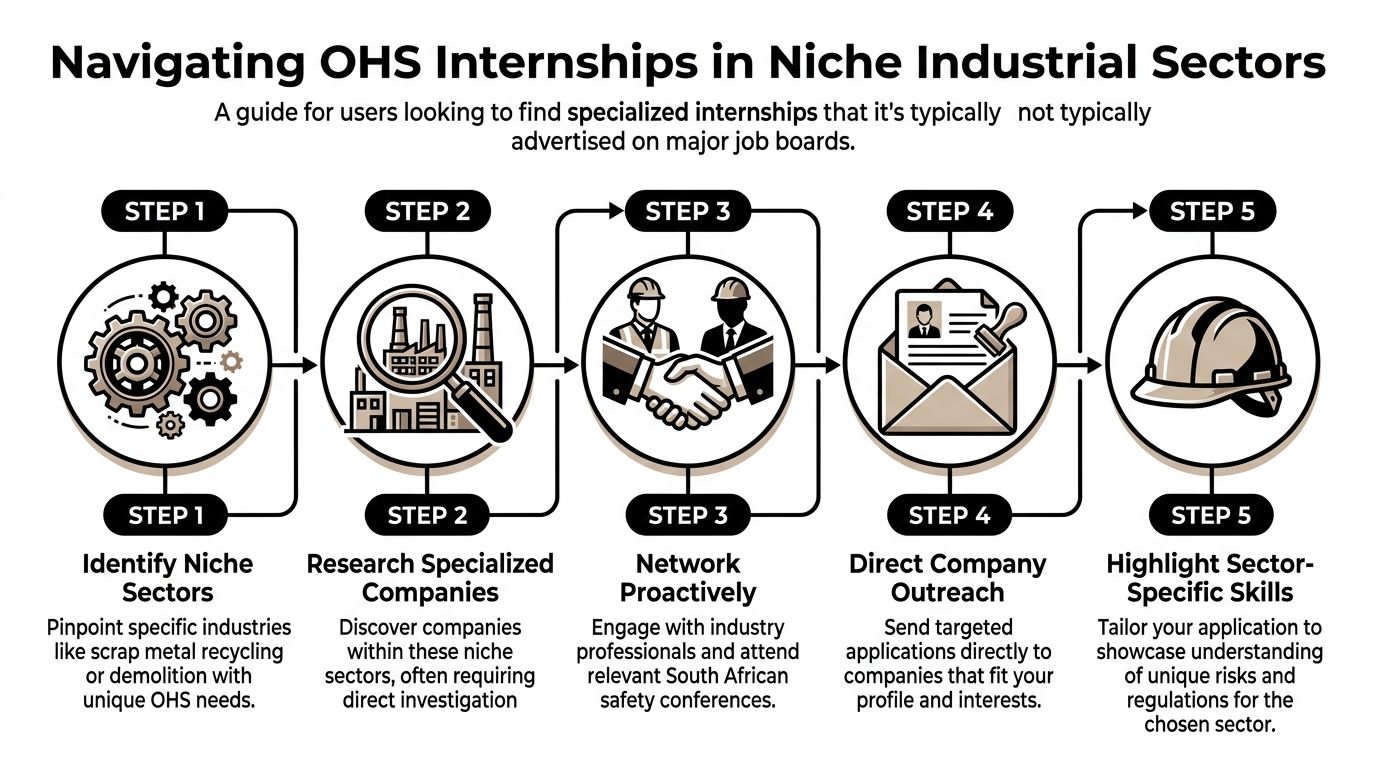
Top private opportunities are often found through persistence, not convenience. If you rely only on major job boards, you’ll mostly see broad listings, recycled posts, or roles that don’t tell you what the workplace is like.
That’s a problem in industrial safety, because the quality of the internship depends heavily on the site, the supervision, and the kind of risks you’ll be exposed to.
Use a targeted search method
A better approach is to build a shortlist of industries first, then search for companies inside them.
For occupational health and safety internships in south africa, the most useful sectors for serious practical learning often include:
- Demolition and decommissioning
- Scrap metal recycling and processing
- Manufacturing and fabrication
- Warehousing and logistics
- Waste handling and municipal support services
Each of those environments exposes interns to different combinations of contractor management, moving machinery, access control, lifting hazards, fire risks, traffic routes, and documentation discipline.
How to uncover the hidden market
Use more than one channel. The strongest candidates usually combine direct research with professional networking.
- University career offices: Ask specifically for industrial, manufacturing, and site-based safety opportunities. General internship lists are often too broad.
- Professional bodies and industry events: Attend talks, branch meetings, and safety forums where practitioners work in the field.
- Direct company outreach: A short, well-written enquiry to the right person can work far better than waiting for a public advert.
- Operational websites: Study service pages, project categories, and sectors served. They tell you whether the business offers the kind of exposure you want.
If you’re exploring industrial waste and metals environments, reviewing specialist service categories like metal waste management in Johannesburg helps you identify the kinds of employers and operations where practical OHS experience is more likely.
What to say when you reach out directly
Keep it professional and brief. Don’t send a life story.
Include:
- Who you are
- What you’ve studied
- Which sector interests you
- Why you’re contacting that company
- What documents you can send immediately
A direct message works best when it sounds deliberate. If you mention that you’re specifically seeking exposure to industrial safety systems, contractor controls, inspections, and site reporting, your enquiry already stands above the usual “Please help with internship” email.
If a company can tell you understand its operating environment, it’s more likely to take your application seriously even when there isn’t a formal vacancy listed.
What to avoid
Don’t waste time on methods that produce weak signals.
Skip these habits:
- Mass emailing without research
- Applying only through one platform
- Asking for “any job available”
- Contacting companies without reading what they do
The search process in this field rewards focus. You’re not trying to be visible to everyone. You’re trying to be credible to the right employer.
Mastering the OHS Internship Interview and Safety Assessment

By the time you reach the interview, the employer already believes you might be trainable. The interview decides whether you can think clearly around risk.
That standard is high for a reason. In South Africa’s construction sector, which is closely tied to demolition, the fatality rate was 17.5 per 100,000 workers in 2022, with about eight workers dying monthly, according to the Employment and Labour statement on occupational health and safety deficits. Employers in adjacent high-risk sectors don’t treat site assessments casually.
What the verbal interview is really testing
A typical interview might start softly. Tell us about yourself. Why safety. Why this industry.
Then the questions tighten.
You may be asked how you’d respond if:
- a worker ignores PPE rules
- a walkway is blocked near active operations
- a contractor starts work without the right approval
- housekeeping keeps failing in the same area
- two hazards compete for attention at once
We’re not expecting a polished speech. We’re checking whether you prioritise correctly, communicate respectfully, and understand escalation.
A poor answer is all theory. A strong answer shows sequence. Identify the immediate risk, control exposure, notify the right person, document the issue, and follow up.
The site walk matters more than many applicants realise
Some employers will take you onto a yard, through a plant, or around a controlled area. Others will use photos, layouts, or scenario sheets.
Either way, we’re watching for a few things:
| What we show you | What we want to see from you |
|---|---|
| A cluttered work area | You notice housekeeping and access problems quickly |
| Mixed pedestrian and vehicle movement | You think about separation, visibility, and control |
| Suspended or unstable materials | You identify exclusion zones and immediate consequences |
| Workers doing a task under pressure | You look for shortcuts, not just obvious hazards |
| Incomplete signage or barriers | You recognise weak control measures and communication failures |
If you’re serious about this path, learn how operational risk appears in environments such as structural demolition services, where sequencing, exclusion control, and constant reassessment are part of safe execution.
Don’t try to impress by naming every hazard on site. Impress by identifying the most serious hazards first and explaining why.
A common interview scenario
A candidate is shown an area with scattered material, a reversing vehicle nearby, and workers moving through the same zone.
The weak candidate says, “There are many safety issues and PPE must be worn.”
The stronger candidate says the area has a traffic segregation problem, poor housekeeping, and exposure to struck-by risk. They’d control movement first, secure the area, raise it with the supervisor, and verify that the corrective action is implemented rather than just reported.
That answer sounds practical because it is.
How to prepare properly
Before any interview, rehearse out loud. Not memorised lines. Clear thinking.
Focus on:
- Hazard identification
- Priority setting
- Communication with supervisors and workers
- Basic reporting logic
- Calm responses under pressure
The employer isn’t looking for a finished professional. We’re looking for evidence that you can become one without putting people at risk in the process.
Your Future in Occupational Health and Safety
A strong start in OHS usually comes from doing ordinary things well. Clean documents. Good observation. Respect for procedure. The discipline to follow through when a corrective action is assigned.
That’s what turns an internship into a career.
The private industrial route is demanding, but it gives you exposure that many applicants never get. You learn how safety works when deadlines are tight, contractors are active, equipment is moving, and site conditions shift during the day. That kind of learning stays with you.
What separates the people who grow
The people who build solid careers in this field usually share a few habits:
- They stay curious on site
- They write clearly
- They don’t bluff when they don’t know
- They follow up after raising an issue
- They treat workers with respect
That last point matters more than many graduates realise. You can know the law and still fail if you can’t speak to people properly.
The best safety people are credible before they are senior.
Occupational health and safety internships in south africa can open into coordination, compliance, training, systems support, audits, contractor management, and eventually site leadership. The path won’t look identical for everyone. What matters is the quality of your first step.
Choose an environment that will test you, not just host you. That’s usually where the true growth begins.
Answering Your Top OHS Internship Questions
Are OHS internships in South Africa always paid
No. Some are paid, some are not, and some offer stipends or fixed-term training support instead of a full salary. You’ll need to read the terms carefully and ask direct questions. In private industry, the bigger issue is often the quality of exposure. A paid placement with weak supervision can leave you with less value than a modestly compensated role where you get real site access and proper mentoring.
How important is legislation knowledge for an intern
It matters more than many applicants think. A South African automotive case study found that implementing a formal OHS system led to a 59% reduction in workplace injury rates, as reported in this study on OHS system implementation in an automotive assembly organisation. The practical lesson is straightforward. Compliance knowledge isn’t just about passing audits. It supports injury prevention when the system is properly applied.
Can related experience help if I haven’t worked as an OHS intern before
Yes, if you frame it correctly. Relevant experience can come from maintenance environments, warehouse work, plant exposure, practical modules, contractor coordination, quality control support, or any role where procedures, hazards, and reporting mattered.
The key is to explain what you observed and what you learned. Don’t just list duties. Show that you understand permit discipline, housekeeping, unsafe acts, supervisor communication, or incident follow-up.
What should I take to an interview or assessment
Bring clean copies of your CV, qualification documents, transcripts, identification, and any relevant certificates. Also prepare mentally for scenario questions and a site-based discussion. Closed shoes and professional presentation matter if there’s any chance of a walkabout.
How do I know if an internship is worth taking
Look for three things:
- Real site exposure
- Structured supervision
- Clear reporting lines
If the employer can explain what you’ll do, who you’ll learn from, and how your work will be reviewed, that’s a stronger sign than a vague title alone.
If your business needs a partner that understands safety in real operational environments, D7 Capital Partners (Pty) Ltd works across scrap metal recycling, structural demolition, and total waste management in South Africa. For industrial, commercial, and municipal projects where compliance, risk control, and execution matter, their team brings practical experience to demanding sites.