That pile of metal from your manufacturing floor or demolition site isn't just waste. It’s a valuable, hidden asset waiting to be unlocked. In South Africa's growing circular economy, industrial scrap metal has become a crucial commodity. Well-sorted industrial scrap metals can create a reliable recovery and revenue stream, capable of opening up a significant new revenue stream for your business while championing sustainability.
Why Industrial Scrap Metals Are a Hidden Asset
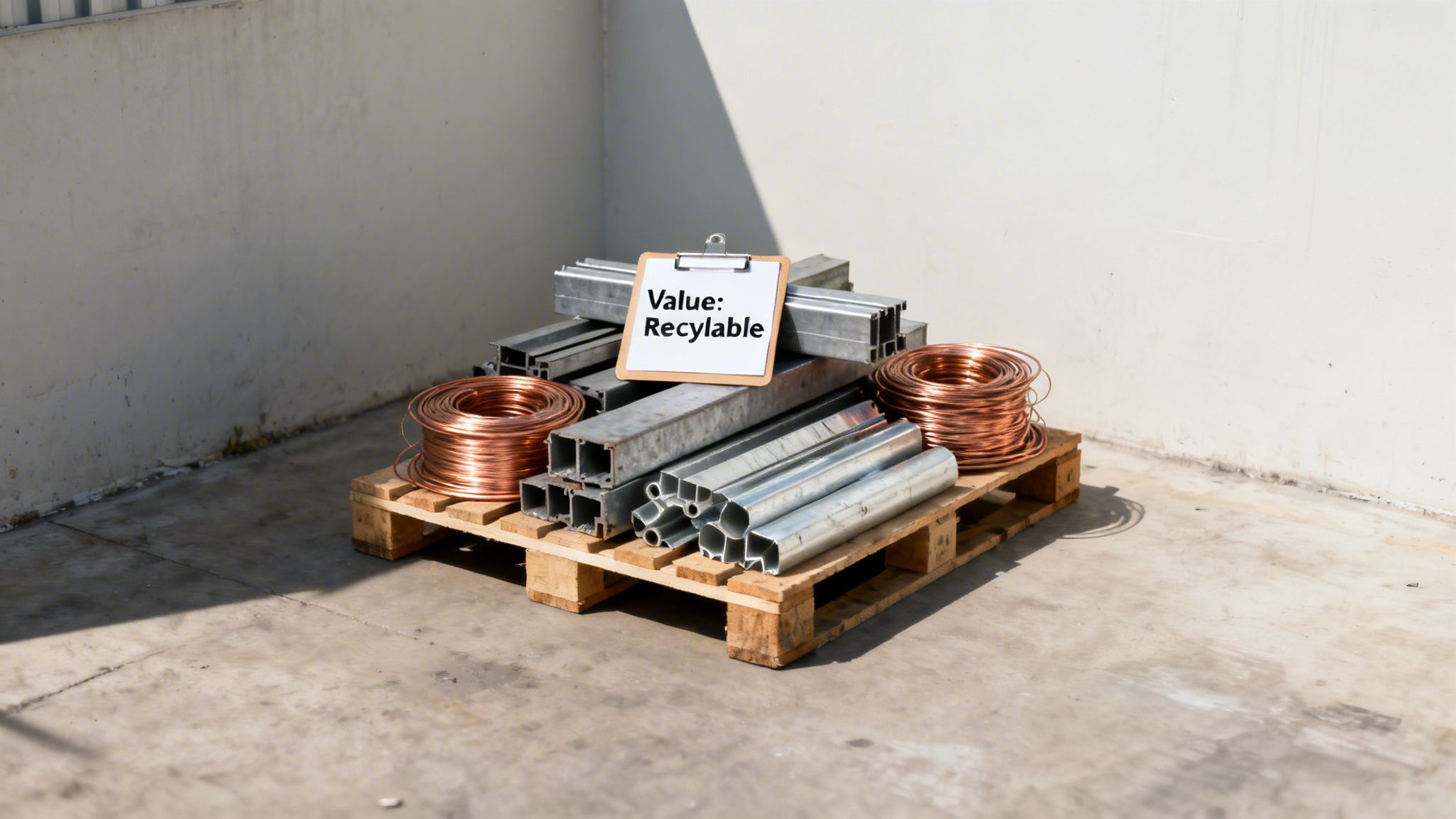
Think of industrial scrap metal like the prime, high-quality off-cuts from a master furniture maker. You wouldn't just sweep away those valuable pieces of timber with the sawdust. In the same way, the metal by-products from your operations—whether from manufacturing, construction, or demolition—are not just leftovers. They are foundational resources for new production.
This shift in perspective is everything. When you start viewing scrap as an asset rather than a disposal problem, you open up entirely new financial and operational possibilities for your company. It’s a direct opportunity to turn what was once a cost centre into a profitable part of your business model.
Turning Waste Into Revenue
Every single kilogram of scrap metal generated on your site has inherent value. From steel beams and off-cuts in a fabrication plant to the copper wiring and pipes from a building teardown, these materials are in constant demand. The global and local markets for recycled metals are robust, driven by industries looking for reliable, cost-effective raw materials.
By putting a structured scrap management programme in place, your business can systematically capture this value. This process transforms operational by-products into a consistent and predictable source of income, directly boosting your bottom line. It’s a strategic financial move, not just a clean-up exercise.
Recycling metals isn’t only about environmental responsibility; it’s a smart financial strategy that reduces our collective reliance on mining new ore. For every ton of recycled steel, for instance, approximately 1.4 tons of iron ore and 740 kilograms of coal are conserved.
The Foundation of a Circular Economy
The concept of a circular economy is straightforward: instead of a "take, make, dispose" model, the goal is to keep resources in use for as long as possible. Industrial scrap metal is a perfect example of this principle in action. Recycling these materials provides a high-quality feedstock for smelters and mills, which comes with several powerful benefits:
- Reduces Environmental Impact: Using recycled metal significantly lowers energy consumption. Recycling aluminium, for example, can slash energy use by up to 95% compared to producing it from raw bauxite ore.
- Conserves Natural Resources: It lessens the demand for virgin ore, preserving South Africa's natural landscapes and reducing the environmental strain that comes with mining.
- Strengthens Supply Chains: A steady domestic supply of recycled metal gives manufacturers a more stable and often more affordable source of raw materials, insulating them from global supply chain volatility.
At its core, industrial scrap falls into two primary families—ferrous (iron-based) and non-ferrous metals. Understanding the difference is the first step in identifying and maximising the value of what you generate, a topic we will explore in detail next.
The Two Metal Families: Ferrous and Non-Ferrous
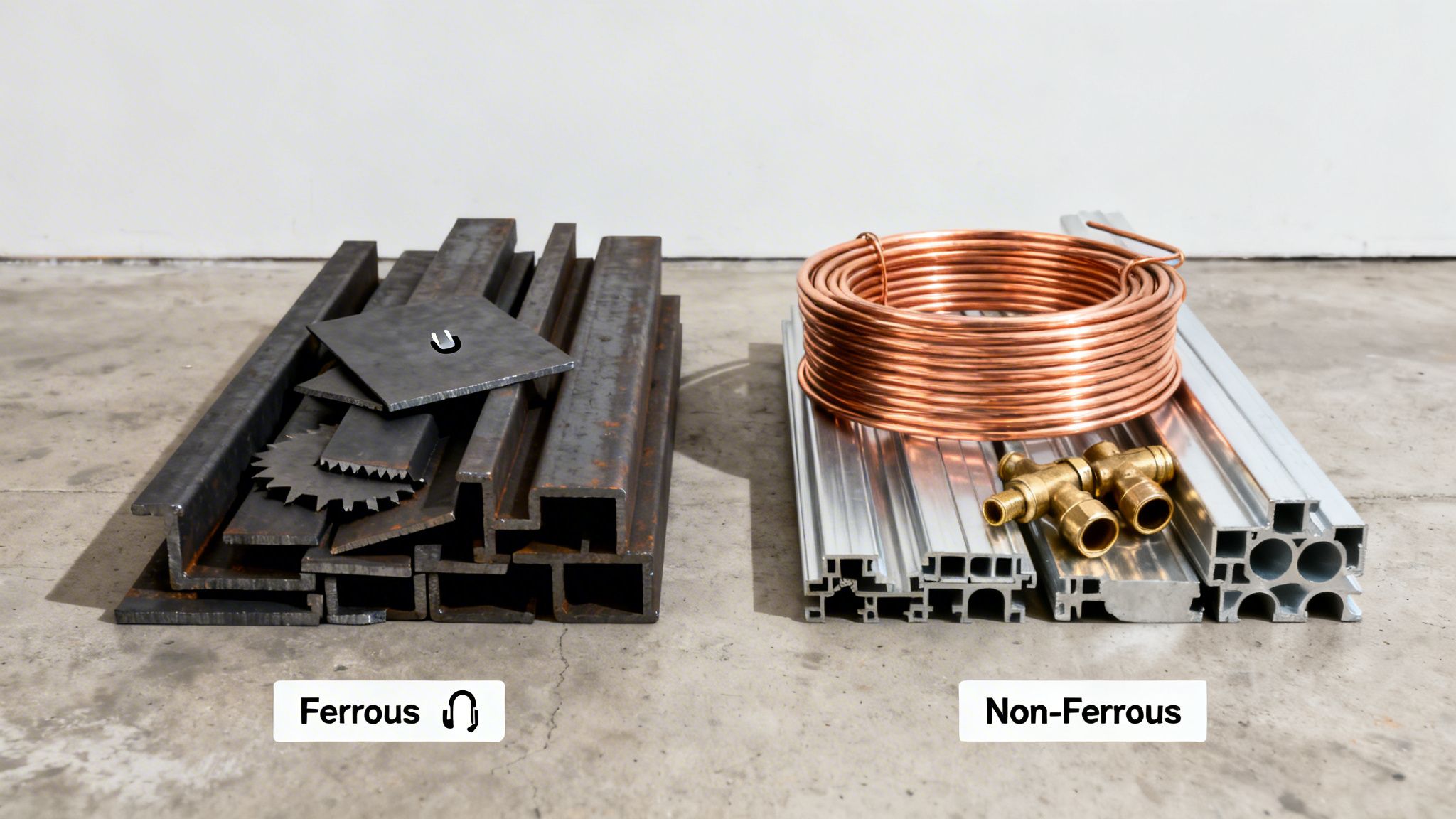
Before you can realise the true value hiding in your industrial scrap, you first need to get to grips with its two fundamental families: ferrous and non-ferrous metals. The difference between them is incredibly simple, but it has a massive impact on everything from the metal's price to how it's recycled and what it becomes next. The entire classification system all comes down to one element—iron.
There's a quick and easy way to tell them apart: grab a magnet. If the magnet snaps right on, you've got a ferrous metal on your hands, thanks to its iron content. If the magnet doesn’t react at all, you’re holding a more valuable non-ferrous metal. This simple test is the first and most critical step in sorting your scrap and unlocking its real market value.
Getting this basic distinction right is everything. Ferrous metals, like steel and iron, are the workhorses of the world—abundant, strong, and forming the backbone of construction and manufacturing. In contrast, non-ferrous metals like copper, aluminium, and brass are less common and boast unique properties that make them significantly more valuable per kilogram.
Understanding Ferrous Metals
Ferrous metals are essentially alloys that contain iron, prized for their strength and durability. They are the most recycled materials on the planet, feeding the global steel industry and forming a massive circular economy. While they don't fetch the same high prices as non-ferrous metals, the sheer volume generated in industrial settings makes them a huge source of consistent revenue.
You'll find ferrous metals everywhere in industry, often as:
- Structural beams and off-cuts from construction sites.
- Worn-out machinery parts and old vehicles.
- Steel sheeting, rebar, and pipes from demolition projects.
Common grades you'll hear about are Heavy Melting Steel (HMS) and Plate & Structural (P&S). HMS is further broken down into HMS 1 and HMS 2, based on thickness and purity. P&S, on the other hand, refers to clean, thicker cuts like steel plates and I-beams, making it a higher-grade ferrous commodity. For a deeper dive, check out our guide on the uses and types of ferrous metals.
The High Value of Non-Ferrous Metals
In the world of industrial scrap, non-ferrous metals are the high-value players. Because they don't contain iron, they are generally far more resistant to rust and corrosion. They are sought after for special properties like electrical conductivity, low weight, and how easily they can be shaped. These materials are essential for just about everything, from electronics and aerospace to plumbing and power transmission.
Think of it this way: if ferrous scrap is the concrete foundation of a building, non-ferrous scrap is the high-tech electrical wiring, precision plumbing, and custom window frames. Both are vital, but one carries a much higher intrinsic value.
Sorting these materials accurately is where a business can seriously boost its bottom line. Mixing valuable copper wire into a pile of steel beams is like accidentally throwing away a gold ring with the daily rubbish—a significant and completely avoidable financial loss.
Common Non-Ferrous Scrap in Industry
Here are some of the most common and valuable non-ferrous metals you'll come across in an industrial environment:
- Copper: Found in electrical wiring, pipes, motors, and transformers. It’s highly sought after for its superb conductivity.
- Aluminium: Used in window frames, vehicle parts, and packaging. Its lightweight and corrosion-resistant nature make it a key material in modern manufacturing.
- Stainless Steel: Technically a ferrous alloy because it contains iron, but its high chromium and nickel content mean it's traded and valued like a high-end non-ferrous metal. You'll find it in kitchen equipment, medical devices, and chemical tanks.
- Brass: An alloy of copper and zinc, often seen in plumbing fittings, valves, and decorative hardware.
- Lead: Commonly sourced from batteries, sheeting, and cable sheathing.
To help you get started, the table below gives a quick overview of the key differences between the two metal families. This simple knowledge is the first step in turning a mixed pile of scrap into distinct, high-value commodities.
Ferrous vs Non-Ferrous Industrial Scrap At a Glance
| Attribute | Ferrous Metals | Non-Ferrous Metals |
|---|---|---|
| Magnetic | Yes | No |
| Key Element | Contains Iron | Does Not Contain Iron |
| Value | Lower per Kilogram | Higher per Kilogram |
| Common Examples | Steel, Cast Iron, Rebar | Copper, Aluminium, Brass, Lead |
| Primary Properties | Strength, Durability | Conductivity, Malleability, Corrosion Resistance |
| Industrial Sources | Structural Beams, Machinery, Demolition Debris | Electrical Wiring, Window Frames, Plumbing Fittings |
By understanding this comparison, you’re no longer just dealing with "waste." You're beginning the process of organising your scrap into valuable resources ready for the recycling market.
Decoding The Language Of Scrap With ISRI Grades
Stepping into the industrial scrap metal market can feel like trying to order coffee in a foreign country without a phrasebook. One person’s “good steel” is another’s “unusable junk,” leading to miscommunication, poor pricing, and ultimately, lost revenue. To cut through the noise, the industry adopted a standardised system.
This system is managed by the Institute of Scrap Recycling Industries (ISRI). It's best to think of ISRI codes as the universal language of scrap. They offer a clear, detailed, and globally recognised set of specifications for virtually every type of recyclable material out there.
Thanks to ISRI codes, a bundle of steel beams in Johannesburg is understood and valued the exact same way as a similar bundle in Shanghai. This shared vocabulary is the bedrock of transparent pricing, efficient global trade, and quality control. For any business that generates scrap, getting to grips with these codes is the first step in turning "waste" into a valuable, sought-after commodity.
Why ISRI Specifications Matter For Your Business
Imagine a market without a common standard. It would be pure chaos. A seller might offer "high-quality steel," but what does that really tell a buyer? How thick is it? Is it clean? Is it mixed with other unwanted metals? ISRI codes get rid of this ambiguity by setting out exact criteria for each grade.
For your business, this has a direct impact on your bottom line. Scrap that has been properly sorted, cleaned, and classified according to a specific ISRI grade will always fetch a higher price than a jumbled, unidentified pile. It gives buyers peace of mind, and they’re willing to pay a premium for that confidence.
By preparing your scrap to meet a higher ISRI specification, you are fundamentally changing its commercial identity. You are no longer just a generator of scrap; you become a supplier of a specific, quality-assured raw material ready for the furnace.
This system gives steel mills and foundries the confidence to buy material sight unseen, knowing its precise chemical and physical makeup. This is critical for their operations, as the wrong type of scrap can damage million-rand equipment or lead to a faulty final product.
Key Ferrous Grades In An Industrial Context
While ISRI has hundreds of codes for materials from paper to plastics, industrial sites typically deal with a core set of ferrous and non-ferrous grades. When it comes to ferrous metals, two of the most common classifications you'll come across are for Heavy Melting Steel (HMS).
These two grades are the workhorses of the steel recycling world. They make up the bulk of industrial scrap metal from demolition sites, manufacturing off-cuts, and old infrastructure projects. The main differences between them boil down to thickness, size, and how clean the material is.
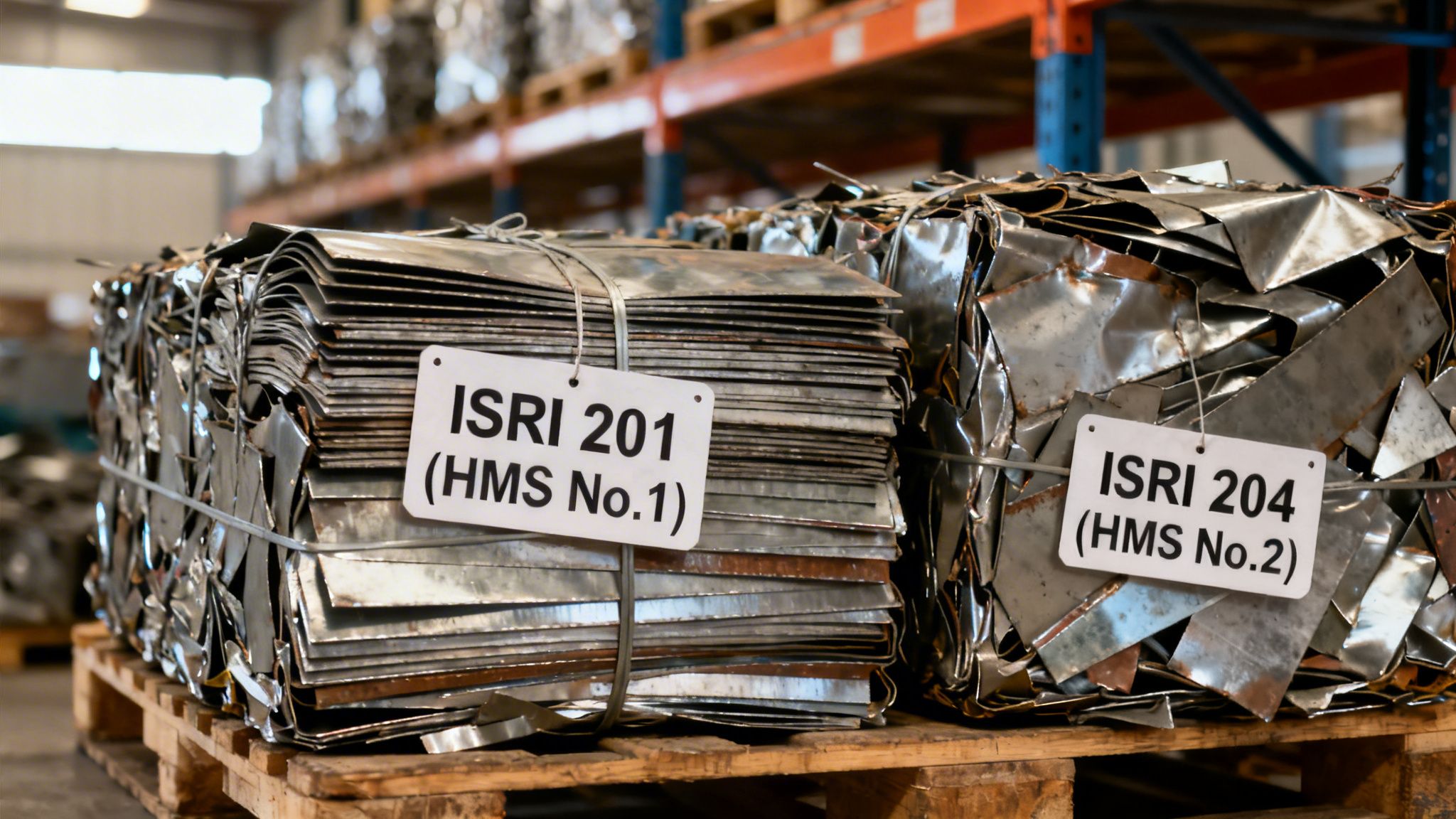
ISRI 201 (HMS No. 1): This is the premium grade. It consists of wrought iron or steel scrap that is 6mm (1/4 inch) or thicker. Pieces must be cut to specific dimensions so they can be easily loaded into a furnace. Crucially, the material must be free of thin-gauge metals and excessive rust.
ISRI 204 (HMS No. 2): This grade is similar but allows for thinner material—specifically, wrought iron or steel scrap that is 3mm (1/8 inch) or thicker. It can also include properly prepared automotive scrap. While still a valuable grade, it’s less dense and might contain more impurities than HMS No. 1.
The price difference between these two grades can be substantial. Simply by keeping your heavier steel separate from your thinner material, you can upgrade a significant portion of your scrap from ISRI 204 to the more valuable ISRI 201. For a detailed overview of various materials, you might be interested in our guide that helps answer, "What are scrap metals?". This simple act of sorting translates directly into a healthier bottom line, showing the real-world power of understanding ISRI grades.
The Journey of Scrap From Your Site to a New Product
So, what really happens to that mountain of industrial scrap once it leaves your site? It’s easy to assume it just disappears, but the reality is far more interesting. That pile of metal is about to begin a fascinating transformation from what you consider waste into a valuable raw commodity, ready for a new life.
This isn't your grandfather's scrapyard. Modern metal recycling is a precise, technology-led process designed to capture every ounce of value from the materials your operation generates. Let’s follow that journey and see how a professional recycler turns your scrap into a financial and environmental asset.
Stage 1: On-Site Collection and Sorting
The entire process kicks off right at your facility. Before any material is moved, the most critical step happens: on-site evaluation and segregation. A good scrap management partner works with you to place clearly labelled bins at strategic points, making it easy for your team to separate different metal types at the source.
This initial sort is absolutely vital. Keeping high-value non-ferrous metals like copper and aluminium separate from lower-value ferrous metals like steel prevents cross-contamination. It’s a simple action that immediately boosts the value of your scrap, as clean, well-sorted materials always fetch a much higher price than a mixed jumble.
Once your bins are full, they’re collected on a schedule that works for you, ensuring there’s zero disruption to your workflow. This first stage is all about setting the process up for maximum efficiency and return.
Stage 2: Secure Transport to the Processing Facility
With the scrap sorted and collected, it’s then securely transported to a licensed recycling facility. This is more than just a quick trip down the road; it involves careful logistical planning to ensure every load is moved safely, efficiently, and in full compliance with all transport regulations.
Upon arrival, every truck is weighed on a certified weighbridge. This is a non-negotiable step that provides a transparent, accurate record of the exact tonnage received from your site. It’s the foundation for fair, precise payment and builds the trust essential for a strong partnership.
The moment your scrap crosses that weighbridge, its status changes. It's no longer "waste" but has officially entered the circular economy, beginning its transformation back into a furnace-ready commodity that will fuel future manufacturing.
Stage 3: Advanced Processing and Purification
This is where the real magic happens. A modern recycling yard is an advanced industrial centre, packed with powerful machinery built to process, purify, and package metal to meet strict international specifications. The entire goal is to prepare the material for its final destination: the foundry or steel mill.
Several key processes get the job done:
- Shearing: Huge hydraulic shears, capable of exerting incredible force, slice through large items like steel beams and plates. This cuts them down into smaller, "furnace-sized" pieces that are essential for efficient melting.
- Baling: Powerful balers take lighter materials like sheet metal and compress them into dense, uniform cubes. These bales are far easier to transport, store, and charge into a furnace.
- Shredding: For complex items like old machinery, massive industrial shredders use powerful rotating hammers to literally rip them apart. This violently separates the valuable metal from other materials like plastic, rubber, and foam.
Throughout all this, advanced sorting technologies are working nonstop. Powerful magnets lift ferrous metals out of the mix, while other sophisticated systems help separate the various non-ferrous grades. This meticulous purification process ensures the final product meets the exact chemical makeup required by end-users.
After this intensive journey, the material is no longer just scrap. It’s a certified, high-quality raw material, ready to be melted down and forged into a brand new product. For a complete look at this cycle, our guide on scrap metal recycling offers even more valuable insights.
What Drives the Value of Your Scrap Metal
"So, what's my industrial scrap metal really worth?" It’s the first question on every business owner’s mind, and the answer is a lot more interesting than a simple price per kilogram. The value of your scrap isn’t just pulled out of a hat; it’s a living number shaped by powerful global forces and the realities of our local market.
The price you get for a pile of steel beams or a tangle of copper wire isn’t decided in a boardroom down the road. It’s directly linked to what’s happening on international commodity exchanges like the London Metal Exchange (LME). These platforms set the global benchmarks for raw metals, and those prices create ripples that reach every corner of the world, including right here in South Africa.
What that means is the value of scrap sitting on your site in Johannesburg is being influenced by things like manufacturing demand in Asia, new construction projects in Europe, or mining output in South America. A good recycling partner isn’t just picking up your metal; they’re watching these global chess moves to time the sale of your materials perfectly, ensuring you get the best possible price.
The Influence of Local Supply and Demand
While global markets set the tempo, local factors fine-tune the price you actually receive. That old principle from Economics 101—supply and demand—is a huge player in the South African industrial scrap metal market. When local construction and manufacturing are firing on all cylinders, the demand for recycled metal shoots up, and so do the prices.
On the other hand, if several big demolition projects finish up at the same time, the market can get flooded with ferrous scrap. This temporary oversupply can cause prices to dip. Navigating this delicate balance is what a skilled partner does day in and day out, using their market knowledge to turn these fluctuations into an advantage for you.
This infographic breaks down the journey your scrap takes, from collection at your site to its new life in a different product, showing the key stages where value is added.

It’s a simple visual, but it captures how your "waste" material is transformed into a valuable commodity, making it a vital link in the circular economy.
Currency Fluctuations and Market Impact
Another massive factor driving your scrap's value is the currency exchange rate, especially the dance between the South African Rand (ZAR) and the US Dollar (USD). Because scrap metal is a global commodity, its price is almost always set in dollars.
A weaker Rand means that when dollar-based scrap prices are converted back into our local currency, they translate into a higher ZAR value. Conversely, a stronger Rand can push the local price down, even if global demand hasn't changed.
This currency rollercoaster adds a whole other layer of complexity. Your recycling partner needs to be more than just a metals expert; they need a sharp understanding of foreign exchange markets to protect and maximise the return on your assets.
The Health of South Africa’s Steel Industry
The health of our own steel industry has a direct and profound impact on scrap prices, particularly for ferrous grades like steel and iron. Local steel mills are massive consumers of scrap, feeding it into their electric arc furnaces as a primary raw material. The production levels and operational health of these mills create a baseline of demand that underpins the entire market.
Unfortunately, South Africa's steel sector has been through a rough patch. Mills have been running at an average of just 50-55% capacity, with some facilities struggling at a low of 42%. When crude steel production drops by 30% and finished steel output falls 32% (as it has since 2018), the appetite for industrial scrap metal shrinks right along with it. To get the full picture, you can read the findings from the SA Iron & Steel Institute.
Understanding how all these forces—global exchanges, local demand, currency rates, and our domestic industry’s health—are interconnected shows why scrap pricing is so dynamic. It’s not just a number; it’s the result of a constantly shifting economic landscape that requires real expertise to navigate successfully.
How to Choose the Right Scrap Management Partner
Once you understand the world of industrial scrap, the next step is putting that knowledge into action. This means finding the right professional partner to manage it. Choosing a scrap management provider is a serious business decision, one that directly impacts your operational flow, your financial returns, and your legal compliance. The aim is to find a partner who becomes a seamless part of your operation, not just a company that hauls away your metal.
This isn't about finding the person with the biggest truck or the cheapest collection fee. A true industrial partner brings a professional, strategic approach, transforming your scrap from a logistical headache into a streamlined, profitable asset. They should feel like an extension of your own team, one focused on maximising value and minimising any disruption to your business.
Core Capabilities of a Premier Partner
When you're vetting potential partners, look past the basic collection service. A premier provider offers a full suite of capabilities designed specifically for industrial environments. Their expertise should be a given, covering logistics, on-site safety, market knowledge, and transparent business practices.
Here are the key attributes you should be looking for:
- Logistical Expertise: A top-tier partner gets that your operation can't grind to a halt. They offer customised bin placement that works with your unique workflow and reliable collection schedules that prevent scrap from piling up, keeping your site clear and productive.
- On-Site Service Excellence: This means showing up with the right equipment for the job. From various bin sizes to specialised containers for different metal types, they ensure safe and efficient handling from the moment scrap is generated.
- Capacity for Complex Projects: Industrial needs are never one-size-fits-all. Your partner must have a proven track record of handling everything from routine manufacturing off-cuts to massive projects like factory cleanouts and full structural demolitions.
Financial Transparency and Trust
The financial side of your scrap partnership must be built on a foundation of absolute trust. Vague promises and opaque pricing are major red flags. A professional partner provides clear, detailed reporting, no questions asked.
This should always include:
- Certified Weighbridge Slips: Every single load has to be weighed on a government-certified scale. You should receive documented proof for each collection—this is a non-negotiable part of a fair deal.
- Clear Payment Structures: You should get detailed statements that break down the weight of each metal type, the market price on the day it was sold, and any service fees. No hidden costs.
- Market-Linked Pricing: A trustworthy partner will clearly explain how their pricing is tied to market indices. This ensures you benefit when market prices climb.
This level of openness means you always know exactly what your industrial scrap metal is worth and how that value was calculated. It eliminates the guesswork and builds a lasting, collaborative relationship.
A partner’s commitment should extend far beyond a price per kilogram. Look for a provider whose primary focus is on creating operational efficiency, maximising your financial return through expert market navigation, and upholding the highest standards of safety and environmental stewardship.
Unwavering Commitment to Compliance and Safety
In any industrial setting, safety and compliance are paramount. A professional scrap management partner doesn’t just talk about safety; they live it. They should arrive on your site with all the necessary personal protective equipment (PPE), follow your specific site safety protocols without fail, and hold all the required licences and insurance.
Furthermore, environmental compliance is critical. Your partner must be fully licensed to handle, transport, and process scrap materials, providing you with a clear chain of custody. This documentation protects your business from liability and ensures your scrap is being managed responsibly, aligning perfectly with your company's own sustainability goals. If you're ready to take this step, learning more about professional scrap metal removal services can give you a clear roadmap.
Choosing the right partner transforms scrap management from a chore into a strategic advantage, driving both financial and operational success for your business.
Your Industrial Scrap Metal Questions Answered
When you're dealing with industrial scrap, practical questions always come up. Whether you're thinking about setting up a new programme or just want to get more out of your current one, getting clear answers is what matters. Let’s tackle some of the most common questions we hear from businesses just like yours.
We've put these answers together to give you the straightforward information you need. The goal is to help you manage your scrap metal effectively and turn what might seem like a challenge into a real, profitable part of your business.
How Quickly Can We Get a Scrap Programme Started?
Getting a professional scrap management programme up and running is often much faster than most businesses expect. A good partner will make sure the entire process is efficient and doesn’t get in the way of your day-to-day operations.
Typically, a professional partner can conduct a full site assessment within a few days of your first call. This isn’t just a quick look-around; it’s a detailed review of your scrap generation rates, the specific types of metal you produce, and your site’s unique logistical and safety needs. From there, they’ll draw up a custom plan, complete with bin placements and a collection schedule. Most new programmes are fully operational within one to two weeks from that point.
What Is the Biggest Mistake Businesses Make with Scrap?
Without a doubt, the single most common and costly mistake is failing to segregate metals at the source. When valuable non-ferrous metals like copper and aluminium get mixed in with lower-value ferrous materials like steel, the entire load gets devalued.
Think of it like mixing premium coffee beans with cheap fillers; the final product can only be sold at the lower price point. Proper sorting from the very beginning is the most critical step to ensure you receive the best possible price for each individual material type.
This simple discipline of separating materials as they’re generated is the difference between seeing scrap as a low-value waste stream and managing it as a high-value asset.
Does the Size of My Business Matter?
Not at all. The size of your business is never a barrier to setting up an effective scrap management programme. A professional recycling partner has experience with operations of all scales, from small, specialised fabrication shops to massive industrial plants and complex demolition projects.
What really matters isn't your company's size, but the consistent generation of scrap metal. A good partner will design a programme that’s scaled specifically to your output and logistical needs, making sure it’s efficient and maximises your return, no matter the volume.
At D7 Capital Partners (Pty) Ltd, we specialise in creating customised, efficient, and transparent scrap management solutions for industrial clients across South Africa. Partner with us for dependable scrap metal solutions and professional demolition services. Learn more at https://d7capital.co.za.