Here in 2026, the question we get asked most often is: "What's the current brass price per kg in South Africa?" It's a great question, and the short answer is that prices typically move between R75 to R115 per kilogram.
But the real answer is a bit more nuanced than that. The price isn't a fixed number you'll find on a stock ticker. It's a living value, constantly shifting with global metal markets, local demand, and, most importantly, how well your scrap is prepared for recycling.
A Quick Snapshot Of The Brass Price Per Kg
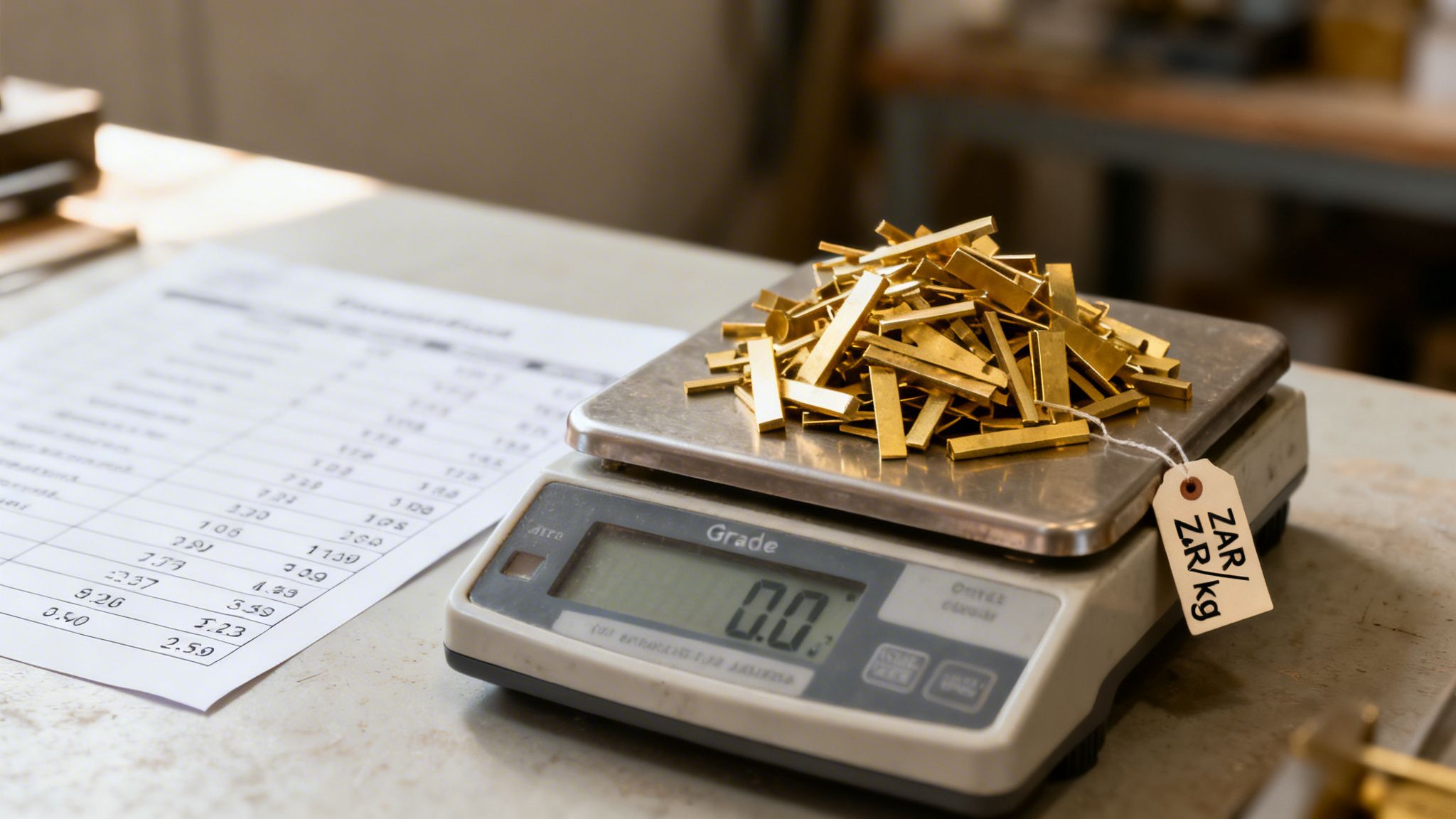
Getting a handle on the brass price per kg is fundamental for any business that generates scrap metal. Whether you’re clearing a demolition site, dealing with manufacturing offcuts, or upgrading plumbing systems, this price determines how much cash you can recover from what would otherwise be waste.
It’s best to think of the price not as a single number, but as a spectrum of value.
The quote you receive from a scrap dealer is tied directly to the specific type—or grade—of brass you have. Just like a butcher values different cuts of meat differently, scrap yards pay more for certain brass grades. This is because brass is an alloy, a mix of copper and zinc, and its value to a smelter depends on that specific metal ratio and the absence of any contaminants.
Estimating Your Scrap Brass Value
To give you a clearer picture right from the start, let's look at how these grades and their prices actually stack up. It’s a simple rule: high-purity, clean brass will always fetch a better price than mixed or dirty scrap.
For businesses managing waste streams, understanding these distinctions is the first real step to maximising your payout. If you're looking for local tips, you might find our guide on how to sell scrap metal near you quite useful.
The table below is a handy reference for the most common brass grades we see in South Africa, along with their estimated price ranges for 2026. Use this as a starting point to get a rough idea of what your material could be worth.
Key Insight: The price gap between the highest and lowest grades can be massive. A little effort spent sorting and cleaning your brass before you sell can make a substantial difference to your final payment by getting it into a higher-priced category.
Quick Guide to Brass Scrap Grades and Estimated 2026 Price Ranges
This table breaks down the common ISRI-coded brass grades you'll find in South Africa, giving you estimated price ranges to help you assess the potential value of your scrap.
| ISRI Code | Common Name | Description | Typical Price Range (Per Kg) |
|---|---|---|---|
| Honey | Yellow Brass Solids | Clean, un-plated yellow brass scrap from taps, fittings, and valves. Must be free of iron and other contaminants. | R95 – R115 |
| Ocean | Mixed Unsweated Auto Radiators | Consists of mixed brass and copper radiators. Must be free of aluminium radiators and iron-finned radiators. | R80 – R100 |
| Label | New Brass Clippings | Clean clippings and solids from new yellow brass sheet or plate. Must be free of foreign material. | R100 – R120 |
| Ebony | Composition or Red Brass | Reddish-hued brass solids, typically from valves and gears, with a higher copper content. | R90 – R110 |
Remember, these prices are estimates. Your final offer will always depend on the scrap yard's assessment of your material's quality, weight, and the live market conditions on the day you sell.
Understanding The Different Grades Of Brass Scrap
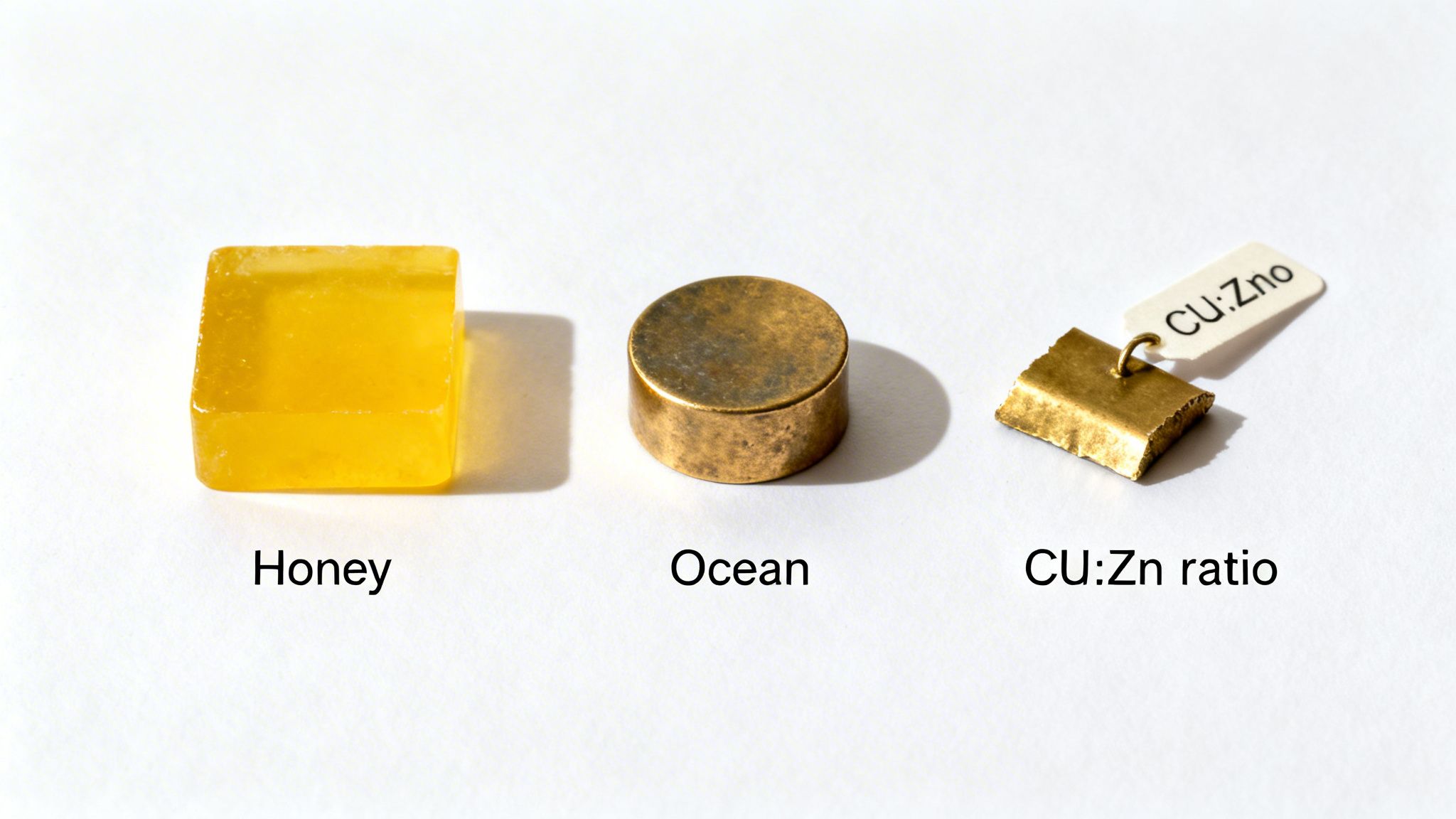
When we talk about the brass price per kg, it's easy to assume all brass is the same. But in the scrap world, that couldn't be further from the truth. Think of brass as a recipe where the main ingredients are copper and zinc. Changing the ingredient ratios creates different types of brass, and each "recipe" has its own value.
These different types are known as grades. Each grade is valued based on its specific metal makeup and how clean it is. To put it simply, cleaner brass with a more valuable copper-to-zinc ratio will always fetch a higher price. This is exactly why a bucket of shiny offcuts from a factory is worth more than a pile of old taps pulled from a demolition site.
Getting to grips with these grades is the single most important thing you can do to make sure you’re paid fairly. If you don't know what you have, you run the risk of having high-value scrap lumped in with lower grades, and that means leaving money on the table.
Decoding Common Brass Grades
The scrap industry uses a set of codes from the Institute of Scrap Recycling Industries (ISRI) to keep things clear and consistent. They might sound technical, but they’re just a straightforward way for everyone to know exactly what’s in a pile of metal. Let's look at the ones you're most likely to come across.
Yellow Brass (ISRI Code: Honey)
This is the grade most people picture when they think of brass scrap. Honey consists of clean, solid yellow brass items like clippings and rods. It's the stuff you’ll commonly find in plumbing, such as taps and pipe fittings.
- Key Characteristics: It must be free of iron, excessive grease, and any other non-metallic bits. Plated brass is fine, as long as it isn't corroded.
- Why It's Valuable: Because it's clean and has a known composition, it requires very little processing before it can be melted down. Foundries love this efficiency, and that purity is what drives up its brass price per kg.
Red Brass (ISRI Code: Ebony)
Sometimes called composition brass, this grade stands out with its reddish hue. That colour comes from its much higher copper content—usually around 85% copper. You’ll often find it in high-quality valves, gears, and certain plumbing fixtures.
Because it contains so much more copper, Red Brass consistently fetches a premium price compared to standard Yellow Brass. Taking a few minutes to sort this out from a mixed load is a simple way to seriously boost your payout.
Dealing With Mixed And Contaminated Brass
Of course, not all scrap comes in clean, sorted piles. Material from job sites or dismantled equipment is often mixed together or still has other bits attached. This material falls into different, lower-value categories.
Mixed Brass (ISRI Code: Ocean)
Think of this as the catch-all category for unsorted brass castings and fixtures. It includes taps, valves, and meters that might have chrome plating or still have small steel screws and plastic handles attached.
- Price Impact: The price for ‘Ocean’ is lower than for ‘Honey’ because the scrap yard has to factor in the labour and waste from removing all the contaminants. The weight of any non-brass material is simply deducted from the total.
- Practical Example: A tap with a steel screw and a plastic handle starts as ‘Ocean’. The moment you take a few seconds to remove that screw and handle, you’ve upgraded it to the more valuable ‘Honey’ grade.
This is where a little bit of effort pays off big time. Sorting your metals isn't just about being tidy; it's a direct investment in the value of your scrap. For more ideas on what’s valuable, have a look at our list of the 10 common types of scrap metal you can recycle for cash. By learning to spot the difference between these grades, you stop being just a seller and become an active manager of your assets.
What Drives The Brass Price In South Africa
The brass price per kg you see quoted isn’t a number pulled out of thin air. It’s the final result of a complex interplay between global markets, currency fluctuations, and what’s happening right here on the ground in South Africa. For anyone in manufacturing, demolition, or industry, getting a handle on these drivers is the key to understanding why the price today might be totally different from the price tomorrow.
Think of it as a three-step process. A global benchmark gets set, our local currency adjusts it, and finally, the supply and demand in our own backyard fine-tune the final number. Once you grasp how each part works, you can stop just accepting prices and start truly understanding them.
The Global Foundation: The London Metal Exchange
The story of any brass price starts thousands of kilometres from our shores, at the London Metal Exchange (LME). The LME is the world's nerve centre for industrial metals trading, acting like a global stock exchange but for metals. This is where the international prices for copper and zinc—the two core ingredients of brass—are decided every single day.
When global industries are booming, they need more copper and zinc, and prices on the LME tend to rise. If manufacturing slows down, demand drops, and prices usually follow suit. Since brass is simply an alloy of these two metals, its core value is directly chained to their performance on the LME.
So, the LME price is the first layer, the bedrock upon which every brass transaction in the world, including ours in South Africa, is built.
The Local Multiplier: The ZAR/USD Exchange Rate
After the LME sets the global price in U.S. dollars, the next crucial piece of the puzzle clicks into place: the ZAR/USD exchange rate. Because metals are traded internationally in dollars, South African scrap dealers have to convert that dollar price into Rands to do business locally.
This conversion isn’t just simple maths; it’s a powerful multiplier that can dramatically shift prices.
- When the Rand is weak (meaning you need more Rands to buy one U.S. dollar), the local price for brass scrap tends to go up. The metal itself hasn't changed, but its dollar value translates into more Rands.
- When the Rand is strong, the opposite is true. The Rand-based price for brass can fall, as fewer Rands are needed to match the international dollar price.
This is exactly why you can see the local brass price per kg jump or fall even when global commodity news seems quiet. Watching the Rand is just as vital as watching the LME.
Global metal prices provide the recipe, but the ZAR/USD exchange rate determines the cost of the ingredients in our local currency. This dynamic explains why local prices can be so volatile, reacting to both international commodity trends and domestic economic news.
The Final Piece: Local Supply And Demand
The third and final driver is the classic economic principle of supply and demand, played out right here in South Africa. While global trends and currency rates set the stage, local conditions direct the final act. It’s why prices in Gauteng might not perfectly match those in the Western Cape on any given day.
For instance, a sudden boom in government infrastructure projects or a surge in private construction can crank up the demand for recycled metals, pushing local prices higher. We’ve seen this happen in the South African market. After the major post-COVID industrial recovery in Johannesburg's manufacturing hubs, demand shot up. In early 2023, for example, clean brass scrap from Gauteng demolition sites was fetching an average of R120 per kg—a huge jump directly linked to construction under the National Development Plan. You can see the economic indicators behind these movements in this detailed breakdown of producer price indexes.
On the flip side, anything that increases supply—like a few large factories being decommissioned simultaneously—can flood the market and cause prices to soften. Even seasonal factors, like the annual builders' holiday in December, can cool off demand and impact what you're paid. To get a better feel for these market forces, you can read about the top 5 trends in metal supply for 2025.
Ultimately, these three forces—LME prices, the exchange rate, and our local market dynamics—all come together to create the brass price per kg you’re quoted for your scrap.
How To Calculate The Value Of Your Brass Scrap
Turning a pile of scrap brass into a predictable payday isn't as mysterious as it might seem. When you understand exactly how a buyer arrives at their final offer, you’re in a much stronger position. It’s all about transparency.
The whole process boils down to a simple formula: weigh your material, identify its grade, get the current price, and then account for any deductions. Once you know how it works, you can move from a rough guess to a solid financial forecast for your scrap.
Step 1: Start With Accurate Weight
Everything in the scrap world starts with weight. It's the bedrock of every single transaction, so getting an accurate measurement is the first, most crucial step.
For big industrial loads, this means using a calibrated weighbridge. If you're dealing with smaller amounts, a good platform scale will work just fine. The magic word here is calibration. An uncalibrated scale can create huge discrepancies, and that difference comes directly out of your pocket. Always make sure your equipment is accurate before you start.
Step 2: Factor In Deductions For Contaminants
Once you've got your total weight, the next job is to figure out what isn't brass. This is where deductions come into play. A scrap dealer will inspect your load for contaminants and subtract their estimated weight to arrive at the payable weight.
Common contaminants include things like:
- Steel attachments such as screws, bolts, and brackets.
- Plastic components like handles, casings, or end caps.
- Excessive moisture, grease, or oil that adds non-metallic weight.
- Other metals mixed in, like aluminium or zinc fittings.
Realising how deductions work is essential. A buyer isn't just paying for a pile of metal; they're paying for usable brass. The labour and disposal costs needed to remove contaminants are factored into the final brass price per kg you get.
This is also where the price itself comes from. The final value is influenced by everything from global commodity markets to what’s happening locally.
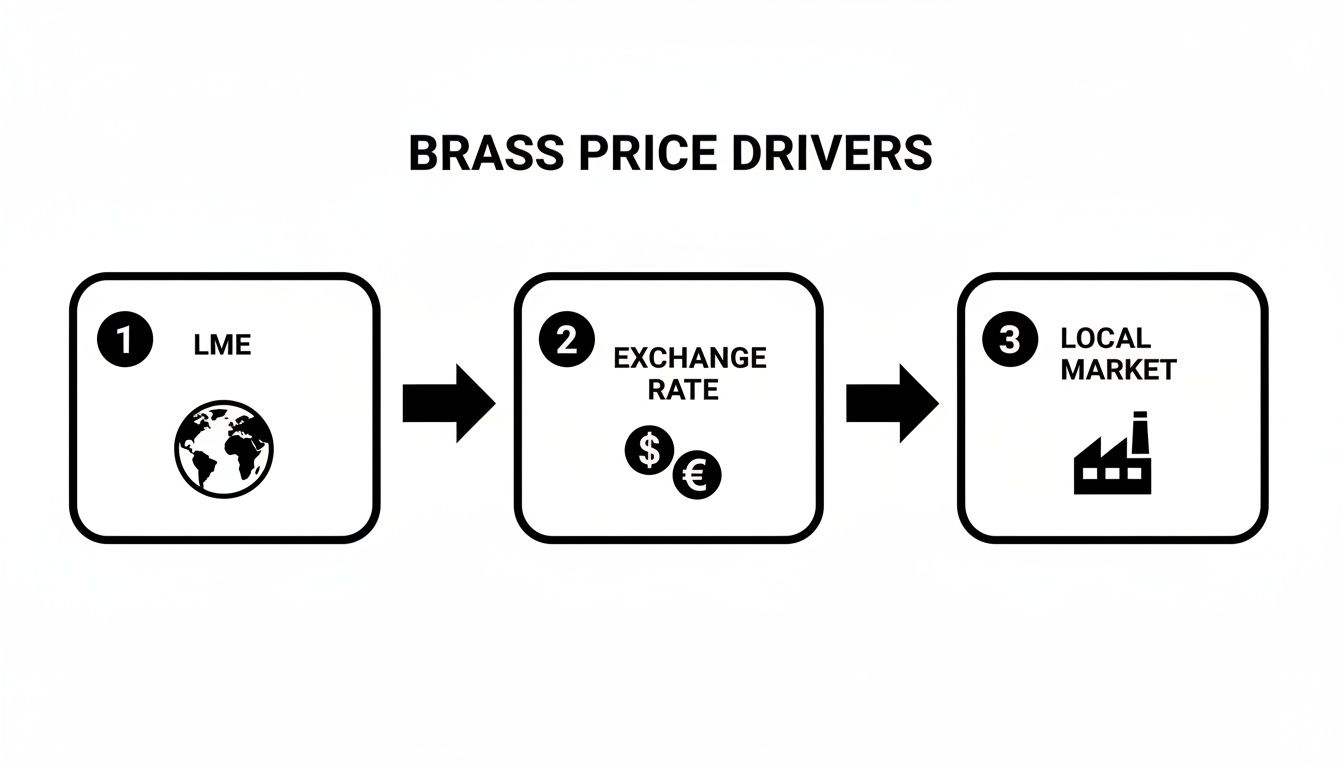
As you can see, the international price set on the London Metal Exchange (LME) is the starting point. That price is then converted via the exchange rate and finally adjusted based on local supply and demand.
Step 3: Calculate The Final Value
With your payable weight sorted, the final maths is easy. You simply multiply the payable weight by the agreed-upon price per kilogram for that specific grade of brass.
Let's walk through a clear example to see it in action:
- Initial Weigh-In: You bring in a load of mixed brass taps and fittings. The weighbridge shows a total weight of 1,500 kg.
- Grading and Inspection: The yard manager takes a look and grades the load as ‘Ocean’ (mixed brass) because of the steel screws and plastic handles. They estimate these contaminants account for about 8% of the total weight.
- Calculating Deductions: The weight of the junk is calculated: 1,500 kg * 0.08 = 120 kg.
- Determining Payable Weight: This deduction is then subtracted from the gross weight: 1,500 kg – 120 kg = 1,380 kg of payable brass.
- Final Value Calculation: The yard’s current price for ‘Ocean’ grade brass is R90 per kg. The total value of your load is: 1,380 kg * R90/kg = R124,200.
This breakdown takes the mystery out of the process, showing you exactly how your scrap pile turns into cash. For a deeper dive into the industry, have a look at our complete scrap metal recycling guide. By understanding this simple formula, you can prepare your material better and assess any quote you receive with confidence.
Practical Tips To Maximise Your Scrap Brass Payout
Getting the best brass price per kg is about more than just piling up as much metal as you can. The real money is made before your scrap even leaves your site. A little bit of smart preparation in sorting, cleaning, and transport can make a massive difference to your final payout.
Think of it as adding value with your own two hands. By taking a few straightforward steps, you ensure your brass is presented in its most valuable form. This isn't just about avoiding deductions; it's about actively capturing the maximum revenue possible. Let's walk through the three key areas that will have the biggest impact on your bottom line.
Sort Your Grades Diligently
The single most profitable thing you can do is sort your brass. As we've covered, clean yellow brass (or ‘Honey’) is worth a lot more than mixed, dirty brass (‘Ocean’). Tossing them in the same bin is like pouring a premium single-malt whisky into a generic blend—you immediately downgrade the entire batch to the value of its lowest-quality component.
Take the time to separate your high-value materials. This means:
- Keeping clean, shiny brass offcuts from manufacturing processes separate from old, tarnished plumbing fittings.
- Isolating any reddish-hued red brass (composition brass) from standard yellow brass. Its higher copper content always fetches a premium price.
- Making distinct piles for clean solids versus materials that still have attachments.
This simple act of separation ensures every grade is weighed and valued correctly, directly boosting your total payout. It’s a non-negotiable step for serious sellers.
Cleanliness Is Next To Profitability
Once your brass is sorted, the next job is cleaning it up. Scrap yards are in the business of buying usable metal, not the steel, plastic, or grease that might be attached. Every kilogram of non-brass material isn't just worthless; it’s a processing cost for the recycler, and that cost gets passed directly back to you as a deduction from your price.
Think about it this way: taking a minute to remove a single steel screw from a brass tap can instantly upgrade its grade from lower-value 'Ocean' to the much more valuable 'Honey', significantly boosting its price per kilogram.
Here are a few practical tips to get your brass ready:
- Remove Steel: A simple magnet is your best friend here. Run it over your brass to quickly find and pull off any attached steel screws, bolts, or brackets.
- Strip Attachments: Get rid of all plastic handles, rubber washers, and any other non-metallic parts.
- Purge Fluids: Make sure all pipes and valves are completely drained of any water, oil, or other fluids.
This level of preparation signals to the buyer that you’re providing quality material, making your load far more attractive.
Optimise Your Logistics
Finally, don’t let poor logistics eat away at your profits. The costs associated with transport, especially for smaller, more frequent collections, can quickly add up. The key is to consolidate your loads whenever you can.
By storing your sorted and cleaned brass until you have a substantial volume, you dramatically reduce your transport cost per kilogram. One large, full shipment is far more cost-effective than several smaller trips. This strategy doesn't just save on fuel and logistics fees; it also gives you more negotiating power. Scrap dealers are always more interested in large, well-prepared loads. Maximising your load weight is how you maximise your efficiency and your final profit margin.
Partnering With A Professional For Optimal Brass Recovery
Getting a good price for your scrap brass is one thing. Managing the entire process—the logistics, the compliance, the sheer operational effort—is another challenge altogether. Trying to handle scrap recovery in-house often turns into a major headache for industrial producers, demolition contractors, and even municipal bodies.
It pulls your team away from their core work, creates logistical nightmares, and opens you up to serious risks if you fall foul of South Africa’s strict environmental and second-hand goods laws. This is where a strategic partner steps in, taking these burdens completely off your plate.
A full-circle service can transform the complex job of scrap recovery into a simple, profitable, and compliant part of your operation. From the moment the scrap appears on your site to the final, transparent payment, a professional partner can manage every detail with precision.
Comprehensive On-Site Solutions
Efficient scrap recovery starts right where the metal is generated. Disorganised piles of scrap aren't just a safety hazard; they're a direct path to downgraded material and lost revenue. Providing the right on-site collection bins for your specific space and needs is a great first step.
This simple, organised approach is crucial. It prevents different grades of metal from mixing, which is key to keeping your high-value brass pure and fetching a better price. For bigger jobs, like decommissioning a factory or a full structural teardown, professional demolition services focused on safety and recovering every last bit of valuable material are a necessity.
By integrating collection and demolition services, a smooth process can be created that minimises disruption to your operations and maximises the quality of the brass recovered. This has a direct, positive impact on the final brass price per kg you receive.
It is critical that every activity on your site strictly adheres to Occupational Health and Safety (OHS) standards. This isn't just about ticking a box; it's about protecting your people and your operations.
Guaranteeing Accuracy With Advanced Technology
A fair price is an accurate price. In high-value scrap transactions, there's simply no room for guesswork. To remove all doubt and provide total transparency, state-of-the-art X-Ray Fluorescence (XRF) analysers are invaluable.
These handheld devices give an instant, non-destructive chemical breakdown of your metal, showing its exact composition. Using this technology means it is possible to:
- Verify Grades Instantly: Tell right away if you have a batch of high-purity yellow brass ('Honey'), red brass, or another alloy.
- Identify Contaminants: The analyser quickly spots any unwanted elements that could lower the brass’s value.
- Provide Definitive Proof: You get a clear, data-backed assessment of what your material is, ensuring you get paid exactly what it’s worth.
This commitment to technology takes all the subjectivity out of grading. It builds trust and guarantees you always get the true market value for your specific grade of brass.
Navigating Compliance And The Market
The South African scrap metal industry is heavily regulated, and for good reason. Working with an expert ensures your business stays fully compliant with all the rules, including the Second-Hand Goods Act. This shields you from significant legal and financial risks.
On top of that, an expert can help you make sense of a constantly changing market. South Africa's brass recycling sector is growing, fuelled by demand both at home and abroad. In fact, recent figures from the Department of Trade, Industry and Competition (DTIC) showed that non-ferrous metal recycling hit 1.2 million tons annually in 2024, with brass making up an 8% share of that. You can find more insights on the brass price index on businessanalytiq.com.
Expertise means all the paperwork is handled, logistics are sorted, and an established network is used to get you the best possible pricing. When you choose a professional partner, you’re not just selling scrap—you’re putting a strategic asset management plan in place that boosts your revenue, ensures compliance, and supports your company’s sustainability goals.
Your Brass Recycling Questions, Answered
When you’re dealing with scrap metal, questions are bound to come up, especially around getting a fair brass price per kg. We get it. To help, we’ve put together answers to some of the most common queries we hear from facility managers, contractors, and industrial partners across South Africa.
Think of this as your go-to reference to clear up any lingering doubts before you turn that scrap brass into a valuable revenue stream.
How Often Does The Brass Price Per Kg Change?
The price of brass scrap isn't set in stone; in fact, it often changes daily. Its value is directly linked to the fluctuating international commodity markets, specifically the London Metal Exchange (LME) prices for copper and zinc.
On top of that, the ZAR/USD exchange rate has a massive impact on the local price. With these two powerful forces constantly in motion, the quote you receive for your brass will always reflect that specific day's market conditions. This is why quotes from scrap dealers are usually only valid for a very short time.
What Is The Most Valuable Type Of Brass Scrap?
The top-tier grade, and therefore the most valuable, is clean, un-plated yellow brass solids. In the industry, we know this by its ISRI code: ‘Honey’. It fetches the highest price for one simple reason—it’s pure and requires the least amount of processing before foundries can melt and reuse it.
To be graded as ‘Honey’, the brass must be completely free of any contaminants. That means no steel screws, no plastic bits, and no other foreign materials. Its high purity and easy recyclability make it the gold standard for scrap brass.
Can I Sell Brass With Steel Or Plastic Attachments?
Yes, you can definitely sell brass that still has steel or plastic parts attached. It’s crucial to realise, however, how this will affect its value. This material will get a lower grading, often as ‘Ocean’ or mixed brass, which naturally comes with a lower price point.
When you bring in contaminated brass, the scrap dealer will assess the load and deduct an estimated weight to account for all the non-brass attachments. To get the best possible brass price per kg, it’s always worth taking the time to clean and separate your materials beforehand. A few minutes spent removing attachments can significantly lift your material’s grade and your final payout.
Do I Need A Permit To Sell Scrap Brass?
Yes. In South Africa, both the transport and trade of scrap metal are regulated industries. To operate legally and avoid any trouble, you must comply with the Second-Hand Goods Act. This legislation was put in place to combat metal theft and ensure every transaction is transparent and fully traceable.
A reputable, professional recycling partner will know these regulations inside and out. They will handle all the necessary legal paperwork and compliance requirements for every transaction, protecting your business from legal risks and ensuring the entire process is secure and professional.
Partner with D7 Capital Partners (Pty) Ltd for dependable scrap metal solutions, professional demolition services, and integrated waste management across South Africa. Visit us at https://d7capital.co.za to learn how we can maximise your recovery value.