You usually land on this topic when the easy options are gone. A fleet has reached end of life. A depot has accident-damaged vehicles taking up space. A plant closure has left old bakkies, forklifts, trailers, and stripped shells standing where productive equipment should be. The pressure is operational first. Clear the yard, stay compliant, recover value, and make sure nothing creates a legal problem later.
That’s where many businesses discover that consumer advice about scrapping one private car doesn’t help much. Commercial disposal in Johannesburg is a different exercise. You’re dealing with asset registers, internal approvals, deregistration, loading access, environmental exposure, security risk, and the difference between a vehicle that should be sold for parts and one that should go straight into metal recovery.
Navigating Johannesburg's Vehicle Scrapping Landscape
Johannesburg businesses don’t operate in a small or informal corner of the market. Auto scrap yards Johannesburg sits inside a broader trade network that matters nationally. The auto scrap yards in Johannesburg are central to South Africa’s motor trade, and the maintenance and repair of motor vehicles subsector recorded a decline of 5,949 jobs nationwide between 2012 and 2022, while Gauteng’s industrial density means its 200+ scrap yards remain essential, processing thousands of vehicles annually for recycled metals and used parts, according to Stats SA’s motor trade report.

That matters for one reason. A proper yard isn’t only a disposal point. It’s part of a recovery system that moves reusable parts, ferrous metal, non-ferrous metal, paperwork, and risk out of your operation.
What commercial clients are usually dealing with
A factory manager and a panel beater don’t ask the same questions. Neither do a municipal workshop and a demolition contractor. In practice, business clients usually need one or more of these outcomes:
- Fleet clearance: Remove multiple end-of-life vehicles without disrupting site traffic.
- Damaged asset recovery: Sort what can be dismantled for parts from what should be processed as scrap.
- Site clean-out: Combine vehicles with general metal waste, obsolete equipment, and loose ferrous stock.
- Audit trail: Keep records for finance, compliance, insurance, and internal governance.
- Controlled loading: Use equipment and timing that fits a live industrial site.
What works and what usually goes wrong
The yards that create value don’t start with cutting. They start with sorting. Vehicles with strong parts demand should be assessed differently from stripped shells, burn-outs, flood-damaged units, or mixed scrap loads.
What doesn’t work is sending everything out as one undifferentiated lot. That’s where businesses lose money. They also lose time when they wait until a site handover date to ask basic questions about access, documents, and removal sequence.
Practical rule: Treat end-of-life vehicles as recoverable assets until inspection proves otherwise.
For industrial sites, vehicle disposal also overlaps with broader waste strategy. Companies that already manage mixed metal streams usually get cleaner outcomes when vehicle scrapping is handled inside a wider metal waste management programme in Johannesburg, rather than as an isolated collection job.
The Johannesburg reality
Johannesburg gives you choice, but choice isn’t the same as fit. Some operators are built around retail spares. Some are geared for salvage. Some can handle larger removals, but only if the load is pre-sorted. Commercial clients need to know the difference before the first truck arrives.
If your job involves more than a single private vehicle, the right question isn’t “Who buys scrap cars?” It’s “Who can clear this asset class safely, document it properly, and recover the best value without creating downstream problems?”
The Professional Vehicle Dismantling Process Explained
A compliant yard follows a sequence. If the order is wrong, value drops and environmental risk rises. Good dismantling is controlled operations, not rough stripping.
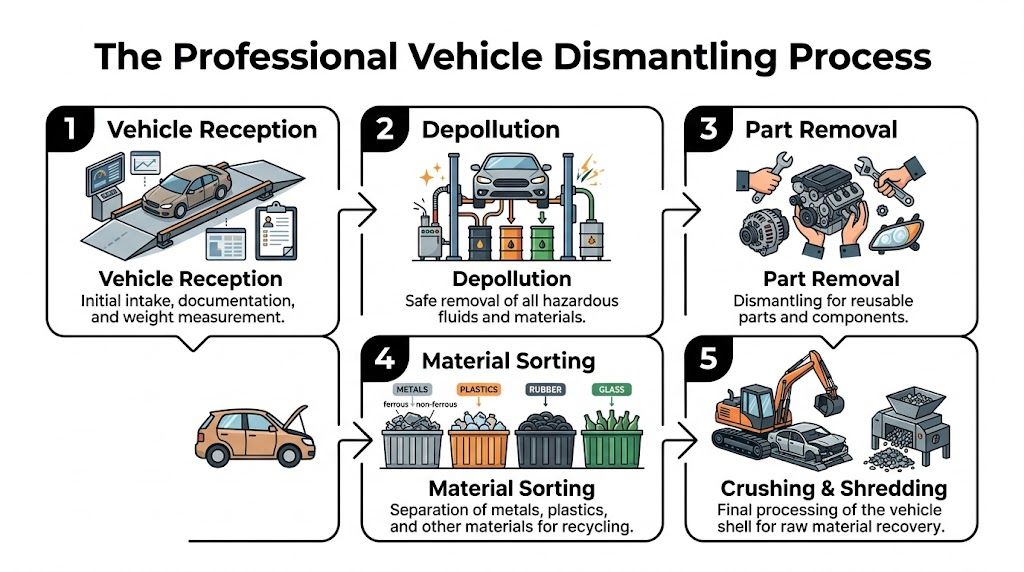
The operating benchmark is clear. The dismantling process at a compliant yard follows strict environmental protocols under NEM:WA, including draining up to 98% of all fluids before stripping begins. A single vehicle can yield over 30,000 components, with 70-80% of vehicles providing reusable parts and the balance going into graded scrap such as HMS 1&2, as described in this Johannesburg scrap yard process overview.
Vehicle reception and intake
Every proper job starts with controlled intake. The vehicle arrives, the unit is identified, and the receiving team checks whether the vehicle is complete, partly stripped, accident-damaged, burnt, or mechanically failed.
At this stage, teams usually look for:
- Ownership alignment: The seller and the paperwork must match.
- Physical condition: Missing engine, gearbox, wheels, battery, ECU, or catalytic converter changes the route and value.
- Handling risk: A leaking vehicle can’t just be parked anywhere in the yard.
- Recovery potential: Some units are parts donors. Others are only metal-bearing carcasses.
For commercial clients, intake matters because the yard should separate administrative acceptance from physical processing. If those are mixed together carelessly, disputes start later.
Depollution comes before dismantling
This is the stage many clients never see, but it’s where professional standards show up first. Fluids need to come out before the vehicle is stripped or moved into heavier processing.
The normal sequence includes removing or draining:
- Fuel
- Engine oil
- Coolant
- Brake and hydraulic fluids
- Other hazardous residues where present
Fluid recovery isn’t just about keeping the floor clean. Once oil, coolant, and fuel spread through mixed scrap, downstream handling gets harder and contamination risk rises.
A yard that skips depollution is usually the same yard that creates problems with traceability, housekeeping, and final settlement.
Systematic parts removal
After depollution, the valuable component recovery starts. This stage is methodical when it’s done properly. Teams remove parts in an order that protects resale value and avoids damage to adjoining components.
High-interest items usually come off early because they carry stronger reuse value or stronger theft risk. Depending on condition, that can include:
- Engines and gearboxes
- Transmissions and driveline assemblies
- Body panels
- Lights and mirrors
- Electronic control units
- Airbags
- Catalytic converters
- Alternators and starters
There’s a major trade-off here. Speed helps yard throughput, but careless stripping destroys resale value. A bumper cut off with no care has less value than one removed intact with brackets and fittings preserved.
Commercial sellers should care about this because the return on a vehicle often depends less on the shell and more on how many saleable assemblies survive removal.
Material segregation after useful parts are removed
Once reusable parts are taken out, the vehicle stops being a vehicle in the commercial sense. It becomes a set of material streams. At this stage, experienced yards protect commodity value.
The shell and residual contents are sorted into categories such as:
| Material stream | Why it matters | Common issue if done badly |
|---|---|---|
| Ferrous steel | Main bulk recovery value | Mixed contamination lowers grade quality |
| Non-ferrous metals | Higher-value recovery in smaller volumes | Copper and aluminium get lost in mixed piles |
| Plastic and trim | Must be separated from metal recovery | Burning or rough disposal creates compliance risk |
| Tyres, glass, residues | Need controlled downstream handling | Yard clutter and unsafe stacking |
A lot of lost value in Johannesburg comes from poor segregation, not poor buying. Once non-ferrous content is buried in mixed scrap, recovery becomes slower and less certain.
For clients who deal with broader metal streams beyond vehicles, this same discipline is covered in a wider scrap metal recycling guide.
Final processing of the shell
After dismantling and sorting, the stripped shell moves into final reduction. Depending on the operation, this can mean compaction, cutting, baling, or transfer for shredding. The point is to convert a bulky shell into a transportable raw material unit.
This is also where operators should maintain separation between clean scrap and contaminated residue. If the shell still carries fluids, trim, or hazardous remnants, the entire load becomes harder to market.
What efficient yards do differently
The technical process is one thing. The commercial process is another. The best-performing operations tend to get these practical decisions right:
- They don’t over-handle stock: Every unnecessary move costs labour and raises damage risk.
- They prioritise recoverable assemblies early: Delay leads to damage, corrosion, and parts loss.
- They control storage: Components need identification, safe stacking, and retrieval discipline.
- They match process to condition: A rolled vehicle, a flood-damaged SUV, and a stripped fleet bakkie should not follow the same recovery path.
If you’re sending multiple vehicles to market, ask how the yard separates parts recovery from bulk metal processing. That answer tells you a lot about whether they’re running an organised dismantling operation or just moving stock through fast.
Essential Documentation and Legal Compliance
Most scrapping problems don’t start in the yard. They start in the file. If the records are weak, the sale becomes difficult to defend later. That matters for fleet owners, finance teams, insurers, auditors, and any business that may need to prove when control of an asset passed from owner to processor.
The safest approach is simple. Build your file before collection day.
The documents that matter in practice
For business disposals, the basic rule is that the yard must be able to identify the vehicle, the seller, and the authority to dispose of it. If one of those is unclear, stop and fix it first.
Below is a practical checklist.
| Document | Company-Owned Vehicle | Privately-Owned Vehicle | Notes |
|---|---|---|---|
| Vehicle registration certificate | Required | Required | If unavailable, resolve the record before release |
| Owner identification | Company representative ID and business registration documents | Owner ID | The person signing must have authority to sell |
| Proof of authority to dispose | Required | Not usually separate if owner signs personally | Use a company letter, resolution, or internal authority record |
| Deregistration request via eNaTIS | Required | Required | Confirm who will handle submission and proof of processing |
| Settlement or finance clearance if applicable | Required where financed | Required where financed | Don’t scrap a financed vehicle without lender clearance |
| Estate authority if applicable | If estate-owned asset | If estate-owned asset | Executor documentation must support the transaction |
Special cases that delay jobs
The straightforward jobs move quickly. The difficult ones are usually one of these:
- Financed vehicles: Ownership and disposal rights may not sit cleanly with the user.
- Lost papers: A missing registration document creates delay unless the record is corrected properly.
- Deceased estates: Nobody should release an estate asset casually.
- Company restructures: The branding on the door and the legal owner on record may not match.
- Municipal or public assets: Internal disposal approvals are often more important than the physical vehicle itself.
A common mistake is assuming the yard will “sort out the admin later”. That’s risky. Once a vehicle leaves your site without a clean trail, you’ve made future disputes harder to resolve.
What your internal checklist should cover
Before releasing any unit, the asset owner should confirm:
- Identity of the vehicle: VIN, registration, and internal fleet reference should match.
- Authority: The signatory must be authorised by the owner entity.
- Status: Finance, insurance, and internal write-off status should be clear.
- Collection record: Keep date, time, vehicle details, and the receiving party’s details.
- Deregistration responsibility: Decide who handles it and who keeps proof.
Compliance note: If your vehicle file can’t answer who owned it, who approved disposal, and when possession transferred, the job isn’t ready for release.
For larger operations, it helps to fold vehicle disposals into a broader total waste management process so transport records, disposal records, and internal approvals sit in one system instead of separate emails and paper files.
What does not work
Three habits create most legal headaches.
First, informal cash arrangements for company assets. Second, releasing units before confirming finance or ownership status. Third, relying on verbal assurances that deregistration will happen somewhere down the line.
Commercial scrapping needs the same discipline as any controlled asset disposal. If your team would never let a machine tool leave site without authorisation, don’t treat an end-of-life vehicle any differently.
How Scrap Yards Determine Vehicle Value
Price starts with the route the vehicle will take. If the unit has useful parts demand, the yard looks at it one way. If it’s incomplete, burnt, heavily damaged, or economically exhausted, the yard values it more like a metal-bearing asset.
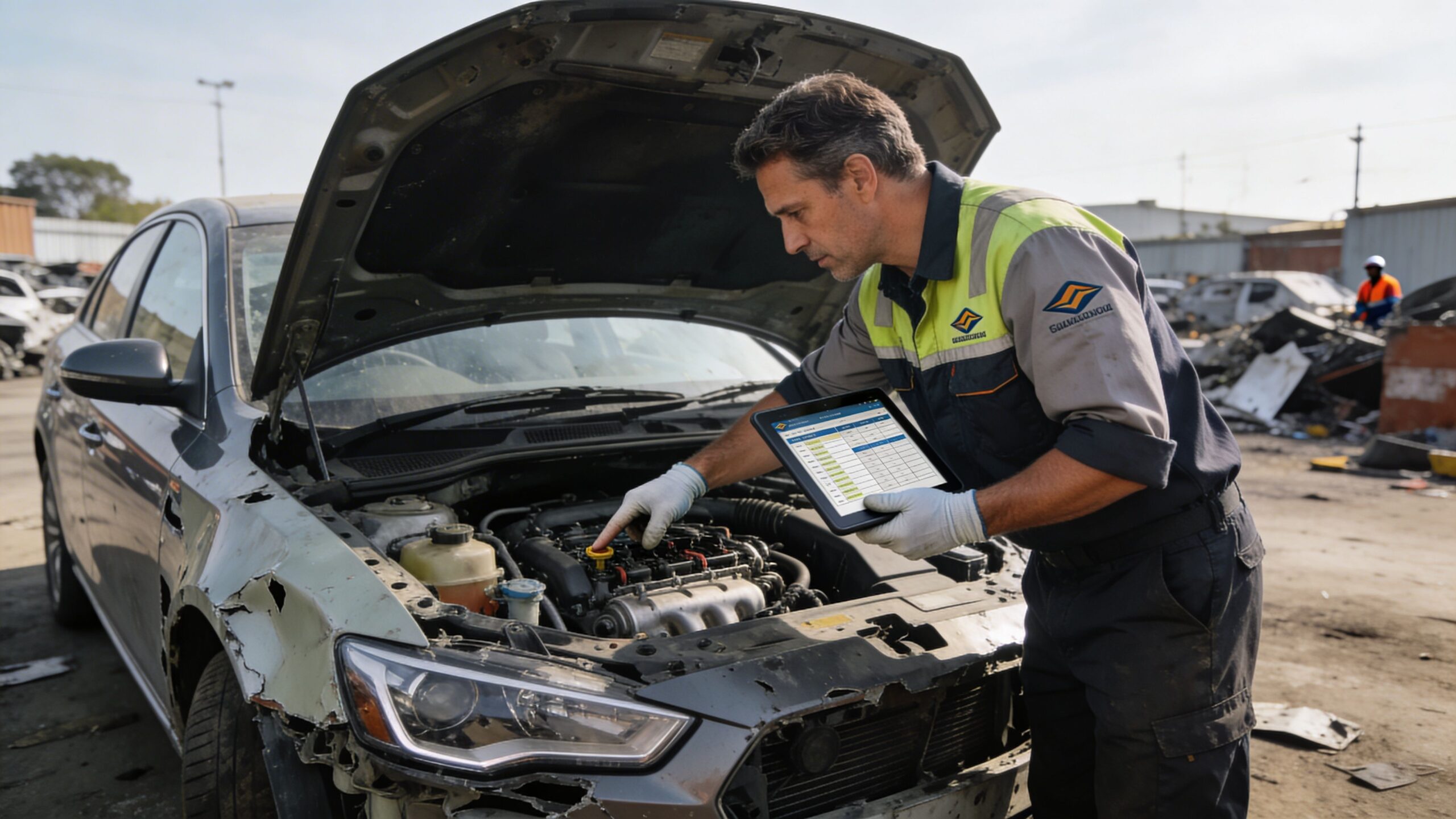
Johannesburg yards make money by maximising what can be recovered from each unit. A written-off vehicle can yield several high-value components, and some South African yards have achieved up to a 100% return on investment within a week by reselling parts such as engines, transmissions, and body panels, as noted in this Gauteng scrap yard directory overview.
Weight matters first, but not by itself
The shell has metal value. That’s the floor, not the full picture. Heavier vehicles usually carry more recoverable ferrous content, but weight alone won’t tell you whether the offer is fair.
A complete vehicle with ordinary damage can be worth more than a heavier shell that’s already been stripped. That’s why serious buyers inspect completeness before discussing final value.
The key questions are practical:
- Is the engine present?
- Is the gearbox still in place?
- Are body panels intact?
- Has the catalytic converter already been removed?
- Are major electronic modules still fitted?
Parts demand changes the offer
Some vehicles are worth more dismantled than crushed. Others aren’t. The difference usually comes down to the resale prospects of the assemblies.
A yard will look at the make, model, age, condition, and common demand for replacement parts in the local market. Engines, gearboxes, lights, doors, mirrors, suspension assemblies, and trim can all move the value if they’re intact and saleable.
If you want a useful valuation, don’t describe a vehicle as “scrap” unless you already know it has no meaningful parts value left.
That’s especially important for commercial fleets. Workhorse models often have steady parts demand because other units are still running in service.
High-value components and material mix
Many sellers often underestimate value. A vehicle isn’t just steel. It may also carry non-ferrous content and specialised components that affect the recovery calculation.
Common value drivers include:
- Catalytic converters: Often checked early because of theft risk and resale relevance.
- Aluminium components: These improve value when properly separated.
- Copper-bearing sections: Wiring and certain assemblies matter if recovery is disciplined.
- Driveline assemblies: Useful where secondary market demand exists.
- Body panels: Clean, undamaged panels often outperform pure scrap value.
A quick reference can help:
| Vehicle feature | Effect on value | Why |
|---|---|---|
| Complete running gear | Usually positive | More assemblies can be sold |
| Missing major parts | Negative | Reduces dismantling yield |
| Intact body panels | Positive | Panels may move faster than shell steel |
| Fire or flood damage | Often negative | Reuse risk rises sharply |
| Mixed non-vehicle scrap loaded with it | Variable | Can help or complicate the transaction depending on sorting |
This short video is useful if you want a visual sense of what inspectors and buyers look for during vehicle assessment.
Why two yards can quote differently
Different yards run different models. One may focus on parts recovery. Another may focus on bulk scrap throughput. One may have stronger demand for a certain type of commercial bakkie. Another may not want the labour time tied up in a badly damaged unit.
That’s why commercial sellers should ask what valuation method is being used. Is the offer based mainly on metal content, on dismantling potential, or on a blended approach?
If you’re also clearing mixed site metal, it helps to understand the broader categories that influence commodity value, especially the distinction between ferrous and non-ferrous material covered in common scrap metal types recycled for cash.
Hallmarks of a Reputable Scrapping Partner
The right partner reduces risk before the first vehicle moves. The wrong one creates a chain of small failures. Missing paperwork, unclear weights, unsafe loading, disputed payouts, and poor yard controls usually travel together.
A reputable operator is easy to recognise when you know what to check.
What a professional operation should show you
Start with visibility. Serious operators don’t hide the basics.
Look for these signs:
- Clear paperwork process: They should explain what documents they need and why.
- Traceable transaction record: You should be able to match each vehicle or load to a collection and settlement trail.
- Structured yard layout: Receiving, storage, dismantling, and loading areas should not look random.
- Visible safety discipline: PPE, controlled movement, and housekeeping matter.
- Environmental controls: Hazardous residues and fluid handling should be managed, not improvised.
If a yard can explain its process plainly, that’s usually a good sign. If every answer is vague, expect problems once the load leaves your site.
The commercial red flags
Some warning signs are obvious. Others are only obvious after you’ve lost time.
Red flags include:
- Cash-only preference for larger transactions: That weakens your audit trail.
- Resistance to issuing formal paperwork: Usually a sign that records are poor elsewhere too.
- No clear valuation basis: If they can’t explain how they reached a number, disputes are likely.
- Unsafe loading practices: Damage claims and site incidents start here.
- Disorganised storage: Parts, shells, and loose scrap all mixed together usually means weak control.
A clean transaction is rarely an accident. It comes from operators who control their paperwork, their yard, and their loading sequence.
Questions worth asking before collection
Don’t ask general questions like “Are you compliant?” Ask operational questions that require a real answer.
For example:
- How do you record received vehicles and issued payments?
- Who checks ownership documents before release is accepted?
- How do you separate parts vehicles from metal-only units?
- What happens if the load condition differs from the description?
- How do you manage site access, loading windows, and collection equipment?
The answers will tell you whether you’re dealing with a business process or with improvisation.
Why due diligence pays off
Most commercial sellers focus on the quoted price first. That’s understandable, but incomplete. A stronger quote loses its appeal quickly if it comes with collection delays, disputes over completeness, or missing records for deregistration and finance.
The better way to assess a scrapping partner is to weigh three things together:
| Check area | Good sign | Risk sign |
|---|---|---|
| Administration | Clear document list and transaction records | Verbal arrangements and missing forms |
| Operations | Orderly yard and controlled loading | Clutter, confusion, poor supervision |
| Settlement | Transparent payment method and valuation logic | Unclear deductions and shifting terms |
Businesses don’t need drama at the end of an asset’s life. They need a partner that can receive, process, record, and settle without creating follow-up work for finance, legal, or operations.
Beyond Single Vehicles Industrial Solutions from D7 Capital Partners
Most online content about auto scrap yards johannesburg is built around a single private car. This scenario doesn't apply to industrial sites. A commercial disposal job may involve accident-damaged fleet units, obsolete machinery, demolition steel, mixed ferrous stock, and non-ferrous recovery from one location under one deadline.
That’s a different service model.
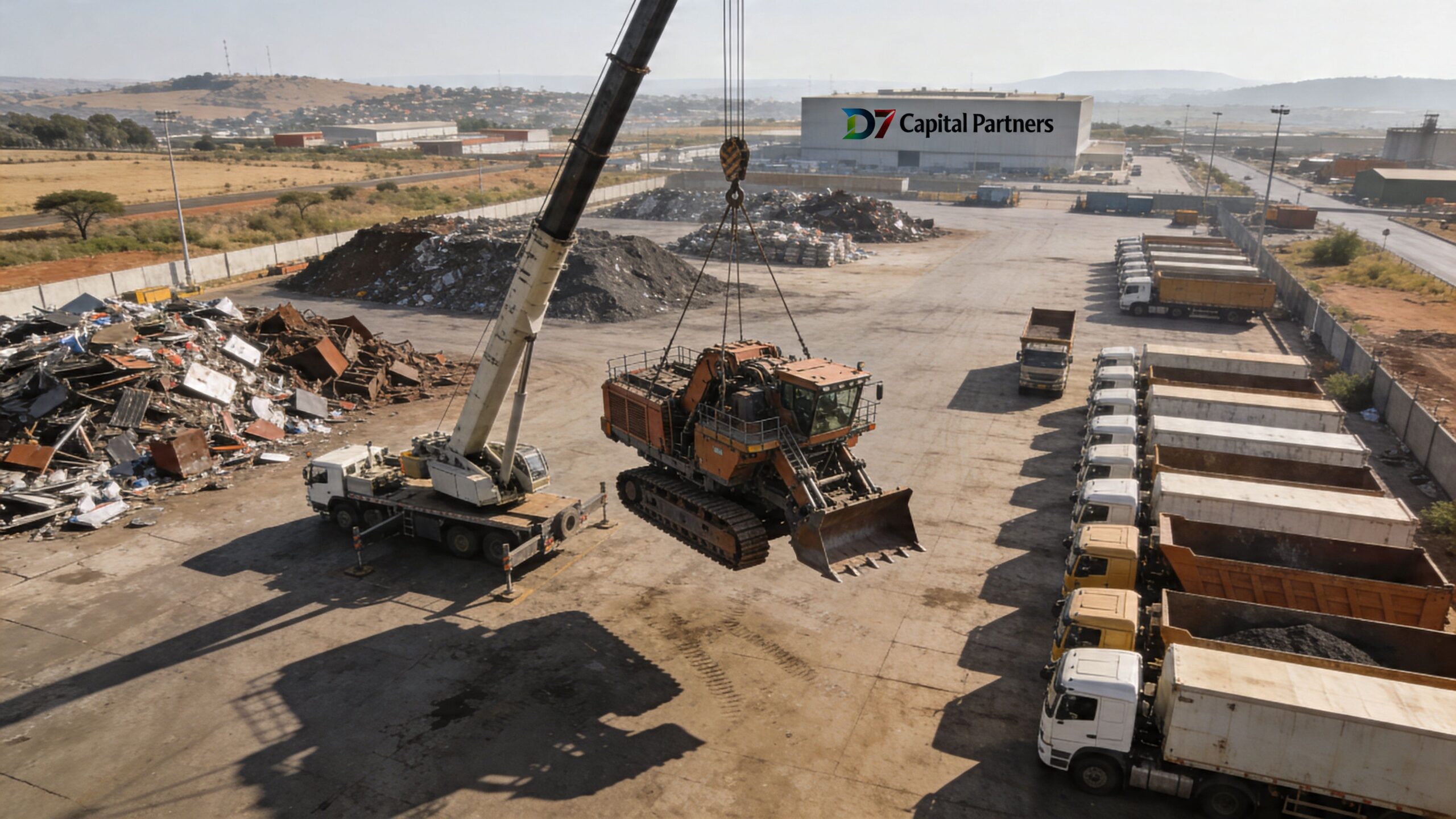
Industrial clients require more than basic vehicle dismantling. They need partners who can handle bulk ferrous and non-ferrous metals to specific ISRI grades such as 201, 204, and 236, provide transparent market-linked pricing for multi-ton contracts, and manage logistics for factory and site clearances, as outlined in this discussion of responsible scrap yard services.
What industrial jobs actually involve
A large-scale disposal often has multiple streams moving at once. The vehicles are only one part of the problem.
Typical job requirements include:
- Fleet disposal: Cars, bakkies, trucks, trailers, and damaged units.
- Machinery removal: Redundant plant items, frames, tanks, and production equipment.
- Demolition recovery: Structural steel and mixed demolition scrap.
- Commodity sorting: Segregation into ferrous and non-ferrous grades fit for trade.
- Logistics control: Loading equipment, bins, trucks, site sequencing, and traffic planning.
This is why a purely retail spares operation often isn’t the right fit for industrial clients. The commercial challenge is not just resale. It’s orchestration.
What a specialised B2B scrap partner should provide
For industrial and municipal work, the service should be built around control. That means the partner should be able to assess the site, identify recoverable material, plan removals, and keep the paperwork aligned with the movement of assets.
The essentials usually include:
| Need | Why it matters to the client |
|---|---|
| On-site evaluation | Confirms access, load type, and recovery route |
| Grading capability | Helps separate commodity metal from mixed waste |
| Removal logistics | Prevents bottlenecks on active sites |
| Destruction and disposal records | Supports governance and internal compliance |
| Market-linked pricing logic | Helps clients understand settlement on larger volumes |
Where D7 Capital Partners fits
For clients dealing with mixed industrial loads rather than a single consumer vehicle, D7 Capital Partners (Pty) Ltd operates in Johannesburg and handles scrap metal recycling, structural demolition, total waste management, and the processing of ferrous and non-ferrous grades including ISRI specifications, HMS 1 & 2, cast iron, PNS, and other industrial scrap streams.
That matters when the job doesn’t fit neatly into a “scrap car” category. A decommissioning project might require vehicle removal, demolition recovery, site bins, grab truck support, and separation of non-ferrous material before final settlement. Treating those as separate vendors often slows the job down and weakens accountability.
Commercial clients usually get better outcomes when one operator can manage the removal logic, the grading logic, and the compliance trail together.
The practical difference
A consumer transaction asks, “What will you pay for this car?” An industrial transaction asks different questions.
- Can you clear the site without stopping operations?
- Can you separate saleable metal from general waste?
- Can you handle fleet units and structural scrap in the same programme?
- Can you work to grade requirements expected by downstream buyers?
- Can you provide records that stand up internally?
That’s the gap many Johannesburg businesses run into. The market has plenty of vehicle-focused operators. Fewer are set up for plant closures, contractor clearances, municipal stock, or mixed recovery projects where scrap is one part of a larger operational problem.
Conclusion A Final Word on Responsible Scrapping
Vehicle scrapping in Johannesburg isn’t a side task. For business owners, fleet managers, contractors, and facilities teams, it’s an asset recovery process with compliance, environmental, and financial consequences.
The pattern is consistent. Good outcomes come from three things. Clean documentation, clear valuation logic, and an operator whose process is organised from intake to final removal.
If a vehicle still has parts value, it should be assessed properly. If it belongs in metal recovery, it should move through a compliant chain with the right records attached. If the job is larger than a single vehicle, the disposal plan should match the scale of the site and the complexity of the material.
Responsible scrapping protects more than the balance sheet. It protects your audit trail, your site safety, and your reputation. In a market as active and varied as Johannesburg, that’s what separates a quick clear-out from a controlled commercial result.
If you need a practical partner for fleet disposal, industrial scrap recovery, demolition-linked metal removal, or broader waste handling, D7 Capital Partners (Pty) Ltd provides Johannesburg-based support for commercial and municipal projects with a focus on compliant removal, material recovery, and operational efficiency.