
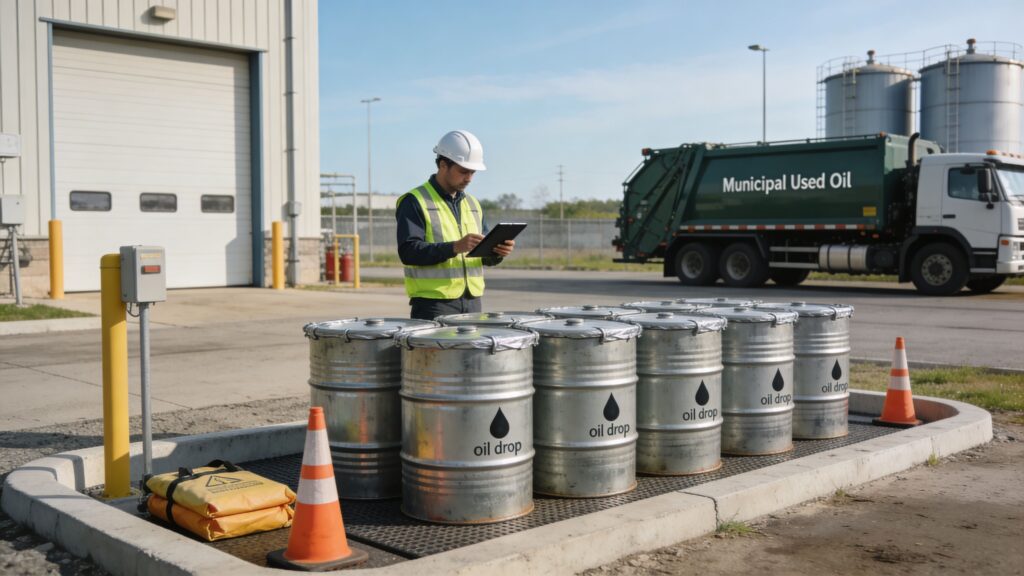
A lot of South African facilities are closer to a used oil problem than they realise. The warning signs are usually ordinary. A half-full drum standing outside a workshop bay. Oil-stained scrap waiting for collection. A maintenance team pouring different streams into the same container because it seems easier on a busy day.
Then the risk lands all at once. An inspection. A spill after rainwater gets into storage. A transporter asks for paperwork nobody can find. At that point, used oil stops being a background issue and starts disrupting operations, procurement, compliance, and site safety.
The good news is that a professional used oil collection programme is practical to build if you treat it as an operational system, not a once-off clean-up. The strongest programmes don't isolate used oil from the rest of the yard. They connect it to maintenance routines, scrap handling, dispatch planning, contractor controls, and recordkeeping. That matters in South Africa, especially on industrial and municipal sites where oil and metal often move through the same spaces.
Transforming Used Oil from Liability to Asset
A facility manager usually meets used oil in one of two ways. Either it's already organised and collected as part of routine maintenance, or it's sitting in pockets across the site, hidden in drip trays, temporary drums, mobile equipment areas, and oil-soaked scrap.
The second situation is far more common than people admit. It also creates the biggest gap between risk and value.
Used oil is not just messy waste. In South Africa, used oil is classified as hazardous under NEM:WA, and non-compliance fines reached R10 million in 2025 according to this used oil collection overview. In the same source, only 15% of Johannesburg fabricators are noted as integrating oil recovery with scrap processing, which means many sites are still treating oil and metal as separate problems when they are operationally linked.
Where sites lose control
The failure point is rarely the big storage tank. It's the handoff before that.
Typical weak spots include:
- Maintenance bays: Oil drained into open pans, then transferred late.
- Scrap staging areas: Oily motors, gearboxes, and steel sections parked with no extraction step.
- Public works depots: Mixed equipment streams from workshops, pumps, generators, and road maintenance units.
- Shutdowns and demolitions: Temporary work creates temporary habits, and temporary habits become compliance failures.
If your site handles both scrap and lubricants, separating those workflows too aggressively creates blind spots. A better approach is to recover oil before metal leaves the yard, then route each stream into its own documented path. That same principle applies whether you're managing a fabrication plant, a municipal depot, or a demolition project.
The operational upside
A disciplined programme changes the conversation internally. Operations sees less clutter. Maintenance gets clearer procedures. Procurement has fewer emergency callouts. Compliance gets traceability. Finance can finally separate avoidable loss from managed waste.
For industrial teams already recovering metal value, the logical next step is to review how oil-bearing materials are handled alongside reclaimed materials workflows. That doesn't turn used oil into a profit centre overnight. It does stop value from leaking out through poor storage, contamination, and missed recovery opportunities.
Used oil becomes manageable the moment someone owns the chain from drain point to final receipt.
A good programme starts with one practical shift. Stop asking, "How do we dispose of this?" Start asking, "Where on site is used oil created, where does it mix with other streams, and who signs off each movement?"
Navigating South Africa's Regulatory Framework
Compliance has to sit underneath every used oil collection decision. If it doesn't, the programme looks tidy on the surface while carrying legal and operational exposure underneath.


What the law means on the ground
Under NEM:WA, used oil is hazardous waste. For a generator, that translates into a simple principle. You remain responsible for the waste stream until it has been properly transferred, transported, and processed through legitimate channels.
That means your programme should be built around clear control points:
- Identify where used oil is generated
- Store it in a designated, controlled area
- Use licensed transporters and processors
- Document each off-site movement
- Keep records that can stand up in an audit
Many sites make a costly mistake in this area. They assume collection starts when the truck arrives. It doesn't. Collection starts when oil leaves the machine, gearbox, hydraulic unit, sump, or contaminated component.
Generator duties that cannot be outsourced
You can outsource transport and processing. You can't outsource accountability for poor site practice.
For industrial generators and municipal depots, the practical checklist is straightforward:
- Appoint site responsibility: Name the person who signs manifests, checks storage integrity, and approves pickups.
- Control access: Don't let every workshop worker improvise storage decisions.
- Segregate hazardous streams: Used oil should not drift into general waste, stormwater systems, or mixed liquid waste.
- Verify contractors: Ask for licensing, permits, and proof of downstream handling.
- Retain documentation: Keep manifests, pickup receipts, and internal logs together.
A site with weak paper control usually also has weak physical control. The opposite is true as well. When the records are clean, the yard usually is.
Practical rule: If a drum, tank, or IBC doesn't have an owner, a label, and a destination, it isn't under control.
Municipal pressure is increasing
Municipal and public works teams face a sharper challenge because they often manage dispersed assets, mixed fleets, and remote depots. The compliance burden isn't theoretical. It is moving into collection targets and programme design.
According to this note on used oil programme obligations, the 2025 EPR regulations mandate municipalities to achieve a 70% used oil collection rate by 2027, yet compliance in provinces like Limpopo and KZN hovers around 22%. Whether you're running a city depot or supporting public works contractors, that gap tells you one thing clearly. Informal or ad hoc collection won't get the job done.
A practical compliance file
Most facilities overcomplicate the legal side and underbuild the operating file. Keep one live compliance file, digital or physical, with the same structure across every site.
| Compliance item | What to keep on file | Why it matters |
|---|---|---|
| Site inventory | List of tanks, drums, drain points, and generation areas | Shows you know where the hazardous stream originates |
| Contractor pack | Licences, permits, insurance, emergency contacts | Confirms the collector is legitimate |
| Manifest records | Signed copies for each load | Maintains cradle-to-grave traceability |
| Incident records | Spill logs, corrective actions, photos | Proves you respond and improve |
| Training evidence | Attendance records and toolbox topics | Demonstrates operational control |
For sites already handling multiple recoverable materials, it's smart to align used oil controls with wider metal waste management in Johannesburg practices so dispatch, segregation, and documentation don't run as separate systems.
What inspectors usually notice first
Inspectors and auditors often spot the basics before they ask for anything technical.
They look for:
- Unlabelled containers
- Storage in traffic areas
- Signs of leakage or rain ingress
- Mixed streams
- No visible paperwork trail
- Confusion over who manages collections
A compliant programme doesn't need to be complicated. It needs to be deliberate. If your site can answer three questions at any moment, you're on solid footing: what used oil you have, where it's stored, and where it's going next.
Designing Your On-Site Collection Infrastructure
Infrastructure decides whether your used oil collection programme stays clean or slowly collapses under contamination, clutter, and avoidable handling errors.
The design principle is simple. Build the collection point so the right action is the easiest action.
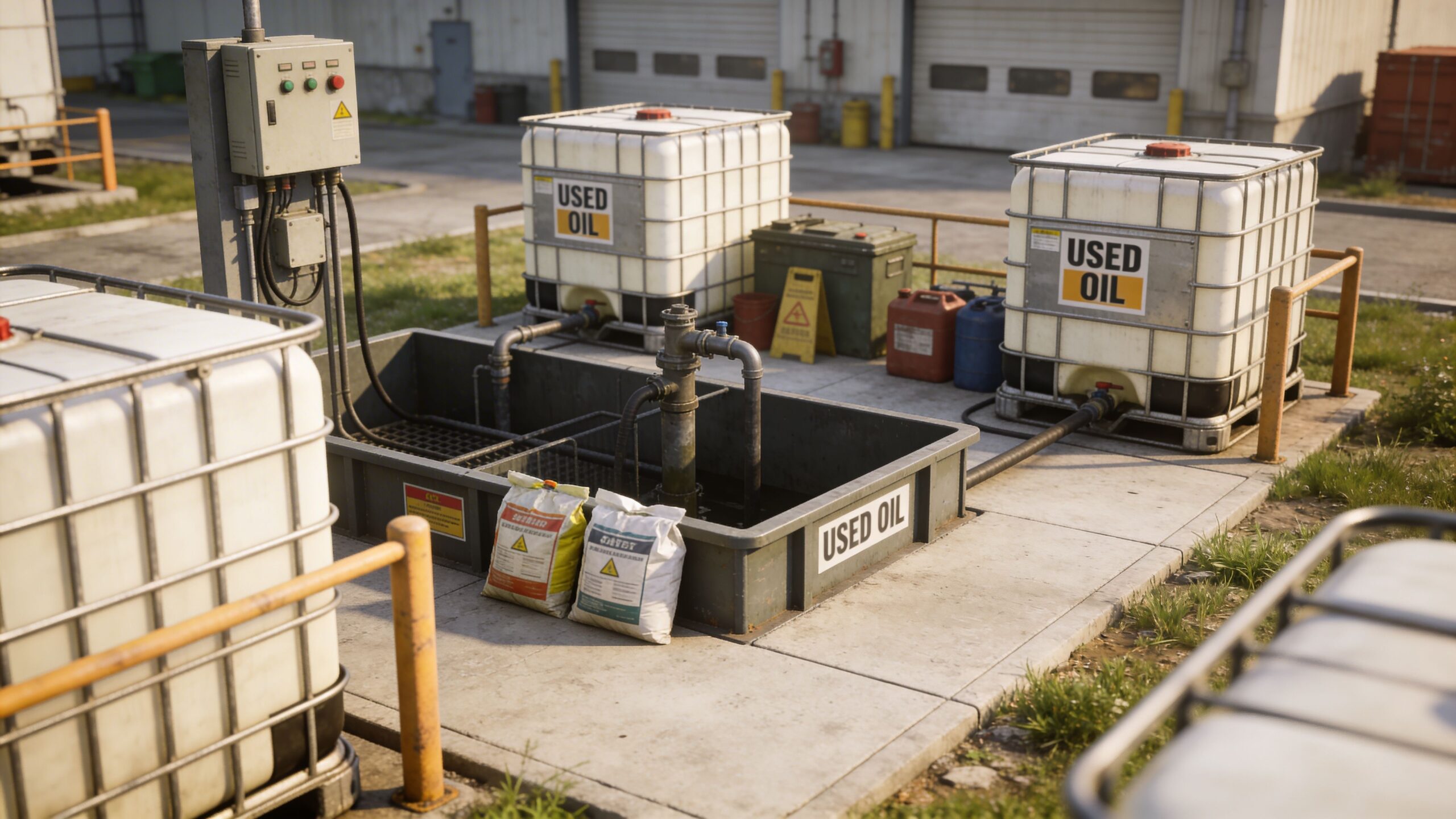
Start with the storage area, not the tank size
Many teams start by asking what container to buy. The better question is where the storage area belongs.
Choose a location that is:
- Accessible for internal transfer
- Safe from forklift strikes and vehicle traffic
- Protected from rain and runoff
- Away from stormwater inlets
- Close enough to generation points that staff will use it
A perfect tank in the wrong place still creates spills, shortcuts, and non-compliance.
For a small workshop, a compact designated area with secure containers, spill response equipment, and clear signage may be enough. A larger plant usually needs satellite collection points feeding into a central storage zone. Municipal yards often need the same model because plant, fleet, and workshop activities don't happen in one building.
Sealed tanks matter more than people think
One of the most expensive mistakes in used oil collection is allowing water into the stream. Sealed tanks compliant with South African National Standards are critical, because water contamination can cause a 15 to 20% volume loss through emulsification and reduce re-refining yield by 25%, as outlined in this used oil management reference.
That changes storage design immediately.
Your primary tank or container setup should include:
- Sealed lids or closed-top storage
- Controlled fill points
- Weather protection
- Secondary containment
- Visible labelling for the exact stream
Don't leave funnels open in the rain. Don't store "temporary" drums without lids. Don't assume a roof alone prevents water ingress. Condensation, poor seals, and bad transfer habits all create the same problem in the tank.
Rainwater is not a minor quality issue. On a used oil site, it is a value-destroying contaminant.
Keep streams apart before they become a problem
Segregation is not admin. It is economics and safety.
At minimum, separate:
- Vehicle service oils
- Industrial lubricants
- Hydraulic oils
- Contaminated oily residues from scrap recovery
- Any non-oil liquids that may be mistaken for oil
Sites lose control when staff use one "waste oil drum" for everything. Once coolant, solvents, wash water, or heavily contaminated residues are mixed in, the whole batch can move from recoverable material to disposal burden.
A layout that works in practice
A functional collection zone usually includes these physical elements:
| Infrastructure element | Practical purpose | Common failure if missing |
|---|---|---|
| Designated drain and transfer point | Gives staff one approved place to decant | Oil gets transferred in random work areas |
| Main storage tank or containers | Consolidates volume safely | Too many scattered drums |
| Bunded or contained base | Captures leaks and overfills | Small spills spread into the yard |
| Signage and labels | Removes ambiguity | Staff mix streams |
| Spill kit nearby | Enables immediate response | Minor incidents become reportable messes |
| Locked or controlled access | Prevents tampering and informal dumping | Unauthorised materials appear in the tank |
Fit the design to the operation
A fabrication yard handling oily scrap has different needs from a municipal workshop.
For fabricators and processors, place oil extraction near the scrap receiving or dismantling area. Recover drainable oil before items join the metal stream.
For factories, connect satellite drip stations to routine preventive maintenance. If technicians have to walk too far with open containers, they'll improvise.
For public works depots, standardise storage points across sites. A small remote depot should mirror the same labels, transfer tools, and sign-off rules used at the main yard.
Build for inspection and pickup
Your collector should be able to access the storage area without driving through your highest-risk operating zone. Keep the route clear, the containers identifiable, and the pickup point consistent.
That sounds basic, but it reduces rushed loading, misidentified containers, and disputes over quantities or stream quality.
A strong storage design does three jobs at once. It protects the site, preserves the quality of the oil, and makes collection routine instead of disruptive.
Implementing Safe Handling and Logistics Workflows
Once the storage area is in place, the programme lives or dies in daily handling. Good infrastructure can still fail if the workflow is loose.
The strongest sites use a chain of custody mindset. Every litre has a source, a transfer method, a storage destination, and a document trail.
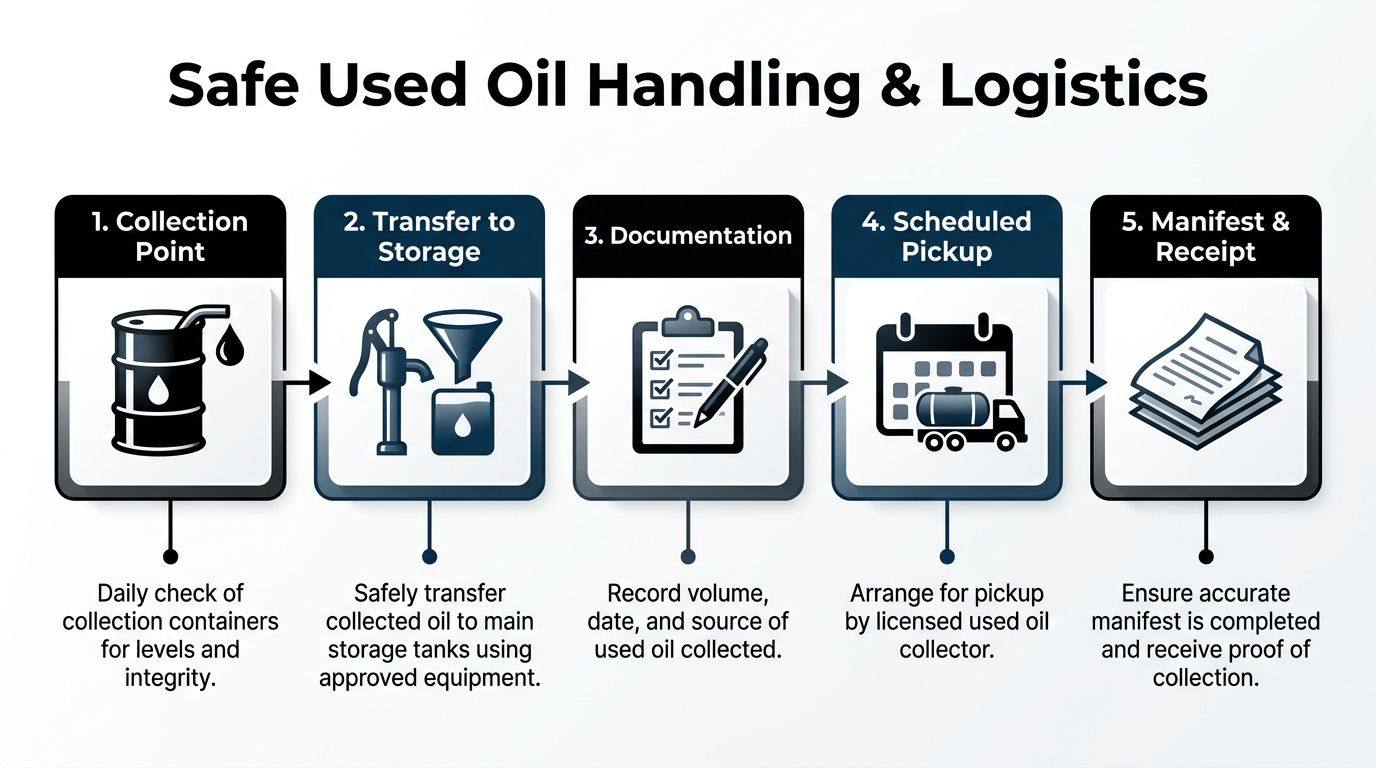

Build the workflow from the machine outward
Start at the drain point, not the gate.
A practical workflow often looks like this:
Drain and capture
Use approved trays, drain units, or collection vessels sized for the task. Don't let oil pool on the floor while someone looks for a container.Transfer under control
Move oil using pumps, funnels with lids, or other approved transfer equipment. Open pouring from awkward containers is where many spills start.Segregate immediately
Staff should know which stream goes where before they begin the task, not after the drum is already filled.Record the movement
Log the date, source area, estimated volume, and operator or department.Prepare for pickup
Store consolidated material in the designated area with labels intact and access ready for collection.
The value of this approach is cumulative. A site with disciplined small transfers usually also has fewer major incidents.
Training that focuses on decisions
A lot of toolbox talks stay too general. Staff don't need a lecture on why pollution is bad. They need to know what to do when they have a drain pan in one hand and three containers in front of them.
Train around decisions such as:
- Which container this stream belongs in
- What to do if water or another liquid is present
- How to report a leaking drum or valve
- Who signs off unusual or heavily contaminated loads
- When to stop and escalate instead of guessing
Short, repeatable rules work better than long policy documents on the workshop wall.
If an operator can't tell the difference between "recoverable used oil" and "mixed liquid waste" in the moment, the site will eventually pay for that confusion.
Technical pre-processing can protect value
Industrial sites with enough volume or higher-grade streams may benefit from on-site pre-processing before off-site transfer. According to this technical reference on oil processing, 10 to 50 micron bag filtration can remove 90% of solids, while vacuum dehydration can remove 99% of water. The same source notes this can support re-refining yields of 66 to 75%.
That doesn't mean every site needs processing equipment. It means you should understand the trade-off.
When pre-processing makes sense
- High-value industrial oil streams
- Sites where metal fines regularly enter the oil
- Remote operations where transport quality matters
- Scrap-linked recovery points where dirty oil can be improved before haulage
When it may not
- Small dispersed volumes
- Highly inconsistent mixed streams
- Sites without trained operators or quality checks
- Facilities where basic segregation is still unreliable
Documentation should follow the physical movement
Recordkeeping works best when it mirrors the workflow. If the paperwork sits in an office disconnected from workshop reality, staff will backfill it later, and errors creep in.
Use a simple on-site logbook or digital register with fields for:
| Field | Why it matters |
|---|---|
| Date of transfer | Creates chronology |
| Source department or asset | Tracks generator origin |
| Stream type | Supports segregation |
| Container or tank ID | Ties the transfer to physical storage |
| Operator or supervisor | Confirms accountability |
| Pickup reference | Links internal records to off-site movement |
For wider site discipline, many of the same habits also improve other recovery streams covered in practical waste management tips. The key is consistency. Staff shouldn't have one method for scrap, another for oils, and a third for hazardous liquids if the systems can be aligned.
Collection day should not feel like an emergency
If pickup only happens when storage is overflowing, you've already lost control. Schedule collections based on operating rhythm, access, and storage thresholds.
A smooth pickup day has four features:
- Containers are labelled and accessible
- Manifest details are prepared in advance
- The collector knows what stream is being loaded
- The receipt is checked before the vehicle leaves
That last step matters more than people think. The manifest is not a ceremonial signature. It is your proof that the material left the site through the right channel.
Choosing Your Strategic Waste Management Partner
Too many organisations buy used oil collection the way they buy general consumables. They compare quotes, check availability, and move on. That approach usually creates hidden cost later.
A low-price collector can become an expensive problem if the paperwork is weak, the fleet is unsuitable, or the downstream handling is unclear. Used oil collection needs a partner who reduces risk while improving control.
What separates a collector from a partner
A collector removes material. A partner improves the whole system around it.
That difference shows up in the questions they ask. A basic collector asks how many litres are ready. A strategic partner asks what generated the oil, how it's stored, whether it's mixed with other streams, how pickups fit your production schedule, and what evidence you need for compliance files.
It also shows up in integration. On a busy industrial site, oil rarely exists alone. It sits alongside scrap metal, oily residues, shutdown waste, decommissioning waste, and workshop discards. A capable provider understands those intersections and plans collection accordingly.
The right partner doesn't just arrive with a truck. They help the site stop making the same handling mistake twice.
Waste Management Partner Evaluation Checklist
| Evaluation Criteria | What to Look For | Why It Matters |
|---|---|---|
| Licensing and permits | Valid authority to transport and handle hazardous waste | Protects your site from using the wrong contractor |
| Manifest discipline | Clear process for completing and returning paperwork | Preserves traceability |
| Fleet suitability | Vehicles and equipment matched to your site access and container types | Reduces loading risk and delays |
| Response capability | Ability to handle urgent pickups, spills, or abnormal loads | Keeps operations moving |
| Processing visibility | Credible explanation of where the oil goes after pickup | Confirms responsible downstream handling |
| Integration with other waste streams | Ability to coordinate with scrap, demolition, or industrial waste removal | Cuts duplication and yard congestion |
| Safety systems | Trained staff, PPE, emergency procedures, site induction compliance | Lowers incident exposure |
| Reporting quality | Receipts, logs, service records, and audit support | Helps your compliance team close the loop |
Questions worth asking before appointment
A good procurement meeting should include operational questions, not just commercial ones.
Ask things like:
- How do you handle mixed or contaminated streams?
- What documentation do you provide on pickup day?
- How do you manage collections from remote or constrained sites?
- Can you support shutdowns, outages, or demolition periods?
- How do you coordinate used oil with other recyclable or hazardous materials on the same site?
The strongest answers are specific. Vague assurances usually mean the system depends on whoever happens to be on shift.
Why integration matters on industrial sites
If your business already manages metal recovery, plant clean-outs, or decommissioning waste, using separate contractors for every stream often creates overlap. Trucks queue longer. Site contacts multiply. Documentation gets split. Responsibility becomes fuzzy.
An integrated approach to total waste management can simplify that by aligning collection windows, site rules, and reporting across related waste streams. That doesn't mean one provider must do everything. It means your chosen partner should understand how used oil collection fits the broader site material flow.
Price still matters. It just shouldn't be the deciding factor on its own. In hazardous waste, the cheapest visible quote can carry the most expensive hidden risk.
Measuring Success The ROI of Responsible Collection
A used oil collection programme should be measured like any other operational initiative. If you only track whether the tank was emptied, you miss the true business case.
The financial return comes from avoided loss, cleaner recovery, lower disruption, and stronger compliance control. The non-financial return often matters just as much, especially when customers, municipal stakeholders, insurers, and internal governance teams ask how waste is managed.

Track the programme with simple site metrics
Start with measures your team can maintain.
Useful indicators include:
- Volume collected by month
- Number of pickups completed as scheduled
- Incidents or spills linked to used oil handling
- Number of mixed or rejected loads
- Storage area inspection findings
- Manifest closure rate
- Oil recovered from scrap-linked activities
These don't need a complicated dashboard to be useful. They need consistency.
A back-of-the-napkin ROI method
Most facility managers can build a practical internal business case using this basic structure:
| ROI component | What to include |
|---|---|
| Avoided compliance cost | Fines exposure, incident response, cleanup, audit findings |
| Preserved material value | Cleaner oil, less contamination, better recovery potential |
| Reduced operating loss | Fewer spills, less rework, less time spent managing ad hoc collections |
| Logistics efficiency | Better pickup planning, fewer duplicated contractor visits |
| Scrap synergy | Oil removed before scrap dispatch, cleaner material handling |
The formula itself doesn't need to be complex. Compare the annual cost of containers, signage, training, inspections, transfers, and collections against the combined value of avoided failures and improved recovery.
The market context supports long-term thinking
This isn't a niche side issue. The global waste oil market was valued at USD 36.20 billion in 2026 and is projected to reach USD 49.89 billion by 2033, according to this waste oil market analysis. For South African operators, that matters less as a headline and more as a signal. There is a substantial and growing value chain around proper collection, processing, and reuse.
A site that protects oil quality and documents its stream properly is better positioned to participate in that value chain than one that stores mixed, watered, poorly identified waste.
The strongest savings are often indirect
Many of the benefits won't appear on a single waste line item.
You may see them in:
- Cleaner yards and fewer housekeeping hours
- Less downtime after leaks or poor transfers
- Simpler shutdown planning
- Easier customer audits
- Stronger ESG reporting
- Better internal confidence between maintenance, SHEQ, and finance
Those gains are true even when they are harder to isolate in a monthly report.
Good used oil collection rarely feels dramatic. It shows up as fewer surprises, cleaner records, and less time spent fixing preventable problems.
Don't ignore the reputational return
Industrial buyers, municipal stakeholders, and international trading partners increasingly look past broad sustainability claims. They want to know whether operational controls are credible.
A site that can demonstrate designated storage, documented transfers, contractor verification, and integrated recovery with scrap handling presents itself differently from a site relying on verbal assurances. That affects trust.
For municipalities and public works departments, the reputational return is even more practical. Clean depots, traceable waste streams, and fewer visible handling failures strengthen public accountability. For manufacturers and fabricators, they support customer due diligence and procurement questionnaires. For demolition and decommissioning teams, they reduce disputes over scope and environmental responsibility.
What success looks like after implementation
A successful programme doesn't mean you never have a spill risk, quality issue, or contractor query again. It means the site can identify problems early and correct them through a stable system.
Look for these signs:
- Operators use the right containers without prompting
- Pickup scheduling follows site needs, not panic
- Records are easy to retrieve
- Oil-bearing scrap is treated as a recovery opportunity, not just dirty metal
- Supervisors can explain the process without guessing
That is the true return. Not a theoretical environmental statement, but a controlled, repeatable operating practice that protects compliance and supports value recovery.
If your site needs a practical, integrated approach to used oil collection, scrap recovery, demolition waste, and compliant industrial waste handling, D7 Capital Partners (Pty) Ltd can help you build a system that works on the ground. Their team supports industrial, commercial, and municipal clients across South Africa with recovery-focused, compliance-minded waste solutions that reduce risk and improve operational control.