You’re probably reading this because you’ve seen tanker truck driver jobs advertised, or you’re already driving general freight and want to move into a better specialised role. In South Africa, that move isn’t just about changing trailers. It means stepping into work where one bad decision at a loading bay, weighbridge, refinery, plant, landfill, or demolition site can shut down an operation and put people at risk.
That’s why tanker work sits in a different category from ordinary line-haul driving. In industrial services, waste management, fuel movement, chemical handling, and site recovery, a tanker driver has to think like a driver, operator, safety officer, and paperwork controller at the same time. You don’t get paid to move a vehicle alone. You get paid to move a risky load without incident, without contamination, without leakage, and without exposing the company or client to avoidable liability.
The Critical Role of Tanker Drivers in South Africa
A tanker driver in South Africa often starts the day long before the engine turns over. On an industrial site, the critical work begins at the gate. The driver checks access conditions, confirms the load class, reviews site safety instructions, and makes sure the tank, hoses, valves, seals, and documents all match the work order. That’s standard practice in waste, chemical, mining, and recovery operations.
Local tanker truck driver jobs are far from generic transport roles. They support critical sectors that keep plants running, remove hazardous liquids from worksites, and connect demolition, recycling, and waste streams to compliant processing routes. If that chain breaks, the problem doesn’t stay on the road. It hits production, safety, environmental compliance, and client confidence.
Most online material about tanker driving still leans on US job data rather than South African conditions, which leaves a real information gap for local drivers and employers. The gap matters because demand here is shaped by mining, fuel, industrial waste, and specialised logistics rather than the same market conditions described in broad overseas guides. That’s one reason operators involved in total waste management services need drivers who understand local site realities, not just general trucking advice.
Why these roles carry more responsibility
A tanker driver doesn’t have the luxury of treating the truck as a simple delivery vehicle. Liquid loads move differently. Site rules differ by industry. Documentation standards can change by cargo type. On some jobs, the driver has to coordinate with plant supervisors, safety reps, and offloading staff before a valve is even opened.
The strongest drivers in this field usually show three habits:
- They slow down before the risk point: Corners, ramps, site entrances, weighbridges, and uneven yards are where avoidable mistakes happen.
- They treat paperwork as part of safety: Load declarations, route instructions, permits, and handover documents protect the driver as much as the company.
- They understand the cargo, not just the route: Waste liquid, fuel, slurry, and chemical byproducts don’t behave the same way.
Tanker work rewards calm judgement. The drivers who last are rarely the fastest. They’re the most controlled.
Why local guidance matters
If you’re looking at tanker truck driver jobs in South Africa, you need guidance that reflects local licensing, local compliance, and local site conditions. Advice built around foreign CDL systems won’t help much when you’re dealing with PrDP requirements, SANS standards, hazardous goods controls, and industrial clients who expect discipline from the moment you enter the gate.
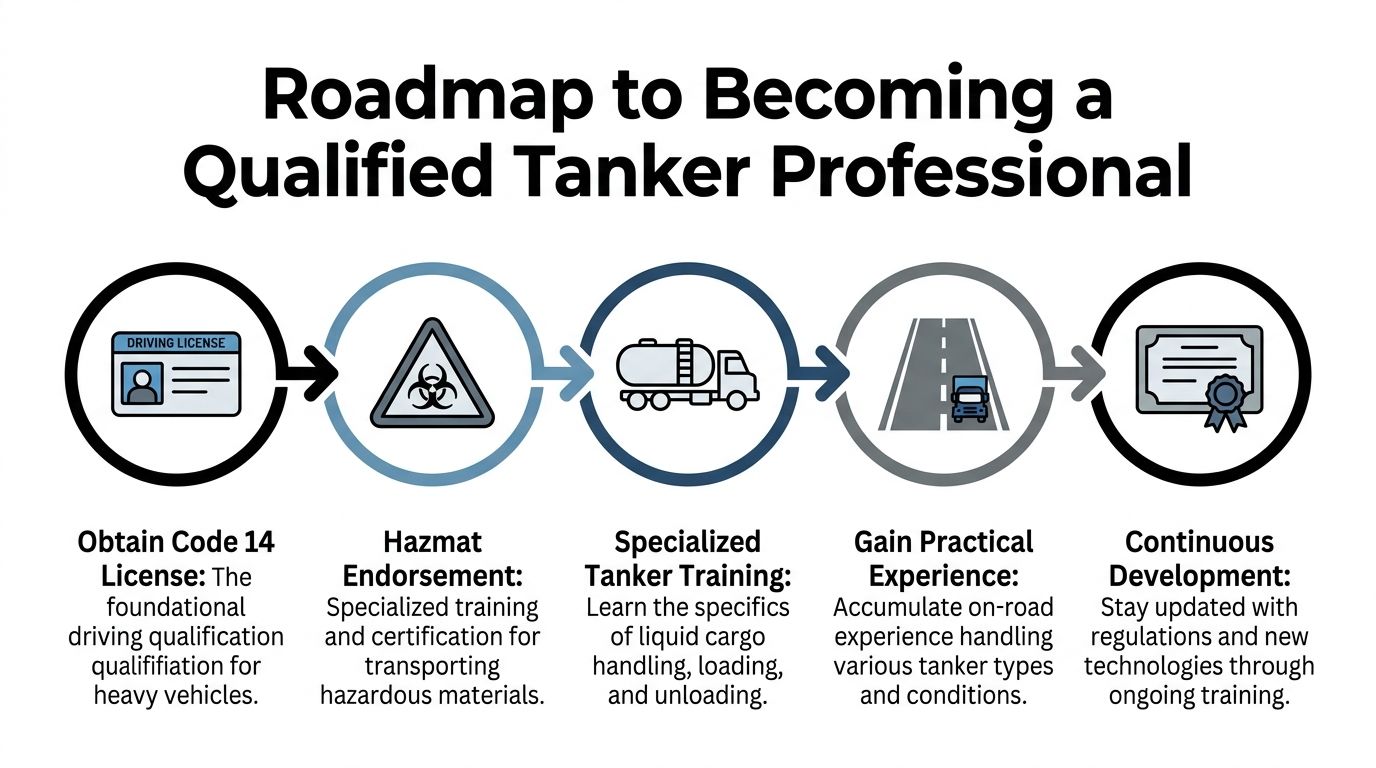
Your Roadmap to Becoming a Qualified Tanker Professional
A driver arrives at a chemical plant with the right licence, but the gate supervisor still turns him around. His PrDP is out of date, he cannot answer basic questions about offloading sequence, and he has never worked under a hazardous site induction. That happens more often than new applicants expect. In South African tanker work, the licence gets you considered. Compliance and site-ready discipline get you hired.
Start with the correct heavy vehicle foundation
The first step is the legal one. You need the correct heavy vehicle licence route under the National Road Traffic Act, and for most tanker roles that means building toward Code 14 with the right testing and supporting documents in place.
That is only the start.
Tanker employers in fuel, chemicals, industrial services, and liquid waste do not treat this as general freight with a round tank on the chassis. They want drivers who understand how liquid loads shift under braking, on cambers, and through site turns. Generic foreign advice about "tanker endorsements" is not much use here. South African employers usually screen for local requirements such as PrDP status, dangerous goods competence where applicable, and familiarity with site procedures shaped by SANS standards and client rules.
Build the qualifications employers actually check
A workable checklist for specialised tanker truck driver jobs usually includes:
- The correct heavy vehicle licence
- A valid PrDP that matches the work
- Dangerous goods training if the cargo requires it
- Medical fitness and supporting documents in order
- Practical tanker handling exposure
- Basic understanding of client systems such as RTMS where fleet operators use them
The trade-off is simple. Some drivers spend money collecting certificates and still struggle to get shortlisted because they cannot explain how those certificates apply on the road or at a customer site. A hiring manager will ask practical questions. How do you approach a partially filled tank? What do you check before offloading? What changes when you are entering a refinery, treatment works, or hazardous waste facility? If the answers are vague, the paperwork will not carry you.
What good practical training looks like
Good training schools and in-house mentors teach routines that hold up outside the test yard. That matters in South Africa because tanker work often crosses public roads, industrial plants, municipal sites, and waste facilities in the same week.
Drivers should leave training able to handle:
- Pre-trip inspections: tank shell condition, valves, hoses, couplings, seals, tyres, brakes, placards, and leak points
- Surge control: smoother braking, wider safety margins, and better speed judgement on corners, ramps, and uneven entrances
- Loading and discharge procedure: confirming product, checking line-up, following sequence, and communicating clearly with site staff
- Emergency response basics: isolating the area, reporting correctly, and avoiding improvisation during spills or leaks
- PPE and site induction discipline: following plant instructions without shortcuts
One sentence tells me a lot about a driver. If he can describe reversing technique but cannot explain surge, venting, hose integrity, or shutdown procedure, he is not ready for serious tanker work.
Get experience that transfers into tanker operations
General heavy vehicle experience still counts, especially if it comes from bulk haulage, construction support, mining service routes, municipal contracts, or plant transport. Those environments teach patience at gates, attention to weighbridge process, and mechanical sympathy. They also expose drivers to the stop-start reality of industrial work, where rushing usually creates the problem.
The strongest entry route is often sideways, not straight in. A driver may start in tipper work, move into vacuum tanker support, then step into chemical or liquid waste operations once he has shown he can follow procedure. That progression is common in the South African industrial and waste sector. For a sense of the kinds of client environments that expect this level of discipline, review the range of industrial service operations active in the market.
A practical pre-application check
Before applying, check your position against what employers usually verify:
| Requirement | What employers want to see |
|---|---|
| Licence status | Correct heavy vehicle licence completed, not still in upgrade process |
| PrDP | Current and valid for the role |
| Dangerous goods readiness | Training matched to the material being moved |
| Tanker knowledge | Clear understanding of surge, loading, offloading, spill control, and shutdown steps |
| Site compliance | Ability to work under induction, PPE rules, permit systems, and customer instructions |
| Work record | References that confirm safe, steady behaviour under pressure |
Drivers who can show all six walk into interviews in a stronger position. They sound more credible because they understand the job as South African employers run it.
Crafting a CV for Specialised Driving Roles
A hiring manager in Secunda, Durban, or on a waste contract in Gauteng can spot a generic CV in seconds. If the document reads like long-haul linehaul work with the word “tanker” added at the end, it usually goes to the bottom of the pile. Specialised tanker truck driver jobs in South Africa are tied to risk control, site discipline, and paperwork accuracy. Your CV needs to show that clearly.
I screen tanker CVs for operational detail first. Licence class matters, but it is only the start. A stronger CV shows that the driver understands compliance terms used on South African sites, can work within customer rules, and has handled the realities of loading, discharge, hose management, spill response, and documentation without supervision.
What to put near the top
The top third of the CV should answer three practical questions fast:
- What licence, PrDP, and dangerous goods training do you currently hold?
- What type of tanker work have you done?
- Which sites or industries have you worked on?
State the facts plainly. For example, list vacuum tanker work, industrial waste collection, chemical transfer support, refinery access, plant shutdown work, or wastewater operations only if you have done them. Include relevant compliance language where it is true and specific, such as SANS 10228 familiarity, permit-to-work exposure, PPE compliance, incident reporting, pre-loading checks, and controlled handover procedures.
That kind of wording helps because employers are not hiring a driver only to move product from one point to another. They are hiring someone who can protect the client site, the public road, and the load.
Bullet points that sound credible
Your work history should describe the job as it is done on site. Generic phrases waste space. Use bullet points that show the level of control expected in industrial and waste operations:
- Completed pre-trip and post-trip tanker inspections, including hoses, valves, couplings, seals, tyres, and basic defect reporting.
- Worked under client induction, permit, and PPE requirements on industrial plants, demolition sites, treatment facilities, and waste-handling operations.
- Handled loading and offloading paperwork accurately, including delivery notes, waste manifests, and handover sign-off where required.
- Followed loading, discharge, and shutdown procedures without bypassing isolation, containment, or spill-control steps.
- Communicated with site supervisors, controllers, and plant operators before entering restricted work areas or starting transfer operations.
If you want to see the kind of operational environment many employers in this sector work in, review recent industrial services and logistics insights on the D7 Capital blog.
What recruiters notice immediately
Recruiters and transport managers usually pick up the same weak points:
| CV mistake | Why it hurts you |
|---|---|
| Listing only licences and vehicle codes | It suggests no real understanding of tanker operations or client-site rules |
| Hiding PrDP, dangerous goods training, or compliance knowledge deep in the CV | Screeners often make a decision from the first section |
| Using vague phrases like “hard-working” or “team player” | These say nothing about whether you can handle controlled loads safely |
| Claiming experience with chemicals or hazardous waste without examples | Interview questions will expose it quickly |
One sentence can strengthen the whole document. “Delivered industrial liquid waste to treatment facilities under site induction, PPE, manifest control, and discharge procedure requirements” says far more than “transported loads safely.”
A strong tanker CV reads like a record of controlled work. That is what employers in the South African industrial and waste sector want to see.
Where to Find Tanker Jobs and How to Win the Interview
Most drivers look for tanker truck driver jobs in only one place. They scroll a job board, send a CV, and wait. That approach misses a lot of real opportunities because specialised driving roles often move through industry networks, contract ramps, and operational hiring cycles rather than neat public listings.

A better approach is to think like an operator. Waste contracts expand. Industrial shutdowns create temporary transport needs. Municipal work changes route demand. Demolition and plant clean-outs often require specialist haulage support. Drivers who watch these patterns tend to find work faster than drivers who only wait for polished job ads.
Where the better openings usually appear
Use more than one channel at the same time:
- Major job portals: Useful for visibility, but filter hard for tanker, dangerous goods, waste, industrial, and vacuum tanker terms.
- Direct employer applications: Many firms keep a driver database even when they aren’t openly advertising.
- Municipal and contractor networks: Waste, water, and site-clearance work often follows contract awards and project mobilisations.
- Industry reading: Following South African industrial and logistics commentary helps you understand where projects, shutdowns, and operational demand are moving.
When you apply directly, tailor the CV and the email to the operation. A tanker operator doesn’t need a life story. They need to know whether you can handle the load, the paperwork, the hours, and the safety culture.
What interviewers test, even when they don’t say it
A good interviewer often cares less about your polished answer and more about whether you think like a safe driver. Expect questions around:
- Vehicle checks: What do you inspect before loading?
- Load behaviour: How do you drive a partially filled tanker differently?
- Site communication: What do you do if the site instruction conflicts with your paperwork?
- Incident response: What are your first actions if you suspect leakage?
If the company includes a driving assessment, they’ll usually watch your calmness more than your speed. Harsh braking, impatient cornering, and poor yard awareness are all bad signs.
Prepare for the practical test properly
Drivers often fail practical assessments because they treat them like ordinary road tests. In tanker work, assessors are watching for habits, not just vehicle control.
A useful preparation routine includes:
- Walk the vehicle systematically and speak your inspection out loud.
- Check couplings and hose areas carefully, not as an afterthought.
- Drive smoothly under changing speed conditions, especially on turn-ins and exits.
- Show site manners, including mirror use, pedestrian awareness, and stopping discipline.
Later in the process, it helps to refresh your understanding visually before an assessment or interview. This short clip is a practical way to get your head back into tanker operations and road behaviour.
If an interviewer asks about a mistake you’ve made, don’t try to sound perfect. Explain the lesson, the correction, and the control you use now. That answer usually lands better than bravado.
Understanding Salary Ranges and Contract Types in 2026
You get an offer for a tanker role in eMalahleni. The monthly figure looks strong until you ask three follow-up questions. How many nights out? How is overtime signed off? Which loads sit on that truck most weeks? In this sector, those details decide whether the job is sustainable or whether the pay only looks good on paper.
South African tanker pay does not sit on one clean national scale. Industrial chemicals, fuel, edible liquids, hazardous waste, and vacuum tanker work all price differently because the risk, paperwork, client controls, and working hours are different. Region also matters. A driver doing short-haul site work around Durban can be on a very different package from a driver covering long rural legs into mining or municipal contracts.
That is why experienced drivers compare the full package, not only the base salary.
What salary range usually means in practice
If a company advertises a high monthly figure, check what is carrying that number. It may include overtime, night shift allowances, dangerous goods work, weekend call-outs, or productivity targets tied to loads completed. In waste and industrial services, some of the harder jobs involve waiting time at plants, strict booking slots, and offloading delays that stretch a shift without improving your real hourly return.
The better-paying roles usually have at least one of these features:
| Experience Level | Typical Pay Position | What Usually Drives It |
|---|---|---|
| Entry-level tanker driver | Lower end of the employer’s pay band | Local routes, lower-complexity loads, close supervision, limited site discretion |
| Mid-career tanker driver | Middle of the pay band | Independent route handling, stronger documentation discipline, regular industrial site work |
| Senior specialised tanker driver | Upper end of the pay band | Hazardous or high-consequence loads, difficult client sites, shutdown work, mentoring juniors |
Use that table as a screening tool. Final pay still turns on the employer’s client base, shift model, and compliance burden.
A driver delivering product to a controlled refinery or collecting hazardous waste from an industrial clean-out is carrying more than liquid. The role includes site rules, permit checks, discharge discipline, and incident exposure. Companies doing specialist work such as industrial strip-out and structural demolition support services often need drivers who can operate inside tighter safety systems than general freight fleets.
Permanent, fixed-term, and owner-driver trade-offs
Permanent employment usually gives the clearest structure. You can expect set leave rules, formal disciplinary and incident processes, scheduled medicals where required by policy, and a more stable fleet standard. For many drivers, that consistency matters as much as the pay.
Fixed-term contracts are common around shutdowns, plant maintenance campaigns, municipal clean-ups, and once-off industrial projects. They can pay well for a defined period, especially where the client needs experienced hands quickly. The trade-off is simple. Good money for a few months can turn into a gap between contracts if the project pipeline dries up.
Owner-driver arrangements suit a smaller group than people think. On paper, the rate can look attractive. In practice, the operator carries tyre costs, maintenance planning, insurance, downtime risk, licensing administration, and the burden of keeping the vehicle acceptable to clients with strict entry standards. In tanker work, one failed inspection or one contamination issue can stop earning immediately.
Questions to ask before accepting an offer
Ask direct questions before you sign:
- What is the base salary, and what part of the package depends on overtime or allowances?
- Which cargoes make up most of the work. Fuel, chemicals, food-grade liquid, waste, or vacuum operations?
- Does the role require a valid PrDP and dangerous goods training from day one?
- How are nights out, standby duty, queue time, and delayed offloading paid?
- What standards govern the fleet and operation. Company SOPs only, or also SANS-aligned controls and RTMS requirements?
- What happens after a spill, inspection failure, or client complaint?
Clear answers usually point to a disciplined operator. Vague answers usually mean disputes later over pay, hours, or accountability.
A Guide for Employers Hiring Safely and Compliantly
A tanker arrives at a customer site at 06:30. The driver clears the gate, but the paperwork is incomplete, the placards do not match the load, and the site supervisor now has doubts about the driver’s understanding of the discharge procedure. That delay is not only an admin problem. In South African waste and industrial operations, it can become a safety incident, a client complaint, or a reportable compliance failure within minutes.

Employers who hire tanker drivers as if they were filling a general freight vacancy usually create problems for operations later. In the South African market, especially in hazardous waste, liquid chemicals, fuel, vacuum loading, and industrial cleaning work, the driver has to meet more than licence requirements. The role sits inside a compliance chain that can include a valid PrDP, dangerous goods training where applicable, site induction records, vehicle inspection discipline, and operating standards shaped by company SOPs, SANS requirements, and, in some fleets, RTMS controls.
A proper hiring process starts before the interview. The job spec should identify the actual operating environment. Long-haul fuel work, municipal waste collection, cross-border chemical transport, and industrial suction or discharge work do not require the same driver profile. Employers that stay vague at this stage often attract the wrong candidates and then try to fix the gap with rushed induction.
What a proper hiring process should include
The minimum safe process should cover:
- Licence and permit verification: Check the driving licence code, PrDP status, expiry dates, and any dangerous goods training records against originals.
- Reference checks that test safety behaviour: Ask former employers about incidents, near misses, loading discipline, site behaviour, paperwork quality, and whether the driver followed escalation procedure when something was wrong.
- A practical assessment tied to the actual job: Test pre-trip inspection quality, reversing control, coupling or hose-handling procedure where relevant, and calm road behaviour with liquid load movement in mind.
- Medical fitness and roster review: A medically fit driver can still become a risk if your shifts, standby system, or turnaround expectations are poorly managed.
- Document discipline: Check whether the candidate can complete logbooks, inspection sheets, delivery documents, and waste manifests correctly. Many dismiss this point until a client audit exposes it.
Shortcuts show up later as damaged equipment, rejected loads, contamination, missed defects, and poor client feedback.
Retention is part of operational control
High churn weakens standards. Experienced tanker drivers carry route knowledge, site-specific habits, customer expectations, and practical judgement that no induction file captures properly. In waste management and industrial services, that knowledge matters on confined sites, during offloading, and when conditions change halfway through a job.
Retention usually improves when employers fix ordinary operational irritants instead of running a morale campaign. Drivers stay longer where vehicles are maintained on time, defects are acted on, overtime rules are clear, and supervisors do not treat fatigue reports as excuses. Pay matters, but so does whether the company backs the driver when a site instruction is unsafe or non-compliant.
| Hiring and retention lever | Why it works |
|---|---|
| Clear shift and standby rules | Reduces fatigue exposure and arguments over hours |
| Structured onboarding | Builds consistency on paperwork, PPE, client rules, and reporting lines |
| Refresher training linked to real incidents | Corrects drift in standards before it becomes damage or a spill |
| Transparent pay and allowance rules | Prevents avoidable resignations over disputes that should have been settled at offer stage |
Match hiring standards to the work
Site conditions should shape the assessment. A driver who performs well on open-road line-haul may still struggle on a demolition project, at a waste transfer station, or inside a refinery-style permit environment. Employers working in those conditions should assess candidates against real tasks found in structural demolition and industrial site services, including restricted access, tight turning space, spotter communication, and strict separation between vehicles, pedestrians, and active plant.
The hiring principle is simple. In tanker operations, a cheap recruitment decision often becomes an expensive compliance failure.
Frequently Asked Questions About Tanker Driving Careers
A few questions come up repeatedly from drivers and employers. The answers below keep to the practical side.
| Question | Answer |
|---|---|
| Do I need tanker experience before I apply for tanker truck driver jobs? | Not always, but employers prefer candidates who already understand heavy vehicle discipline and site procedure. General freight experience helps if you can show strong safety habits and a willingness to learn specialist controls. |
| Is tanker work harder than ordinary truck driving? | Yes. The driving itself can be smoother when done properly, but the job carries more compliance, more site procedure, and more consequence if you get it wrong. |
| What should I mention first in an interview? | Start with your licence status, PrDP position, dangerous goods exposure if relevant, and the kinds of sites or loads you’ve handled. Then explain how you manage inspections and paperwork. |
| Are all tanker jobs hazardous goods jobs? | No. Some tanker roles involve non-hazardous liquids or industrial service work. But even non-hazardous tanker work needs stricter handling than standard dry freight because liquid loads affect vehicle behaviour. |
| Should a new driver accept a fixed-term tanker contract? | It can be a good entry point if the employer has proper supervision, decent maintenance, and clear safety systems. Don’t accept a contract only because the headline pay looks strong. |
| What makes one driver stand out from another? | Calm decision-making, clean documentation, respect for procedure, and the ability to work safely on industrial sites. Those traits usually matter more than flashy claims. |
If you’re pursuing tanker truck driver jobs, treat the role as a specialist trade. If you’re hiring, treat it as a safety-critical function. That mindset changes the quality of every decision that follows.
If your business needs a dependable partner for scrap metal recycling, demolition, or integrated waste logistics, D7 Capital Partners (Pty) Ltd brings practical South African operating experience, compliance-driven service, and a strong focus on safe industrial execution.