Metal scrap tends to become visible all at once. A plant shutdown is scheduled. A workshop yard is filling with offcuts. Redundant cable, old racking, damaged bins, failed machinery, stripped structural steel and mixed non-ferrous stock are sitting where productive space should be. At that point, most businesses don’t need a buyer in the abstract. They need a partner who can classify material correctly, remove it safely, document it properly and return the best possible value without creating compliance problems.
That’s where experienced scrap metal dealers separate themselves from simple collection operators. If you are comparing scrap metal dealers near me, scrap metal close to me or scrap metal yards close to me, the safest choice is a documented industrial partner rather than the nearest unverified yard. Their core function isn’t just taking metal off site. It’s building a controlled recovery process around value, safety, timing and legal traceability.
Scrap Metal Dealers Near Me: Beyond the Bin
When scrap is handled late, it usually costs more than people expect. Yards get congested. Forklift routes become messy. Mixed loads reduce value. Internal teams lose time trying to decide what can move, what must be isolated, and what paperwork is required before anything leaves site.
A modern scrap metal dealer solves that operational problem first. Collection is only one part of the work. The bigger function is asset recovery. That means identifying what has value, separating what shouldn’t be mixed, aligning removal with production or shutdown schedules, and making sure the material moves into the right downstream channel.
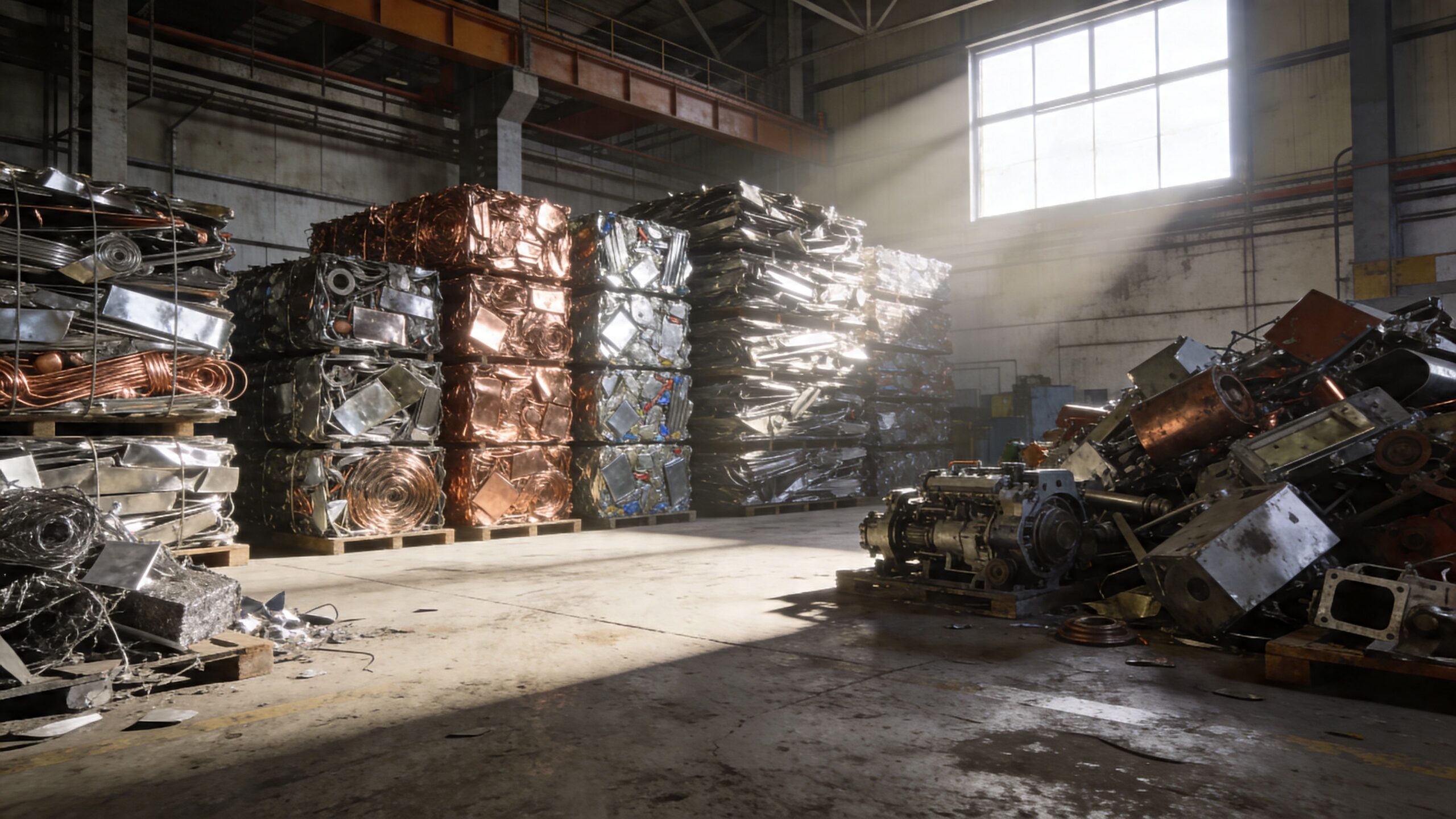
In South Africa, that role matters at national scale as well. The industry processes approximately 3.5 million tonnes of ferrous scrap annually, supplying about 45% of the raw material for local electric arc furnace steel production, and recycling scrap steel uses 74% less energy than primary production, according to this industry overview. For an industrial client, the practical meaning is simpler. Scrap isn’t just waste leaving your premises. It’s part of a supply chain that rewards good preparation.
What a strategic dealer changes on site
The old scrapyard model was mostly reactive. Material arrived, got weighed, and changed hands. Industrial clients now need more than that.
A strong dealer should help you improve:
- Material visibility: You need to know what is ferrous, what is non-ferrous, what is contaminated, and what needs separate handling.
- Operational flow: Collection must fit production realities, shutdown windows and contractor access.
- Compliance control: Every movement of material should be traceable and defensible.
- Commercial recovery: Clean, correctly sorted metal generally performs better than mixed, poorly handled loads.
Practical rule: If your scrap process starts only when the yard is full, you’re already losing value.
Why the partnership model works better
Industrial scrap is rarely uniform. A single site can produce turnings, plate offcuts, cable, stainless, demolition steel, obsolete equipment and non-metal contamination in the same week. Treating that stream as one pile creates friction at every step.
The better model is a standing relationship with a dealer who understands your site, your waste profile, your access constraints and your reporting requirements. That moves scrap management out of the “cleanup” category and into routine operations. It also gives procurement, maintenance, SHEQ and finance a shared process instead of separate handoffs.
That’s the fundamental shift. Professional scrap metal dealers don’t just remove metal. They help industrial clients recover value, reduce disruption and avoid preventable risk.
What to Expect A Full Spectrum of Scrap Management Services
Not every dealer offers the same depth of support. For an industrial or municipal client, the difference shows up in missed collections, mixed loads, poor grading, weak reporting and unsafe removals. A full-service operator should cover the entire chain from generation point to processed saleable material.
South Africa’s non-ferrous market shows how far the service model has matured. The country recycled 120,000 tonnes of copper in 2023, equal to 35% of apparent consumption, and the sector employs around 15,000 workers while generating over R12 billion in turnover, according to this metals recycling industry reference. That scale only works when yards, logistics teams, processors and compliance staff operate in a coordinated way.
Buying and sourcing
At the front end, scrap metal dealers buy recoverable metal from factories, fabricators, demolition contractors, municipalities and facilities with obsolete equipment. But the useful question isn’t “Do they buy scrap?” It’s “How do they assess and structure the stream?”
Good buying support includes:
- Material assessment at source: Before pricing, the dealer should identify likely grades, contamination risks and handling requirements.
- Separation advice: Clients often improve value by keeping stainless away from carbon steel, and insulated copper away from mixed non-ferrous.
- Volume planning: Ongoing generators need a recurring programme, not ad hoc spot clearances.
For example, a fabrication shop may generate steady ferrous offcuts and occasional stainless. A decommissioned plant may release a short-term surge of mixed structural steel, cable, motors and redundant process equipment. Those are different sourcing jobs and should be treated differently.
Processing and sorting
Value is won or lost here. Once material enters the dealer’s stream, it must be sorted, cleaned, cut, baled or prepared to meet buyer requirements. Industrial clients should expect more than a weighbridge and a loader.
The core processing functions usually include:
| Service area | What it does | Why it matters |
|---|---|---|
| Ferrous separation | Pulls iron and steel from mixed loads | Prevents valuable non-ferrous from being buried in low-grade tonnage |
| Non-ferrous segregation | Separates copper, brass, aluminium, stainless and other alloys | Protects price by matching material to the right grade |
| Size reduction | Shearing, cutting or baling bulky scrap | Improves transport efficiency and downstream handling |
| Quality control | Checks for contamination and off-spec material | Reduces disputes and protects your final settlement |
Some businesses also need a dealer that can support niche grades, export-ready packing, or custom sorting requirements for repeat industrial streams. One example of a provider structured around that broader model is D7 Capital’s scrap and recovery services.
Logistics and on-site support
This pillar gets underestimated until it fails. The best price on paper means very little if material sits on site because the right truck, bin or lifting arrangement wasn’t planned.
Look for practical support such as:
- Dedicated bins for specific metals
- Scheduled collections matched to production cycles
- Grab trucks or bin trucks for difficult access points
- On-site loading support for larger clearances
- Safe movement planning during shutdowns or live operations
A reliable scrap programme is usually quiet. Bins arrive on time, material is separated properly, and the site team doesn’t need to chase every collection.
Demolition and decommissioning support
This is a separate capability, not an add-on. Once structures, plant or fixed assets are involved, the work moves beyond recycling into sequencing, dismantling, segregation and safe clearance.
The dealer should be able to coordinate:
- Pre-work identification of recoverable metals
- Safe dismantling of equipment and structures
- On-site segregation during strip-out
- Removal, transport and final processing
- Waste handling for non-recyclable residues
That combination turns what could be a disorderly disposal exercise into a controlled value-recovery project.
Decoding Your Scrap The Guide to Metal Grades and Specifications
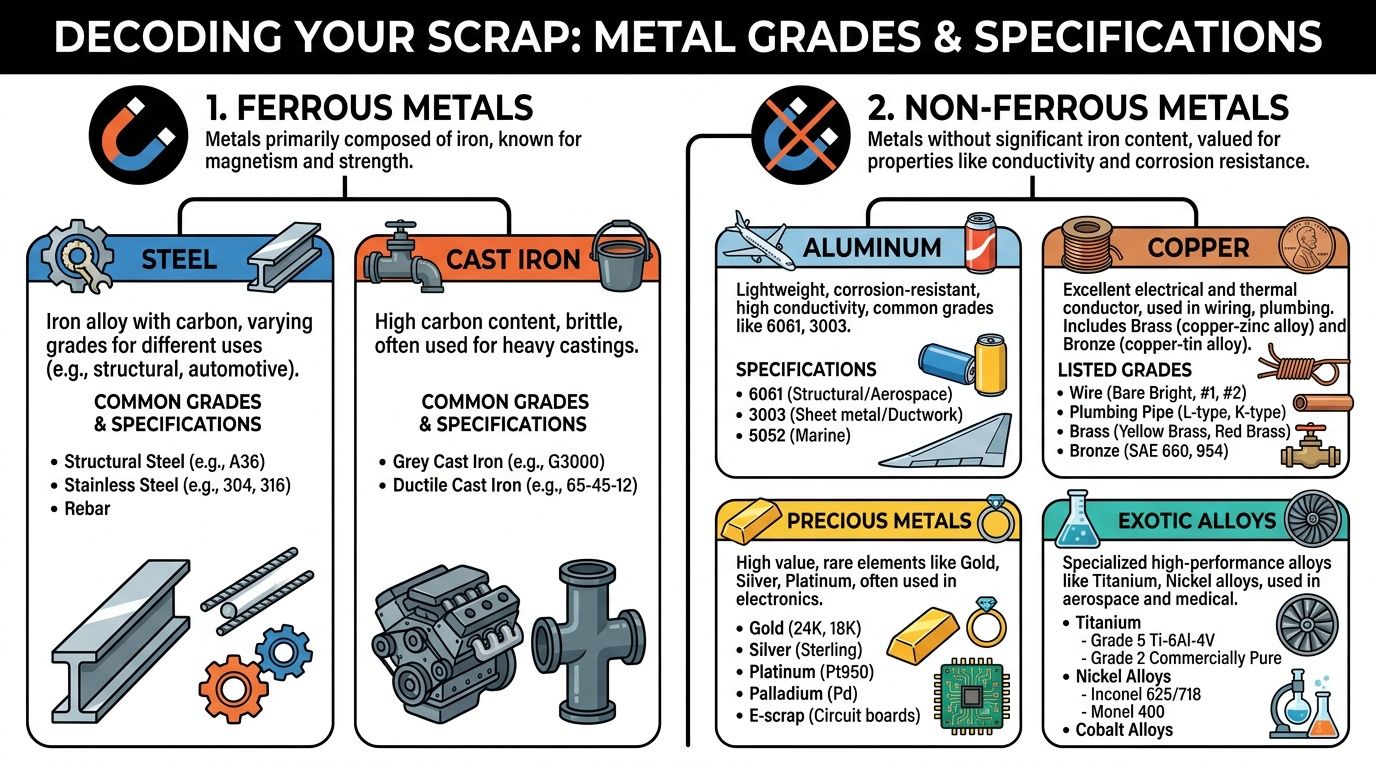
The easiest way to think about scrap grades is as a metal dictionary. If everyone in the chain uses the same language, material can be priced, packed, shipped and melted with fewer disputes. If the language is vague, value slips out in re-sorting, downgrades and rejected loads.
For most industrial clients, the first split is simple. Ferrous metals contain iron and are generally magnetic. Non-ferrous metals do not rely on iron in the same way and are often more valuable per unit because of conductivity, corrosion resistance or alloy content.
Ferrous grades that industrial clients see most often
Ferrous material usually forms the bulk of volume on manufacturing, demolition and plant sites. Common examples include structural steel, sheet offcuts, plate, obsolete equipment frames, cast components and production scrap.
Typical categories include:
- HMS 1 and 2: Heavy melting steel. Common in structural sections, thicker steel scrap and general industrial recovery.
- PNS: Plate and structural scrap from demolition, cut beams, channels and heavy sections.
- Cast iron grades: Heavy castings, machine bases, valves, housings and certain obsolete process equipment.
- New and old black bales: Prepared carbon steel material compacted for efficient handling and furnace charging.
- ISRI 201 and ISRI 204: Prepared ferrous grades used when mills and buyers need more exact classification.
- ISRI 238: Heavy breakable cast iron, relevant where dense cast material is recovered in volume.
A useful rule on ferrous scrap is that thickness, size, cleanliness and preparation all affect how easy the material is to process downstream. Large torch-cut sections, mixed attachments or heavy contamination usually trigger deductions or rework.
Non-ferrous grades where value concentrates
Non-ferrous streams are often lower in volume but higher in sensitivity. Small mistakes in sorting can wipe out margin fast. Copper mixed with brass, aluminium contaminated with steel fixings, or stainless loaded in with carbon steel all create avoidable losses.
Industrial sites commonly generate:
- Copper: Cable, busbar, tubing, windings and process components.
- Aluminium: Extrusions, sheet, castings and light fabrication scrap.
- Brass: Valves, fittings, plumbing assemblies and machined turnings.
- Stainless steel: Food-grade equipment, tanks, conveyors, process lines and fabrication offcuts.
- Lead and zinc: Specialised recovery streams that need careful handling.
- Custom alloys: Materials such as manganese mill rolls or application-specific blends.
If your internal team needs a plain-language refresher on common categories, this overview of scrap metals is a useful starting point.
Why specifications matter
Buyers don’t pay for intentions. They pay for metal that matches a grade closely enough to move straight into their process. That’s why professional yards use tools such as magnetic separators for ferrous recovery and XRF spectrometers for alloy identification and verification.
According to this explanation of commercial scrap sorting methods, precise sorting with tools like XRF and magnetic separation is critical for meeting ISRI specifications, and achieving 95% to 99% purity for grades such as ISRI 236 low-lead brass can reduce downstream smelting costs by 15% to 20%. That’s the commercial logic behind careful grading. Better identification produces cleaner loads. Cleaner loads tend to protect value.
The fastest way to lose money on non-ferrous scrap is to treat all “yellow metal” or all “silver metal” as one category.
What works on site
Clients usually get better results when they don’t try to memorise every code. Instead, they create a clean first layer of separation at source.
A workable approach looks like this:
| On-site practice | Result |
|---|---|
| Keep ferrous and non-ferrous apart | Prevents immediate downgrading |
| Separate cable, stainless, aluminium and brass | Preserves pricing accuracy |
| Remove rubbish and visible contamination | Cuts handling disputes |
| Store high-value metals securely | Protects both value and traceability |
| Label bins by material family | Makes collections faster and cleaner |
That gives the dealer a better base to classify exact grades correctly. It also shortens the argument over what the material “really is”, which is where many strained transactions begin.
Maximising Your Return How Scrap Metal Valuation Works
Scrap valuation isn’t arbitrary, but it also isn’t a single posted number. Industrial clients usually receive a final value based on four moving parts working together: the market reference, the grade, the actual recoverable weight, and the cost to move and process the material.
That’s why two loads that look similar in the yard can settle very differently.
The four drivers behind price
Start with the market. Baseline values for many metals move with international commodity conditions and currency pressure. In South Africa, scrap prices can swing by 25% to 35%, and HMS 1 and 2 saw an 18% year-on-year drop in 2025, based on the verified market data provided in the brief. That volatility is one reason astute dealers don’t rely only on a daily spot mindset.
Then comes grade and purity. A load of clean, clearly prepared material is easier to sell than mixed scrap that needs labour, testing and rehandling. The dealer has to account for the difference. Weight is straightforward in principle, but only recoverable metal weight matters commercially. Moisture, attachments, insulation, dirt and embedded waste all affect what the buyer can use.
Finally, there’s logistics. A load that requires special collection equipment, long-distance haulage, difficult loading conditions or intensive yard preparation will not price the same way as material that is already separated, accessible and ready to move.
What clients can control
You can’t control the copper market or the rand. You can control how your material leaves site.
The practical levers are:
- Sort earlier: Separation at source usually preserves more value than re-sorting after contamination.
- Present material cleanly: Keep scrap free from rubbish, concrete, rubber, wood and liquids where possible.
- Improve access: Efficient loading conditions reduce transport and handling friction.
- Bundle by type: Distinct lots are easier to weigh, classify and settle accurately.
- Plan recurring collections: Predictable movements often work better than emergency clear-outs.
For a basic material overview that helps internal teams sort better before collection, this guide to common recyclable scrap metal types can help align site staff around visible categories.
Pricing disputes usually start long before the weighbridge. They start when material is mixed, unlabelled and poorly stored on site.
Managing volatility on larger programmes
Large generators should think beyond spot pricing alone. The verified data shows that forward contracts helped 60% of compliant dealers stabilise revenues. That doesn’t mean every client needs a formal hedging structure, but it does mean volume producers should ask how their dealer manages price risk, timing and settlement windows.
What works in practice is a pricing conversation tied to your scrap pattern. If your site produces regular monthly tonnage, structured collection and agreed pricing methods usually outperform rushed sales made only when space runs out.
The Non-Negotiables Compliance and Environmental Requirements
A scrap transaction can be commercially sound and still be a bad decision if the compliance side is weak. For industrial clients, legal and environmental exposure doesn’t disappear when the truck leaves the gate. If the material was mishandled, undocumented or moved through a poor chain of custody, the risk can come straight back to the generator.
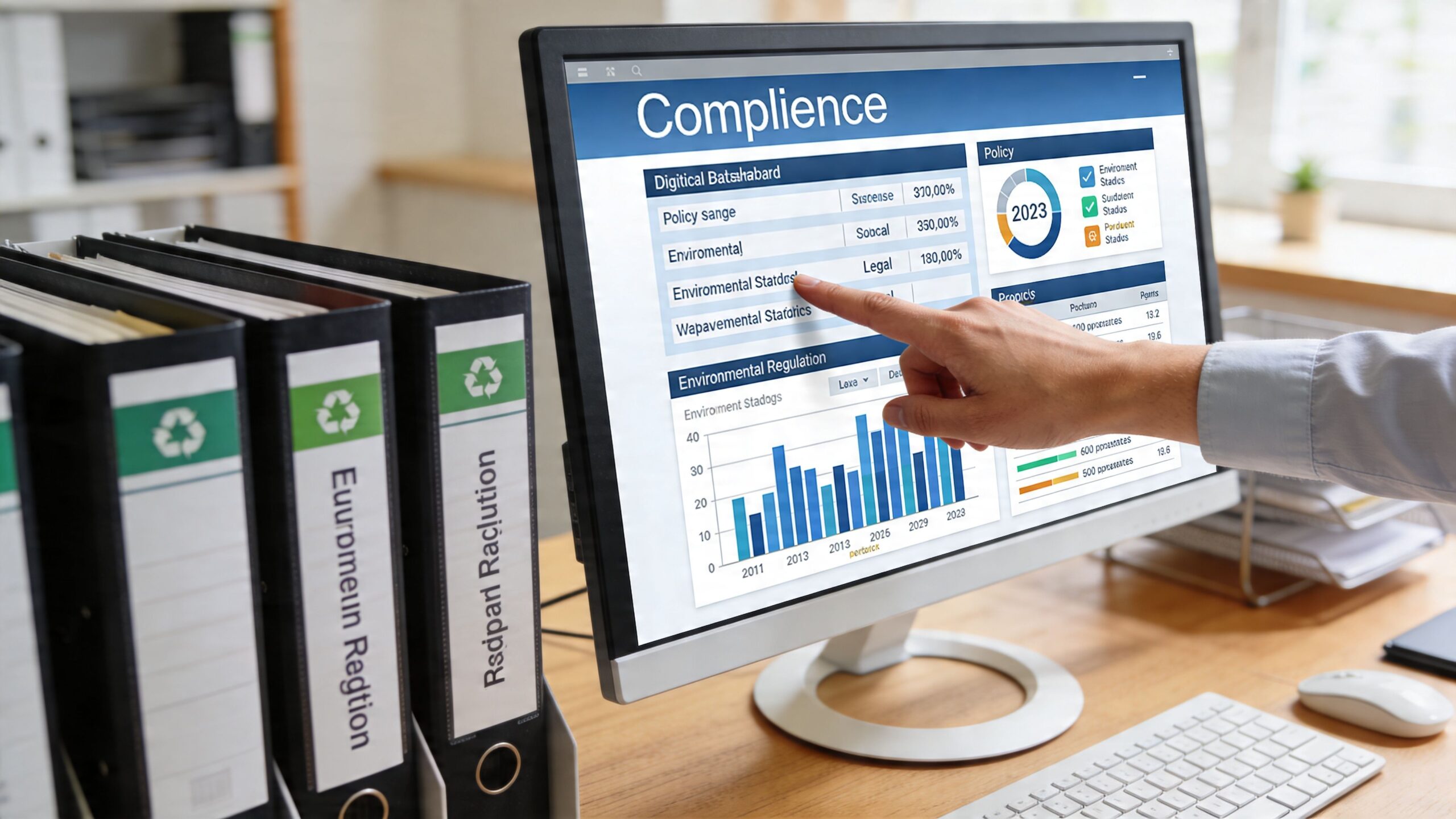
That’s why compliance should be treated as part of value recovery, not as admin added after the fact. The two key issues are clear traceability and correct handling under the relevant legal framework, including duties linked to the National Environmental Management: Waste Act.
Why weak compliance is expensive
The verified 2025 data in the brief shows that 40% of scrap operations faced fines over R500,000 for non-compliance. That’s not a marginal issue. It means a large portion of the market is still exposed to enforcement risk.
At the same time, the same verified data indicates that strictly compliant dealers can see a 15% to 20% boost in recovery value by supplying certified grades that attract stronger international demand. In other words, compliance isn’t only about avoiding penalties. It also supports cleaner specifications, better documentation and more bankable material.
A credible partner should be able to explain how they manage:
- Waste identification and classification
- Site handling and segregation controls
- Licensed operations and traceable buying procedures
- Documentation for removals and disposals
- Records that support audits and downstream verification
If you need a broader view of integrated compliance-led waste handling, D7 Capital’s total waste management approach shows how these services are typically structured.
What industrial clients should insist on
The basic standard is simple. If a dealer is vague about licences, records, transport controls or downstream handling, stop there.
A sound process usually includes the following checkpoints:
| Compliance point | Why it matters to the client |
|---|---|
| Licensing and legal status | Reduces the risk of dealing with unlawful operators |
| Material records | Creates traceability for audits and internal reporting |
| Controlled site handling | Limits environmental incidents and unsafe storage |
| Manifest and movement documentation | Supports chain-of-custody visibility |
| Grade certification where relevant | Strengthens saleability and settlement confidence |
Some clients only focus on these items after a problem appears. That’s backwards. They belong in the supplier selection stage.
A short visual overview can help frame the issue before procurement or operations review it internally.
Compliance is part of the product. If the paperwork, licensing and environmental controls are weak, the service is incomplete no matter what price was offered.
Choosing Your Partner A Due Diligence Checklist
Most problems with scrap metal dealers can be spotted early if the right questions are asked. The mistake many industrial clients make is comparing only price and collection speed. That’s too narrow. A dealer might quote quickly and still be the wrong fit for your material, your site conditions or your compliance obligations.
Use the checklist below as a working screen before you move any serious volume.

Ask for proof, not assurances
Start with documents. Verbal confidence doesn’t protect your business.
Ask:
- Are you fully licensed for the categories of material you handle? A good answer comes with current, relevant documentation.
- How do you manage records for collections, grading and final settlement? You want a clear audit trail, not a vague promise.
- What compliance procedures do you follow for controlled or higher-risk material? The answer should be specific enough to test.
If the response is fuzzy, that’s useful information. Serious operators usually answer this part quickly because they deal with it every day.
Test operational capability
A dealer can be legitimate and still not be capable. Capacity matters. So does fit.
Questions worth asking include:
What material types do you handle regularly?
A strong answer will match your actual stream, whether that’s HMS, PNS, copper cable, stainless, cast iron or mixed decommissioning material.What collection equipment do you provide?
Look for alignment with your site reality, such as bins, grab trucks, loading support or scheduled removals.Can you support shutdowns, factory strip-outs or demolition-linked recovery?
This separates routine collectors from firms that can work inside complex industrial programmes.How do you sort and verify grades?
You’re listening for practical methods, not generic claims.
Check how transparent the commercial side is
A trustworthy dealer should explain how they price material, where deductions may apply, and how disputes are handled. You don’t need every formula exposed in detail, but you do need a process that can be followed and checked.
A simple comparison helps:
| Question | Good answer sounds like | Weak answer sounds like |
|---|---|---|
| How is my scrap valued? | Tied to grade, quality, weight and handling realities | “We’ll see when it arrives” |
| How are deductions handled? | Defined categories such as contamination or extra processing | “We just deduct what’s necessary” |
| What reporting do I receive? | Weights, material categories, collection records and settlements | “We send a payment note” |
A reliable partner doesn’t become transparent only when there’s a disagreement. Their process is transparent from the start.
Look at safety and site conduct
Industrial recovery happens in live environments, shutdown environments and demolition environments. The site risk changes, but the standard shouldn’t.
Ask about:
- Safety procedures for loading and removal
- Experience working around production areas
- Housekeeping expectations during collections
- Supervision during decommissioning or dismantling
- Escalation paths if material differs from the original assessment
The best answer is usually calm, specific and procedural. If a dealer speaks only about buying price and collection speed, they may not be thinking like an industrial partner.
From Transaction to Partnership Building a Long-Term Strategy
Short-term scrap sales are easy to start and hard to optimise. A truck arrives, material is weighed, payment follows, and everyone moves on. That works for isolated clear-outs. It doesn’t work nearly as well for factories, demolition contractors, municipalities or facilities with recurring metal streams and ongoing compliance pressure.
The stronger model is a standing recovery strategy. In that model, the dealer already knows your material profile, your access constraints, your shutdown windows, your reporting format and your risk points. That reduces friction at every stage because the work doesn’t restart from zero each time.
What partnership changes in practice
A real partnership improves outcomes in three areas at once.
First, it improves operational efficiency. Collections are scheduled around your site, not forced into disruption windows. Bins and loading support match the actual material. Internal teams stop improvising.
Second, it improves commercial recovery. Better source separation, cleaner grading and more disciplined handling give the dealer a stronger base from which to sell the material onward. That matters because the quality of incoming scrap affects the entire supply chain. South African electric arc furnace steel production relies on scrap for 60% of its input, and pre-shearing and sorting to exacting standards can increase melt efficiency by 18%, according to this explanation of EAF processing and scrap preparation.
Third, it improves risk control. When the same partner manages documentation, removal discipline and material traceability consistently, it’s easier for your procurement, operations and environmental teams to stay aligned.
What works and what usually fails
The practical difference between a good scrap programme and a poor one usually comes down to habits.
What works:
- Recurring collection plans instead of emergency calls
- Material separation at source instead of mixed-yard clean-ups
- Defined site contacts instead of ad hoc coordination
- Clear reporting routines instead of one-off settlement disputes
- Alignment between operations, finance and compliance teams
What tends to fail:
- Spot selling every load without a standing process
- Treating all scrap as one category
- Waiting until shutdown week to plan removal
- Choosing only on headline price
- Letting paperwork trail behind the physical movement of scrap
Long-term value in scrap recovery usually comes from process discipline, not from chasing the last small movement in a quoted price.
How one integrated model applies these principles
A practical example is a firm that combines recovery, sorting, logistics, demolition support and waste management in one operating model. That structure is useful because industrial clients rarely generate neat, single-material streams. They generate mixed operational realities.
D7 Capital Partners fits that integrated model in factual terms. The business handles ferrous and non-ferrous scrap recovery, supports structural demolition and decommissioning, and provides end-to-end waste solutions for industrial, commercial and municipal clients. For a buyer or generator, that matters because the same operating relationship can cover on-site removal, grade preparation, controlled handling and downstream movement without splitting responsibility across several vendors.
That’s the shift worth making. When scrap metal dealers are treated as strategic partners, scrap stops being a yard problem and becomes part of a deliberate value-recovery system. The result is cleaner sites, clearer reporting, stronger compliance and better commercial control over material that many businesses still underestimate.
If your site is dealing with recurring scrap volumes, obsolete plant, demolition recovery or broader waste handling requirements, D7 Capital Partners (Pty) Ltd offers a practical starting point for building a structured recovery programme around compliance, logistics and material value.