

Your steel order is probably under pressure before the first truck even loads. Lead times move, logistics windows tighten, and the wrong mill choice can leave a fabricator carrying stock that doesn’t match the job, or worse, waiting on product that was never the right fit in the first place. In South Africa, that pressure is sharper because local capability is strong but uneven across flat steel, stainless, coated coil, billets, sections, and downstream wire products.
That’s why buyers who treat sa steel mills as interchangeable usually end up paying for the mistake somewhere else. It shows up in rework, inland freight, conversion delays, documentation gaps, or a scrap stream that doesn’t align with the mill’s melt practice. The better approach is practical. Match the mill to the product family, the project profile, the QA requirement, and the transport route. Then lock down upstream material risk, especially if your supply chain touches scrap, demolition recovery, or semi-finished feedstock.
South Africa has deep industrial steel roots. The first steel was tapped at the Pretoria Works on 4 April 1934, with an initial capacity of 160,000 ingot tonnes per annum, a milestone recorded in the South African Iron and Steel Institute history archive. That long industrial base still matters. It shaped the ecosystems around fabrication, rail, mining, construction, processing, and recycling that procurement teams still rely on today.
What follows is a working directory, not a generic roundup. It focuses on how major sa steel mills fit into real buying decisions. You’ll see where each mill is strongest, where it’s a poor fit, and what to check before you issue an RFQ, nominate a carrier, or commit a programme around local supply.
1. ArcelorMittal South Africa (AMSA)
For buyers who need locally made flat steel at industrial scale, ArcelorMittal South Africa is still the first mill to assess. In practice, AMSA matters most when the requirement is hot rolled, cold rolled, or coated flat product backed by established mill systems, formal documentation, and technical engagement that larger OEMs and service centres expect.
That doesn’t mean it’s the right answer for every enquiry. If your need is structural sections, merchant bar, or other long products, you have to qualify availability very carefully because AMSA announced the closure of its long steel operations affecting Newcastle and Vereeniging works, plus the Rail and Structural unit at Highveld Steel in Mpumalanga, with closures set for March 2025, as detailed by TIPS on disruptions in the South African steel industry.
Where AMSA fits best
AMSA works best when the buyer needs consistency over improvisation. Large contract volumes, repeat monthly call-offs, formal test certificates, and a stable flat-steel specification regime are where the mill makes the most sense.
Procurement teams usually choose AMSA for three reasons:
- Flat product depth: Hot rolled, cold rolled, and coated categories suit manufacturers, converters, and service centres that need continuity rather than opportunistic spot buying.
- Documentation discipline: Mill test paperwork, grade traceability, and export-friendly documentation matter if your customer audits every bundle or coil.
- Technical interface: Engineers can push technical queries through an established commercial and quality structure instead of trying to buy commodity steel with no support behind it.
What buyers often miss
The biggest mistake is treating AMSA as a universal local source. It isn’t. Today, it’s more practical to view it as the anchor option for flat steel procurement, not as a broad answer across every carbon steel family.
Practical rule: If your project needs flat steel and your contract penalises specification drift, start with AMSA. If your project needs long products, verify rolling status and alternatives before you build the programme around it.
There’s also a commercial reality. AMSA is rarely a simple “send cart, get price” supplier for industrial buyers. RFQs, negotiation, grade confirmation, and allocation discussions all matter, especially where the order sits between commodity volume and engineered specification.
A second point is supply-chain visibility. Buyers that understand the wider metal chain usually manage risk better, especially when they trace feedstock, processing, and movement from origin to final use. The lifecycle perspective explained in D7 Capital’s guide to the life cycle of metal is useful when procurement, sustainability, and operations teams need one common view of material flow.
2. Columbus Stainless
If the enquiry is stainless flat product, Columbus Stainless is the local benchmark. It’s Africa’s only primary producer of stainless steel flat products, which is why many procurement teams start here before they even look at import substitution for coil, sheet, or plate requirements.
That local positioning matters because stainless procurement usually fails on details, not on headline price. Grade selection, fabrication behaviour, documentation, and consistency from coil to coil all count. Food and beverage plants, mining projects, chemical installations, and architectural fabricators tend to care less about marketing and more about whether the supplied stainless behaves properly in welding, forming, and corrosion-critical service.
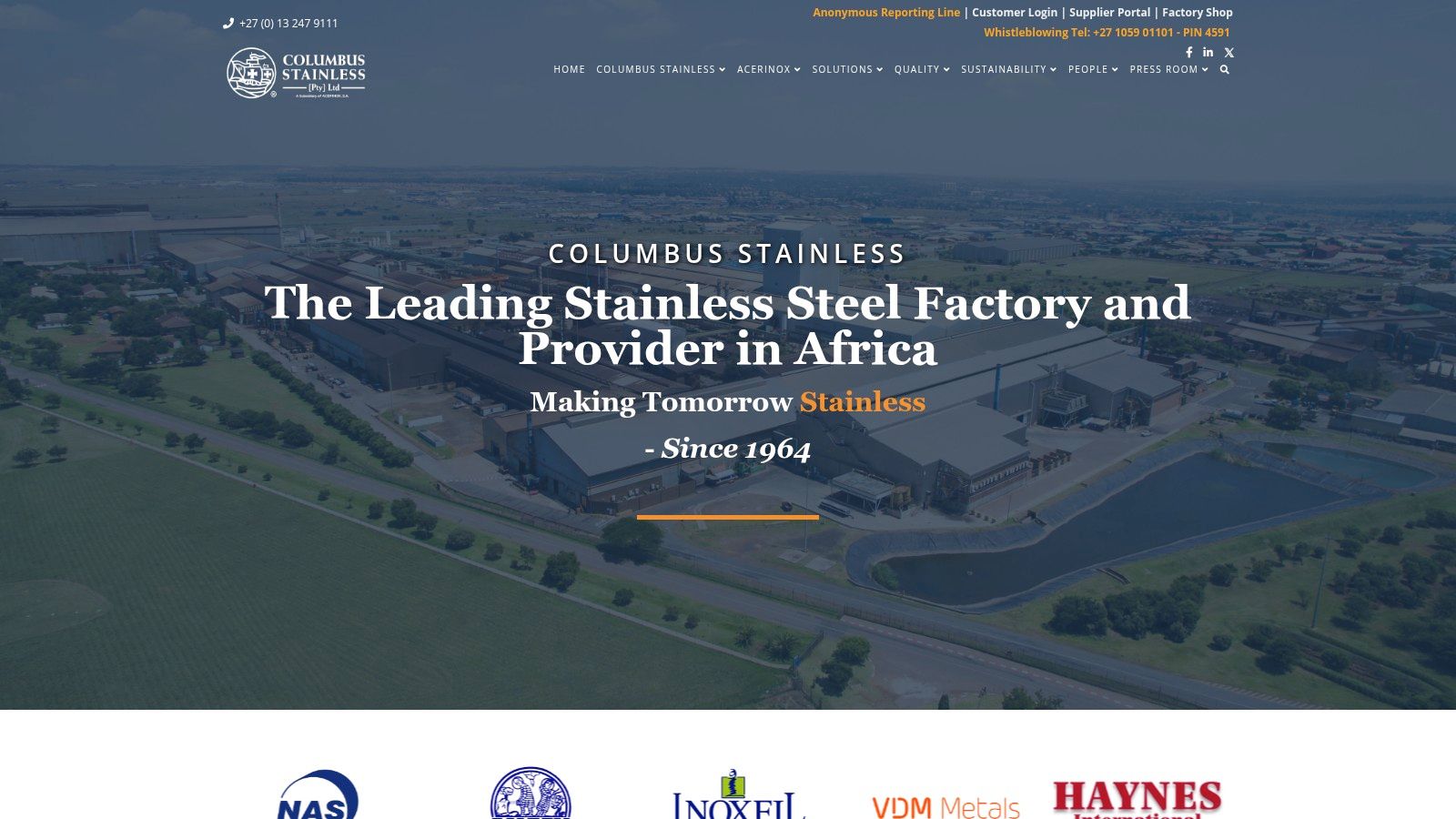
A plant view helps place the operation in context.

Why stainless buyers use Columbus
Columbus is strongest when you need a primary stainless source with traceability. Its value is less about broad product diversity across all steel families and more about being a serious, single-source local option for stainless flat product.
In practical procurement terms, that means:
- Stainless focus: Austenitic, ferritic, and duplex families make it relevant for demanding service environments.
- Traceability: Buyers who must tie delivered material back to grade and production records generally prefer a primary mill route.
- Technical support: Grade selection errors in stainless are expensive. A mill that can engage on fabrication and application is worth more than a nominally cheaper offer with weak technical backup.
Trade-offs that matter on the ground
Columbus isn’t where you go for carbon structural sections, merchant bar, or generic flat carbon substitution. It’s a specialised stainless producer. If your BOM mixes stainless with carbon steel or coated roofing material, you’ll still need a multi-supplier buying strategy.
Pricing also tends to require proper engagement because stainless isn’t bought intelligently from a generic list price mindset. Alloy effects, finish, width, thickness, and downstream fabrication risk all shape the conversation.
Stainless buying goes wrong when procurement treats grade as interchangeable and expects fabrication to absorb the difference later.
That’s why a broader market lens helps. The shifts outlined in D7 Capital’s overview of metal supply trends for 2025 are relevant here, especially for buyers balancing local stainless sourcing against imported material, volatile logistics, and tighter project schedules.
3. Safal Steel
Safal Steel is the right mill to assess when the job is really about coated performance, roofing system consistency, and project-facing building products. Buyers often make the mistake of sourcing coated coil as if it were just substrate plus paint. In reality, roofing and cladding packages live or die on finish consistency, colour matching, weathering performance, and whether the supplier understands the application.
Safal’s value is straightforward. It gives the local market a coating and colour-coating base aimed squarely at the construction and fabrication chain. If you’re buying for roofing, cladding, rainwater goods, or related building-envelope work, it’s usually a more logical starting point than trying to force a structural or primary flat-steel mill into that role.
Here’s the business environment behind that logic. The South African structural steel market generated USD 325.0 million in 2024 and is projected to reach USD 430.3 million by 2030, growing at a CAGR of 5.3% from 2025 to 2030, while non-residential applications held a 53.17% revenue share in 2024, according to Grand View Research’s South Africa structural steel outlook. Even though Safal is a coated specialist rather than a structural section producer, that project activity feeds demand for roofing, cladding, and associated building systems around industrial and commercial developments.
Best use cases
Safal is usually the better fit when your buying brief includes appearance and envelope performance, not just metal supply.
- Roofing and cladding projects: Local colour systems simplify specification control.
- Tender compliance: Contractors needing consistency across a project package benefit from a specialist coated supplier.
- Reduced import friction: Local coated coil can remove some of the uncertainty that imported painted product introduces.
Where it isn’t the right fit
Safal doesn’t produce the hot rolled substrate. That means buyers still need to understand the upstream chain and how substrate availability affects downstream coated output. If your project needs a single supplier for the full primary steel route, this isn’t that model.
It also means technical conversations should be application-led. Ask about coating system suitability, environment, profile compatibility, and project sequencing. Don’t just ask for “colour-coated coil” and hope the downstream contractor resolves the rest.
For buyers tracking shifts in higher-spec and performance-driven steel demand, D7 Capital’s article on advanced alloys and high-performance materials gives useful context on where specification pressure is increasing across industrial sectors.
4. Veer Steel Mills
Veer Steel Mills sits in a different buying conversation altogether. This is a long-products play. If you need angles, channels, flats, and related profiles for construction, fabrication, and general engineering, Veer belongs on the shortlist because local rolling changes the procurement equation in ways import-heavy buyers sometimes underestimate.
The first advantage is speed. Not a numerical promise, but a structural one. Gauteng-based production shortens the chain for buyers serving inland construction and fabrication demand. That matters when site changes, detailing revisions, or contractor sequencing creates a need for responsive replenishment rather than a long import cycle.
Why long-product buyers look at Veer
Veer fits buyers who need practical domestic access to rolled sections without overcomplicating the order.
Its appeal usually comes down to:
- Construction-facing section range: Angles, channels, flats, and related profiles suit merchants, service centres, and contractors.
- Local supply logic: A South African mill base can reduce exposure to import timing and shipping volatility.
- Regional delivery strength: Gauteng positioning helps inland distribution, especially for projects where transport cost can swing the true landed value.
The real limitation
Veer is not a flat-steel mill and it isn’t a stainless source. That sounds obvious, but mixed procurement teams still issue broad RFQs to the wrong mills all the time. If your project includes plate, HR coil, CR sheet, coated roofing stock, and merchant sections, split the buying package by product family from the start.
Buyers save time when they stop asking a section mill to solve a flat-steel problem.
There’s also a broader industry context behind the importance of local long-product and scrap-based routes. In the 1980s, South Africa’s crude steel production accounted for over 70% of Africa’s total output, a historic position noted in the earlier cited TIPS analysis. The market today is more fragmented and stressed, which makes practical local procurement choices more important, not less.
For buyers who rely on recycled ferrous inputs, or who need to understand how recovered material supports domestic melting and rolling, D7 Capital’s explanation of the benefits of recycling ferrous metals is directly relevant to sourcing strategy.
5. Unica Iron & Steel
Unica Iron & Steel is one of the more useful mills for buyers who care about section diversity, traceability, and service to local fabricators. Its Pretoria, Babelegi operation follows a scrap-to-billet-to-section route, which makes it especially relevant in procurement programmes where domestic recycling, recoverability, and section availability all matter.
What stands out isn’t hype. It’s control. Unica positions itself around a broad catalogue of structural profiles, management-system discipline, and traceability through bundle marking and laboratory verification. For many merchants and fabrication shops, that practical combination is more valuable than chasing the broadest possible product universe.
Where Unica earns its place
Unica is best suited to buyers ordering light and medium structural sections for recurring fabrication work.
The strengths are clear:
- Wide profile mix: The mill offers more than 85 structural profiles for construction applications through its own stated range.
- Integrated scrap route: Scrap to billet to section is attractive when buyers want local circularity built into the steel supply chain.
- Management accreditations: ISO 9001, 14001 and 45001 give comfort to customers who audit supplier systems, not just product dimensions.
- Traceability: Independent lab involvement and bundle identification help where downstream QA is strict.
What to check before placing an order
Unica is not a flat-steel source. It also isn’t the place to solve stainless requirements. Buyers should approach it as a specialised structural section mill with strong local service orientation, not as a catch-all supplier.
Ask sales for rolling schedules, section availability, and order sequencing early, especially if your fabrication programme depends on specific section combinations rather than a single profile family. That’s where many orders either run smoothly or become a coordination problem.
There’s another practical reason to keep scrap-route mills in view. The broader South African steel market recorded revenues of $3.7 billion in 2024, while production volumes reached 4.7 million tonnes and declined at a steeper rate of 5.2% CAGR over 2019 to 2024, according to MarketLine’s South Africa steel market analysis. When primary production is under pressure, reliable secondary and scrap-linked routes become more strategically important for local supply resilience.
6. Coega Steels
Coega Steels serves a narrower but very important function in the local value chain. It’s a billet producer. That means it’s not competing to be your source for finished sections, plate, or coil. It matters when you need semi-finished steel feedstock, or when your procurement strategy depends on understanding who can convert scrap into billets inside a logistics-friendly industrial zone.
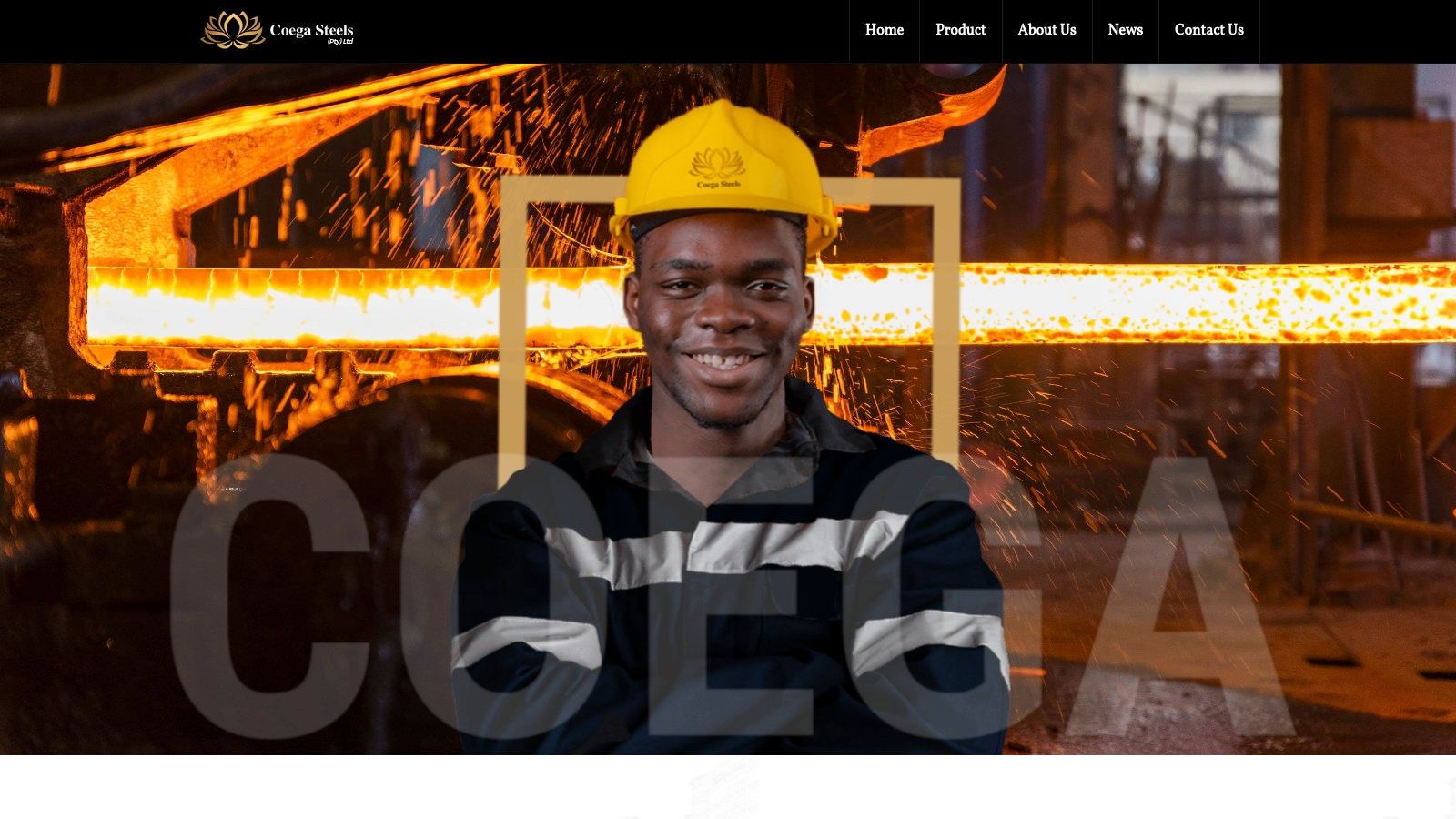
Coega Steels operates from Gqeberha within the Coega SEZ environment and produces mild-steel billets using a scrap-fired route with two 25-ton induction furnaces. It also states an installed capacity of around 240,000 tonnes per annum. For billet buyers and rolling operations, that’s the part that matters. You’re buying melt-and-cast capability, not a finished-product catalogue.
When Coega makes commercial sense
Coega is a sensible fit in three situations.
- Billet procurement: Rolling mills or downstream converters needing semi-finished feedstock should look here first.
- Scrap-linked partnerships: The scrap-based route creates natural alignment with recyclers and demolition recovery suppliers.
- Port-oriented logistics: SEZ positioning can help where domestic and export movement both matter.
The procurement caution
Don’t issue a finished-product RFQ to a billet mill. It wastes time on both sides. If your operation needs billets for internal rolling, remelting strategy, or downstream conversion, Coega is relevant. If you need delivered angles, channels, coil, or roofing sheet, it isn’t.
A good billet supplier can stabilise a rolling programme. It won’t replace a finished-product mill.
This is also where scrap policy starts to matter in a very practical way. The export duty and related policy pressure on scrap can squeeze local processors and distort feedstock economics for mills and recyclers. The issue is laid out in Engineering News coverage of pressure on South Africa’s steel industry, including the 20% export duty introduced in 2020, concerns around domestic supply distortion, and the knock-on effect on local scrap businesses. Buyers relying on scrap-based steel routes should watch that policy environment closely because feedstock certainty affects everyone downstream.
7. Cape Gate (Davsteel Division)
Cape Gate is one of the easier mills to place correctly because its strength is vertical integration across long products and downstream wire families. Through the Davsteel division and related operations, it serves buyers who need more than a single steel item. Mining, fencing, agriculture, construction, and engineering customers often need billets, long products, drawn wire, or rope-related products from one established industrial group.
That integrated model is the point. If your procurement team is trying to cut supplier complexity across wire derivatives and associated long-product demand, Cape Gate can simplify the chain in a way a narrower rolling mill can’t.
Where Cape Gate is strongest
Cape Gate is usually a strong fit for multi-line industrial buying.
- Vertical integration: Steelmaking through downstream wire and rope helps reduce coordination between separate suppliers.
- Sector coverage: Mining and agriculture buyers often need product families that sit outside a standard structural RFQ.
- Established manufacturing base: Continuity and industrial experience matter when the supply relationship is long term.
Where buyers should draw the line
Cape Gate isn’t your stainless flat supplier and it isn’t your broad flat-carbon source. It belongs in the long-products and wire discussion. Use it where those strengths matter, and don’t force it into unrelated categories.
That distinction matters more in the current environment because industrial disruption isn’t only about output. Labour instability and skills gaps can affect mill modernisation, scrap offtake reliability, and downstream confidence, especially in scrap-based and EAF-linked parts of the sector. The workforce pressure around SA Steel Mills and the broader green-transition skills gap are discussed in this video report on labour unrest and steel-sector strain. The practical lesson for procurement is simple. A resilient supply chain needs more than a good quote. It needs counterparties with operational staying power.

South African Steel Mills: 7-Company Comparison
| Supplier | Product focus & capacity ⭐ | Implementation complexity 🔄 | Resource requirements ⚡ | Expected outcomes / Impact 📊 | Ideal use cases & Key advantages 💡 |
|---|---|---|---|---|---|
| ArcelorMittal South Africa (AMSA) | Broad flat‑steel range (hot/cold/coated); high volume capacity | High, long‑term contracts and RFQ negotiation | High volume commitments, national distribution, mill documentation | Consistent, certified supply; export‑grade QA/QC | OEMs, large fabricators/service centres; deep certifications and offtake ability |
| Columbus Stainless | Stainless flat coil/sheet/plate; austenitic/ferritic/duplex grades | Moderate, alloy surcharges and contract pricing on request | Alloy‑dependent sourcing, export logistics, traceability systems | Traceable stainless supply meeting major standards | Food & beverage, mining, chemical, architectural; single‑source local stainless |
| Safal Steel | AZ and colour‑coated coils for roofing/cladding; tailored colour systems | Low–Moderate, coating specs often RFQ based | Local coated‑coil stocks, colour matching, faster lead times vs imports | Reduced lead times; consistent coating/colour compliance | Construction projects, tendered roofing/cladding; local coated solutions |
| Veer Steel Mills | Long products (angles, channels, flats) from mini‑mill | Low, mill‑direct quotations, short lead times | Regional logistics, short lead times for Gauteng/national delivery | Mitigates import volatility; ready supply of common sections | Contractors, service centres, local construction supply chains |
| Unica Iron & Steel | 85+ structural profiles; scrap‑to‑billet production with SGS testing | Low, service‑oriented RFQ and scheduling | Scrap feedstock, integrated QA labs, accreditations (ISO) | High traceability and verified test results | Local fabricators/merchants needing custom sections and verified QA |
| Coega Steels | Scrap‑fired billets (induction furnaces); semi‑finished feedstock | Moderate, coordination for billet supply and export/domestic sales | Scrap partnerships, SEZ logistics advantages, billet handling | Consistent billet quality suitable for downstream rolling mills | Rolling mills seeking feedstock; recyclers/demolition suppliers partnerships |
| Cape Gate (Davsteel Division) | Vertically integrated long products to wire/rope; diverse long‑product catalogue | Moderate, integrated sourcing simplifies multi‑product procurement | End‑to‑end production resources, national distribution | Simplified single‑supplier sourcing for long/wire products | Mining, fencing, agriculture, engineering requiring wire/rope and long products |
Building a Resilient South African Steel Supply Chain
Buying from sa steel mills still makes strong commercial sense when the procurement strategy is disciplined. Local sourcing can reduce uncertainty around shipping, shorten decision loops between buyer and mill, and make technical engagement easier when the project requires grade control, traceability, or coordinated delivery into fabrication. It also keeps more of the industrial value chain inside South Africa, which matters for continuity over the life of repeat contracts.
The main mistake isn’t choosing a weak mill. It’s choosing the wrong type of mill. Flat steel, stainless flat product, coated coil, billets, structural sections, and wire derivatives all sit in different operating models. The buyer who recognises that early writes better RFQs, gets faster technical answers, and avoids trying to force one supplier to solve a product-family mismatch.
A practical procurement framework helps. Start with the actual steel form, not the company name. If the requirement is HR, CR, or coated flat product with formal documentation and contract supply discipline, assess AMSA. If it’s stainless coil, sheet, or plate with traceability, Columbus is the obvious local route. If the job sits in roofing and cladding, Safal should be treated as a specialist application supplier, not just a coil source. For sections and structural profiles, Veer and Unica serve different local long-product needs. If the requirement is billet feedstock, Coega belongs in the discussion. If wire and downstream derivatives matter, Cape Gate’s integrated model can simplify procurement.
Logistics should be qualified at the same time as product. Inland freight can change the landed cost enough to overturn what looked like the cheapest ex-works quote. Port access matters for export-oriented programmes. Gauteng service logic matters for inland fabricators. Coated and finished products need handling discipline that differs from bulk billet movement. The procurement team that separates mill price from delivered project cost usually makes better decisions than the team chasing nominal base rates.
Documentation needs equal attention. On industrial and public-sector work, compliance failures often come from mismatched certs, incomplete test records, or unclear traceability once bundles hit the yard. That’s why stronger mills tend to justify their position when the project owner, EPC, or fabricator runs a harder QA process. Cheap steel becomes expensive very quickly if the paperwork doesn’t support release, fabrication, or client sign-off.
The other factor many buyers still underestimate is scrap. In South Africa, scrap isn’t just a recycling topic. It’s a production topic, a cost topic, and a continuity topic. Scrap-based mini-mills, billet casters, and downstream processors all depend on a compliant, properly sorted, properly moved scrap stream. If your operation demolishes old plant, strips redundant structures, or generates recoverable ferrous and non-ferrous material, you’re already part of that chain whether you manage it deliberately or not.
That’s where a partner like D7 Capital becomes useful beyond a simple buying or selling transaction. Procurement teams often need someone who can recover, process, classify, and move material in line with what local mills and downstream buyers can use. Demolition contractors need lawful removal and sorting. Facility managers need a clean decommissioning process. International buyers need confidence that recovered material is prepared and documented properly. The steel supply chain gets stronger when those steps are handled by specialists rather than improvised on site.
The strongest local strategy is usually layered. Buy the right steel family from the right mill. Align inland and port logistics before the order is released. Keep documentation clean. Secure the scrap and recovery side with a partner that understands compliance, grading, transport, and industrial timing. That’s how you make local steel procurement work under pressure, not just on paper.
If you need a dependable partner for scrap metal recycling, structural demolition, compliant waste handling, and processed ferrous or non-ferrous supply, speak to D7 Capital Partners (Pty) Ltd. D7 supports manufacturers, fabricators, contractors, municipalities, and international buyers with practical material recovery and supply solutions that strengthen the South African steel value chain.