An industrial scrap site audit shows where metal value is being lost before the material ever reaches a scale. Mixed grades, poorly placed bins, unauthorised disposal and incomplete records can turn a useful recovery stream into a recurring cost and safety problem.
This practical South African checklist helps facilities, production, procurement and SHEQ teams review how scrap is generated, stored, released and collected. It is designed for factories, warehouses, mines, workshops and project sites that want a safer, more traceable and commercially stronger metal-recovery programme.
What an industrial scrap site audit should achieve
A useful audit is not a once-off count of bins. It follows material from the point where it becomes scrap to the point where it leaves the gate. The result should identify immediate hazards, preventable mixing, control gaps and practical improvements that can be assigned to named owners.

South Africa’s National Environmental Management: Waste Act provides the national framework for waste management, including licensing, control, compliance and enforcement. The Occupational Health and Safety Act addresses the health and safety of people at work and risks connected with plant and machinery. Your audit should therefore treat material recovery and safe handling as parts of the same operating system.
1. Map every point where scrap is generated
Begin at the process, not at the central scrap yard. Walk production lines, maintenance workshops, stores, loading areas and project zones. Record which activity creates each metal stream, how often it appears and who currently decides where it goes.
- Production offcuts, rejected parts and swarf
- Maintenance spares, motors, cable and redundant equipment
- Packaging metals, drums, racking and damaged pallets
- Shutdown, refurbishment and demolition material
- Contractor-generated scrap and temporary project waste
This map exposes “invisible” streams that are being placed in general waste, stored indefinitely or removed without a clear release process.
2. Build a material-stream register
Create a simple register for recurring ferrous and non-ferrous materials. Describe the source and physical condition as well as the metal. For example, clean aluminium extrusion offcuts and painted mixed aluminium should not be recorded as one vague stream if they require different handling or grading.
| Audit field | What to record |
|---|---|
| Source | Department, machine, project or contractor |
| Material | Likely metal and grade, where known |
| Condition | Clean, coated, oily, insulated, mixed or oversized |
| Volume | Typical quantity and frequency |
| Current container | Bin, cage, skip, drum or open storage |
| Control owner | Person who releases and reconciles material |
3. Check segregation at the source
Metal normally retains more commercial value when higher-value grades are kept separate and contamination is controlled. Inspect what employees actually place in each container. A label that says “copper” does not protect value if the same cage contains steel fasteners, plastic, cable ties and general waste.
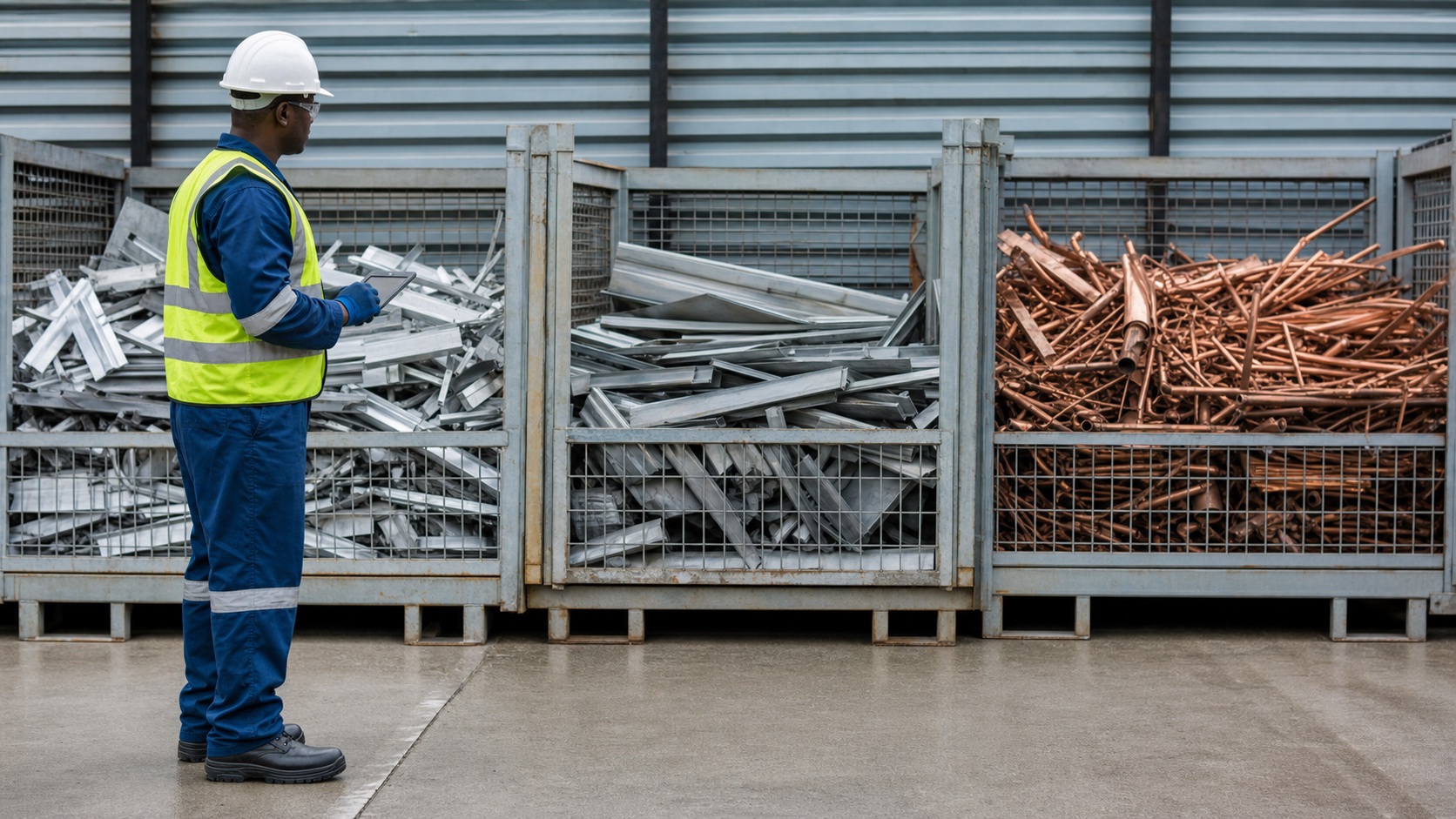
Ask whether the container is close enough to the work area, easy to recognise and practical for the material shape. Poor segregation is often a layout problem rather than a training problem. If the correct cage is far away or regularly full, the nearest general-waste bin will win.
4. Inspect contamination and prohibited items
Look for oils, coolants, chemicals, insulation, rubber, concrete, sealed vessels, gas cylinders, batteries, aerosols and unidentified residues. Do not assume that every metal object can follow the same route. Flag anything pressurised, hazardous, liquid-containing or otherwise uncertain for assessment under the site’s approved procedure.
The audit should identify who may approve cleaning, draining, dismantling or rejection. It should never encourage untrained employees to cut open or empty an unknown item merely to improve its scrap grade.
5. Review storage, housekeeping and fire risk
Check that scrap is stable, contained and kept within the intended footprint. Sharp edges should not project into walkways. Long sections should not be able to roll or fall. Containers should not block emergency equipment, drains, doors, pedestrian routes or visibility at vehicle intersections.
- Is the surface level and capable of carrying the loaded container?
- Can rainwater or leaked residue reach a stormwater drain?
- Are hot-work residues and combustible materials controlled?
- Is the fill line visible and respected?
- Are access and exclusion zones clearly defined?
- Is lighting adequate for early or late collections?
6. Test ownership and release controls
A part is not automatically scrap because it sits beside a bin. Review how equipment is declared redundant, how serialised or branded assets are controlled and who may authorise removal. Maintenance, finance, IT, security and asset-management requirements may all apply before an item is released.
The SAPS second-hand goods framework includes registration requirements for dealers and recyclers. Confirm the registrations relevant to the contractor and material in scope, and keep gate-release controls strong for cable, infrastructure components and recognisable assets.
7. Observe collection and vehicle movement
Walk the route a collection vehicle will use. Check gate booking, turning space, overhead clearance, ground condition, pedestrian exposure and interaction with forklifts or production traffic. The selected container must suit both the material and the vehicle that exchanges it.
Review induction, supervision, loading equipment, permits and communication between the driver and site representative. Where lifting, cutting or dismantling is required, confirm that it is separately planned rather than left to an improvised decision on collection day.
8. Reconcile weights, grades and payments
Select a recent sample of collections and trace each one from the site instruction to the payment or credit. The pack should make it possible to see what left, who approved it, how it was graded, where it was weighed and how the transaction value was calculated.
- Collection or release reference
- Date, vehicle and authorised site contact
- Material description and grade
- Gross, tare and net weight
- Rate, deductions and total value
- Rejected-load or contamination evidence
- Destination or recovery record where required
9. Turn findings into a 30-day action plan
Rank findings by safety, compliance, value and ease of correction. Close urgent hazards immediately. Then assign each remaining action to an owner with a target date and proof of completion.
| Priority | Typical response |
|---|---|
| Critical | Stop or isolate an unsafe or uncontrolled activity |
| High | Correct release, contamination or vehicle-access gaps |
| Medium | Improve container placement, labels and collection frequency |
| Opportunity | Separate a valuable stream or improve reporting |
Repeat a shorter inspection monthly and a full audit after material, process, contractor or layout changes. Useful measures include contamination rate, recoverable metal found in general waste, collections completed on time, unresolved weight queries and value recovered per material stream.
Arrange a practical site assessment
D7 Capital Partners supports industrial and commercial clients with scrap metal removal, recycling, structural demolition and total waste management. A site assessment can help align containers, collection frequency, safety controls, material grading and reporting with the way your operation actually works.
Contact D7 Capital Partners to discuss a scrap site audit or a structured recovery programme for your facility.
This article is a general operational checklist, not legal or safety advice. Confirm the requirements that apply to your site, materials and activities with appropriately qualified advisers.