If you’ve found yourself searching for "electronic waste near me," you know it’s not as simple as finding the nearest drop-off bin. For most businesses, finding a responsible and compliant way to get rid of old electronics is a far bigger challenge than a quick map search suggests. This guide cuts through the noise to give South African businesses a practical framework for managing e-waste properly, including the safe handling of electronics waste from offices, factories and technical facilities.
Electronics Waste and South Africa’s E-Waste Challenge
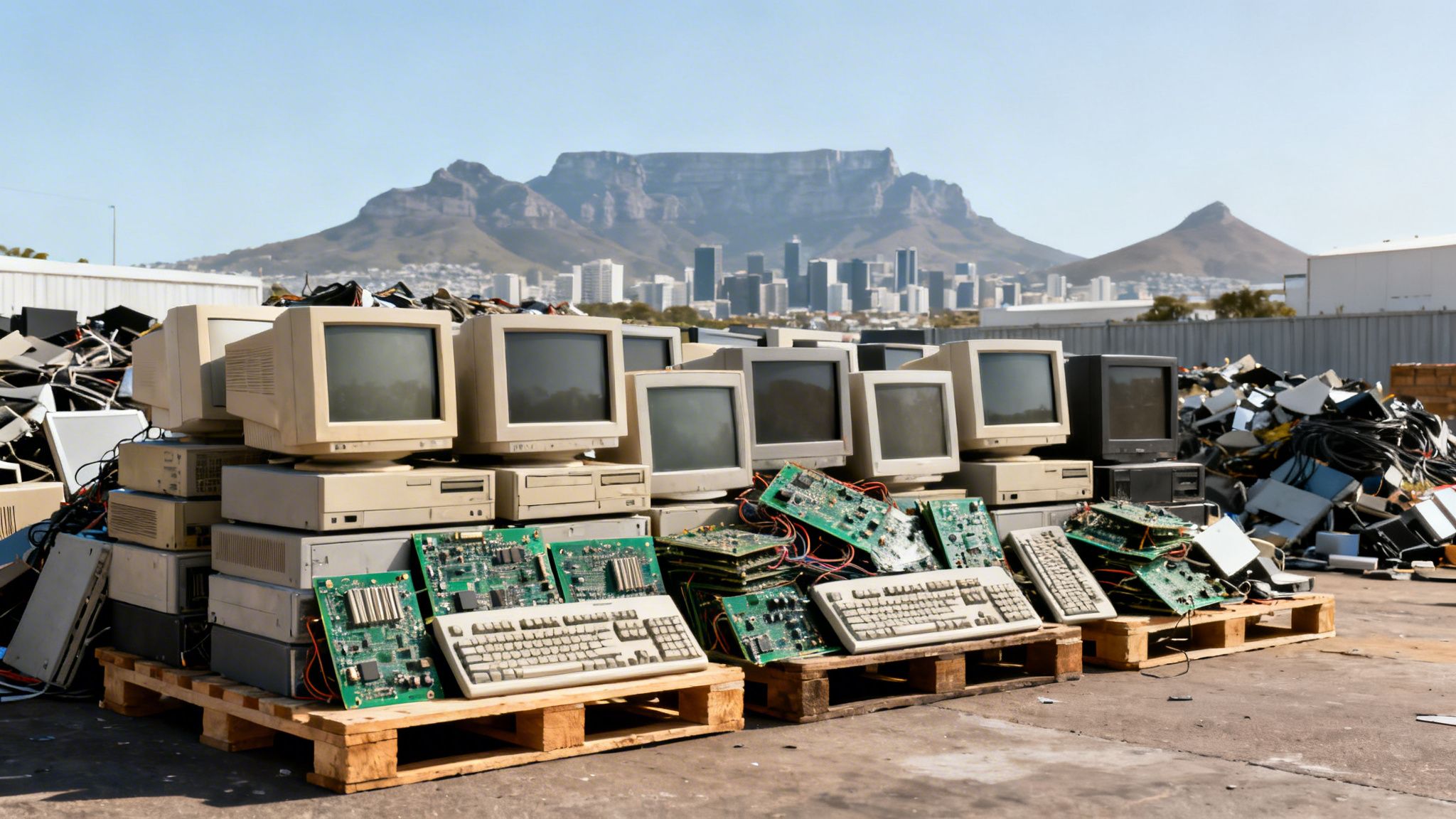
Managing electronic waste has become a serious headache for industrial and commercial operations across the country. Technology moves fast—servers, machinery controls, and office equipment become obsolete quicker than ever, creating a non-stop flow of e-waste. We’re not just talking about a few old computers; this is about tonnes of complex materials that your average waste disposal service simply can't handle.
The sheer volume of discarded electronics is creating a mountain of a problem. In 2022, South Africa generated roughly 527,000 tonnes of e-waste. By 2030, that number is expected to balloon to 750,000 tonnes every year. Even with a national ban on sending e-waste to landfills, the reality on the ground is stark: an estimated 90% to 95% of this waste never makes it to a proper recycling facility. You can get a deeper look at these figures and what they mean for our infrastructure in this comprehensive report.
More Than Just Waste
Calling it "e-waste" is a bit misleading. It makes you think these materials are useless, but that couldn’t be further from the truth. Discarded electronics are actually a goldmine of valuable resources.
- Ferrous and non-ferrous metals: Old IT infrastructure and industrial control panels contain large amounts of steel, aluminium, and copper.
- Precious metals: Tiny but valuable quantities of gold, silver, and platinum are embedded in circuit boards and connectors.
- Other recoverable materials: Plastics and glass from monitors and device casings can also be recovered and put back into the manufacturing supply chain.
When a business just dumps its e-waste, it's literally throwing away assets. These materials could have generated revenue, helped offset disposal costs, and supported a circular economy. This challenge isn't isolated to electronics; it connects to all industrial waste streams. If you’re dealing with other materials, our guide on metal waste management in Johannesburg might also be helpful.
The Hidden Risks of Improper Disposal
Beyond the missed financial opportunity, handling e-waste incorrectly opens your business up to serious environmental and compliance risks. Old electronics are packed with hazardous materials like lead, mercury, and cadmium. If they end up in a landfill or are dismantled by informal recyclers, these toxins can seep into the soil and groundwater, creating environmental liabilities that can last for decades.
For businesses, the risk is twofold. You could face hefty fines for not complying with regulations like the National Environmental Management: Waste Act (NEM:WA). At the same time, a damaged environmental reputation can destroy the trust you’ve built with customers and stakeholders.
That search for "electronic waste near me" is really the first step towards a much bigger conversation. It’s about finding a partner who won’t just take your old equipment away, but will also help you unlock its value and ensure your business stays 100% compliant—turning a potential liability into a structured, value-driven opportunity.
A Practical Framework for E-Waste Management
Moving from simply knowing about the e-waste problem to actually doing something about it needs a plan. A solid framework helps your business handle old electronics responsibly, keeping you compliant without getting bogged down in complicated steps. It all starts with a clear, internal look at what you have and where it is.
The first move is an internal e-waste audit. This isn't just about counting old computers in a storeroom; think of it as a detailed mapping exercise. The goal is to find, sort, and count every electronic asset that’s reached the end of its life across your entire operation.
A good audit will help you answer some crucial questions:
- What kinds of e-waste are we holding? (Think IT equipment, industrial controls, old phones, etc.)
- Where is it all physically located? (Is it in a central storeroom, spread across departments, or at off-site facilities?)
- What’s the rough volume or weight of these items?
- Do any of these devices still hold sensitive company or client data?
Getting this inventory sorted provides the bedrock for every decision you make next. It turns a vague problem like "we have too much old tech" into a manageable project with clear boundaries.
Preparing Equipment for Secure Disposal
Once you’ve got a clear picture of your e-waste, the next phase is preparation. This is probably the most critical stage because it tackles two major business risks head-on: data security and environmental liability. You can't just hand over a pallet of old servers and hope for the best.
Secure data destruction is absolutely essential for any device that has ever stored company information. A simple factory reset won’t cut it. Professional data sanitisation makes sure that sensitive files, client details, and internal secrets are permanently wiped and can never be recovered. This is usually done in two ways:
- Data Wiping: Using specialised software to overwrite the entire hard drive with random data, making the original information impossible to get back.
- Physical Destruction: Shredding or degaussing hard drives and other storage media. This physically obliterates the platters where data lives.
For many businesses, especially those in finance, healthcare, or law, getting a Certificate of Destruction is a vital part of the process. This document is your auditable proof that your data has been destroyed for good, helping you meet your compliance duties under privacy laws.
Your responsibility for data doesn't end when a device is unplugged. A single data breach from an improperly discarded hard drive can lead to severe financial penalties and do irreparable damage to your company's reputation.
Safely Handling Hazardous Components
Beyond the data, a lot of electronics contain parts that are hazardous if they aren't handled correctly. Batteries are a major one. Lithium-ion batteries, found in most laptops and mobile devices, are a serious fire risk if they get damaged or stored the wrong way.
It’s crucial to separate batteries from their main electronic units whenever you can. They need their own collection and recycling stream to prevent chemical leaks and fires during transport and processing. In the same way, old CRT monitors and the fluorescent backlights in LCD screens contain mercury and lead—substances that need specialist handling to stop environmental contamination.
By separating these items, you make the recycling process much simpler and ensure every component is managed safely. This careful approach is a key part of a wider, responsible waste management strategy. If your business deals with multiple waste streams, understanding these principles is key, and you can learn more about our approach to total waste management services.
Navigating South Africa’s Legal Landscape
Operating with confidence means operating in full compliance. In South Africa, the laws around e-waste are quite clear. The National Environmental Management: Waste Act (NEM:WA) outright bans the disposal of electronic waste in landfills. This means your business is legally required to find a compliant recycling channel.
On top of that, the Extended Producer Responsibility (EPR) Regulations push the responsibility for a product's end-of-life management back onto the manufacturers and importers. While this mainly targets the producers, it reinforces the national drive towards a circular economy and puts a bigger compliance burden on the entire supply chain.
This is all happening against a tough backdrop. South Africa is facing a huge waste crisis, generating around 122 million tonnes of waste every year, with only about 10% of it being recycled. Although EPR regulations are designed to make the system more accountable, enforcement can be patchy, and some operators may fly under the compliance radar. For your business, this just highlights how important it is to partner with a recycler who not only gets these laws but can also give you the paperwork to prove you're compliant.
Choosing the Right E-Waste Recycling Partner
That search for “electronic waste near me” is about more than finding a truck to haul away old computers. For any business, it’s about finding a partner to handle a complex and heavily regulated part of your operations. The success of your entire e-waste programme really comes down to this one choice.
Going beyond a quick online search is crucial, especially when you need to guarantee compliance, data security, and operational continuity.
The right partner can take what feels like a monumental headache—think of a full-scale factory decommissioning or an office-wide tech refresh—and turn it into a managed, predictable process. It’s about having a team that simplifies everything, from the first collection to the final piece of paperwork, so nothing is left to chance.
Look Beyond a Simple Collection Service
Choosing a partner isn't about who can show up the fastest. It's about finding a company with proven experience in handling industrial-scale projects and navigating South Africa’s strict regulatory landscape. There's a world of difference between a simple collection service and a genuine management partnership.
A professional recycler should bring far more to the table than just a truck and a team. You need someone who has a deep, practical understanding of the entire e-waste lifecycle, covering everything from secure logistics and data destruction to material recovery and compliant reporting.
This is where certifications and a solid track record aren't just nice-to-haves; they're non-negotiable.
Look for a partner who can provide:
- Industry-Specific Certifications: Verify they hold all the necessary licenses to legally handle and process electronic waste in South Africa.
- A Demonstrable Track Record: Ask for case studies or references, especially from businesses with needs similar to yours, like large or complex projects.
- Comprehensive Service Offerings: Make sure they can manage every single step, including on-site assessments, secure transport, and value recovery.
The Power of A Proven Process
A certified partner doesn’t just wing it. They bring a structured methodology to a task that can easily descend into chaos. For your business, this translates into predictability and, frankly, peace of mind. A core part of this is a clear, documented process for auditing, securing, and handling your assets from the moment they leave your premises.
This flowchart maps out the key steps a professional partner follows to manage your electronic waste responsibly.
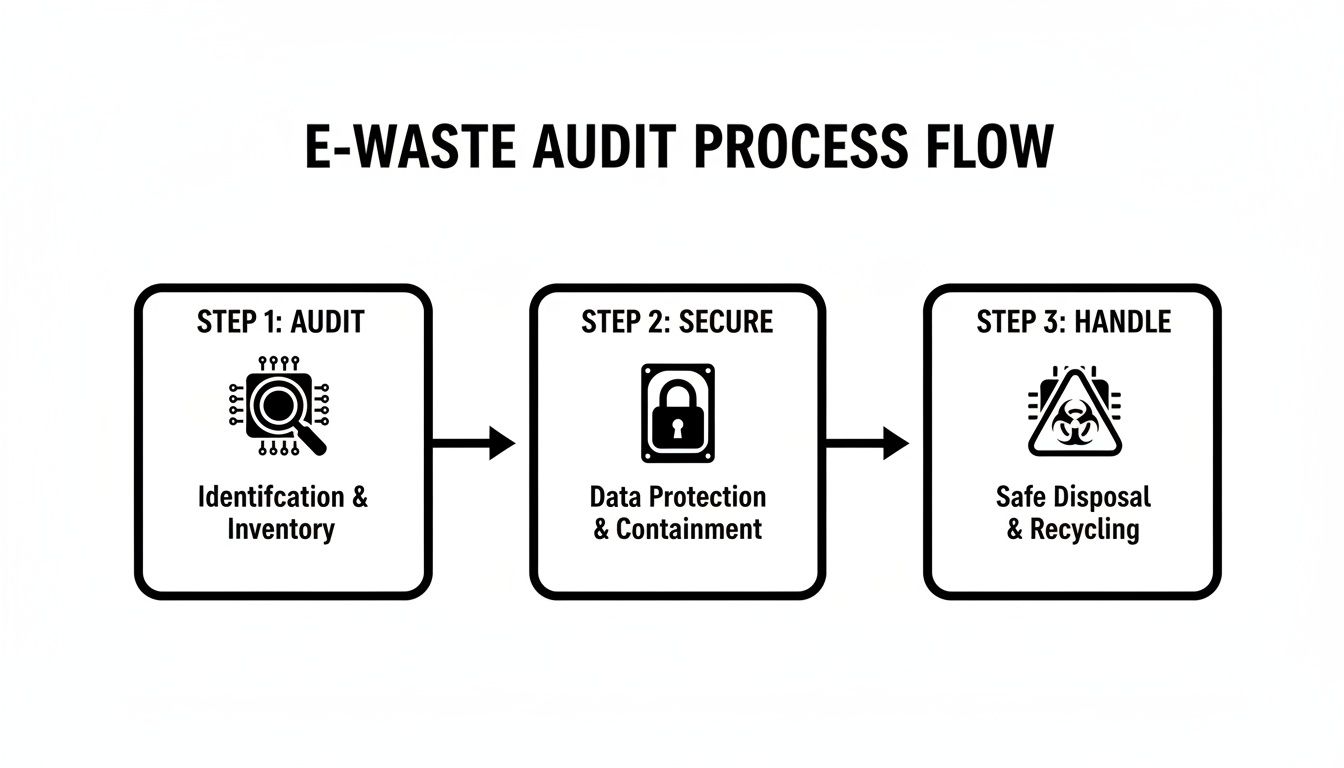
The flow from audit to secure handling shows a systematic approach designed to minimise risk at every stage, ensuring your assets are managed securely and in full compliance.
The real value of a professional e-waste partner isn’t just in what they take away, but in the liabilities they prevent. A transparent chain of custody and certified destruction processes protect your business from data breaches, environmental fines, and reputational damage.
Real-World Scenario: Office Tech Refresh
Let’s get practical. Imagine your company is upgrading the IT gear for all 500 employees in your head office. This means decommissioning hundreds of old desktops, monitors, laptops, and printers—all loaded with sensitive company and client data.
A basic collection service might just load it all onto a truck and drive away. You’re left hoping the data was properly destroyed, but you have no proof.
A strategic partner approaches this completely differently. They'd start by working with your IT team to create a detailed inventory. Then, they would schedule a phased on-site collection to minimise disruption, using secure, sealed containers for every single data-bearing device.
That equipment is then transported in a GPS-tracked vehicle to their secure facility. Once it arrives, they perform certified data destruction on every hard drive, providing you with serialised Certificates of Destruction as proof. This documentation is your ironclad guarantee against future data liability and a critical piece of good corporate governance.
What to Demand From Your E-Waste Partner
When you’re evaluating potential partners, your checklist should go far beyond just the price. A cheap quote often hides gaps in security, compliance, or service that will end up costing you far more down the line.
Your checklist should include these demands:
- Tailored On-Site Logistics: Can they adapt their collection process to your site? A busy factory floor has very different needs from a multi-storey office building.
- Secure Chain of Custody: Do they provide clear, transparent paperwork that tracks your assets from your door to their final disposition? You should be able to see every step.
- Certified Compliance: Can they give you all the necessary documentation, like waste transfer notes and recycling certificates, to satisfy both internal audits and regulators like the NEM:WA?
- Value Recovery Transparency: Is their process for assessing the value of recoverable materials clear? Do they explain exactly how that value is credited back to you?
Ultimately, the right partner to handle your electronic waste near me is one that acts as an extension of your own risk management and sustainability teams. They provide the expertise and infrastructure to transform a complex regulatory burden into a well-managed, value-added process.
The Nuts and Bolts of E-Waste Collection and Logistics
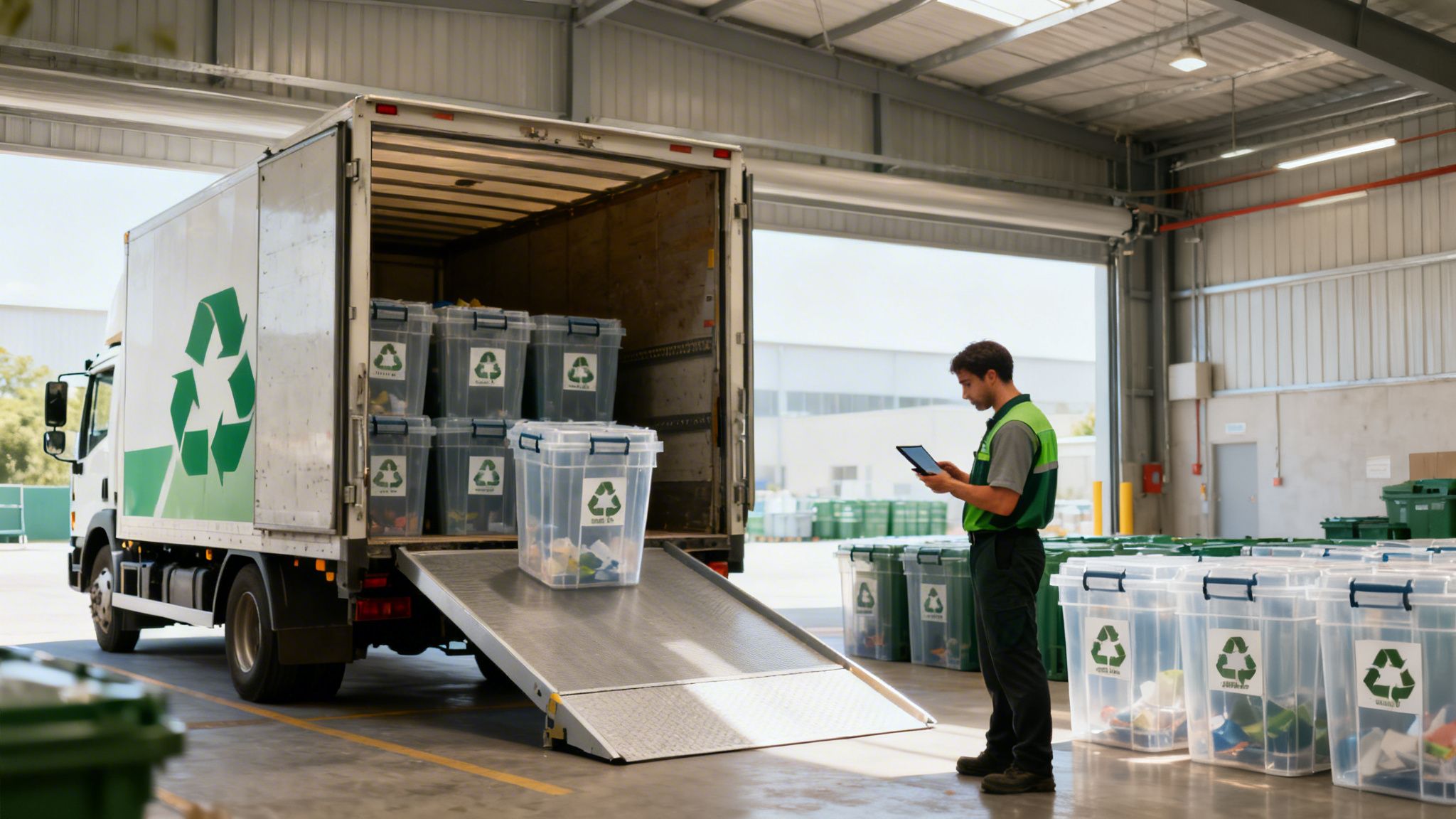
So, you’ve audited your old equipment and prepped it all for disposal. Now for the big question: how does all that e-waste actually get from your premises to a processing facility? Moving electronic waste, especially for industrial, construction, or commercial businesses, is a world away from a simple kerbside pickup.
This is where the operational muscle of a true e-waste management partner really shows. It’s all about designing a collection plan that works around your business, not forcing you into a rigid, one-size-fits-all schedule. A professional service takes the guesswork out of the process, ensuring your day-to-day operations carry on without a hitch while every asset is handled securely.
A Collection Plan That Fits Your Business
No two businesses operate in the same way, so why should their e-waste collection needs be identical? A busy factory churning out obsolete machinery has a completely different set of requirements to a corporate office doing a once-off tech refresh. The secret lies in a custom-fit approach.
For example, a manufacturer might find that scheduled on-site collections are the perfect solution. In this model, we place dedicated, heavy-duty containers at your facility. Your team can fill these bins with e-waste as it accumulates, and we'll arrange regular pickups that match your production cycle. This prevents hazardous stockpiling and keeps your valuable workspace clear.
On the flip side, a massive project like a site demolition or a full office clear-out needs a totally different game plan. These are often high-volume, one-time jobs where speed and efficiency are everything to hit tight project deadlines.
A professional recycler doesn’t just show up with a truck; they deliver a complete logistical solution. It's about taking the time to understand the unique challenges of your site and building a collection plan around them—not the other way around.
Handling the Logistics of Complex Scenarios
Think about the challenge of clearing out old IT gear from a multi-storey office block in Sandton. The logistical hurdles are immense. You’re dealing with service lifts, strict building operating hours, and the critical need to make sure every single hard drive is securely tracked from the desk to the truck. This requires pinpoint coordination from a team that knows how to operate in sensitive corporate spaces.
Now, contrast that with managing scrap from a major industrial demolition. The operational playbook is completely different. Here, the focus shifts to heavy-duty machinery, strict site safety protocols, and manhandling large, awkward items like old control panels and giant motors. Site access can be tricky, and the materials are often bulky and dirty.
A proper e-waste partner thrives in these diverse situations by mastering the key logistical details:
- Site Access: We assess entry points, loading dock availability, and any potential obstructions long before collection day arrives.
- Secure Transport: We only use enclosed, GPS-tracked vehicles. This provides an unbroken, secure chain of custody from the moment your assets leave your control.
- The Right Containers: We supply the correct bins, cages, or pallets for the specific type and volume of e-waste, ensuring everything is loaded safely and efficiently.
This meticulous planning is what separates a basic collection service from a genuine management partner. It guarantees a smooth process that lets your business operate without interruption. It's a level of service we bring to all material streams, and you can see more about how we manage it in our overview of professional scrap metal removal.
Keeping Disruption Low and Security High
Ultimately, the goal of a well-run logistics plan is simple: to make the entire process practically invisible to your daily operations. By taking care of all the details—from scheduling and on-site coordination to secure transport and final unloading—a professional partner frees up your team to focus on what they do best.
This careful, behind-the-scenes management ensures that your search for "electronic waste near me" connects you with a solution that doesn't just tick the compliance boxes but also respects your time and operational needs. It turns a potentially messy and disruptive task into a seamless, secure part of your own asset management programme.
Unlocking Value and Ensuring Full Compliance
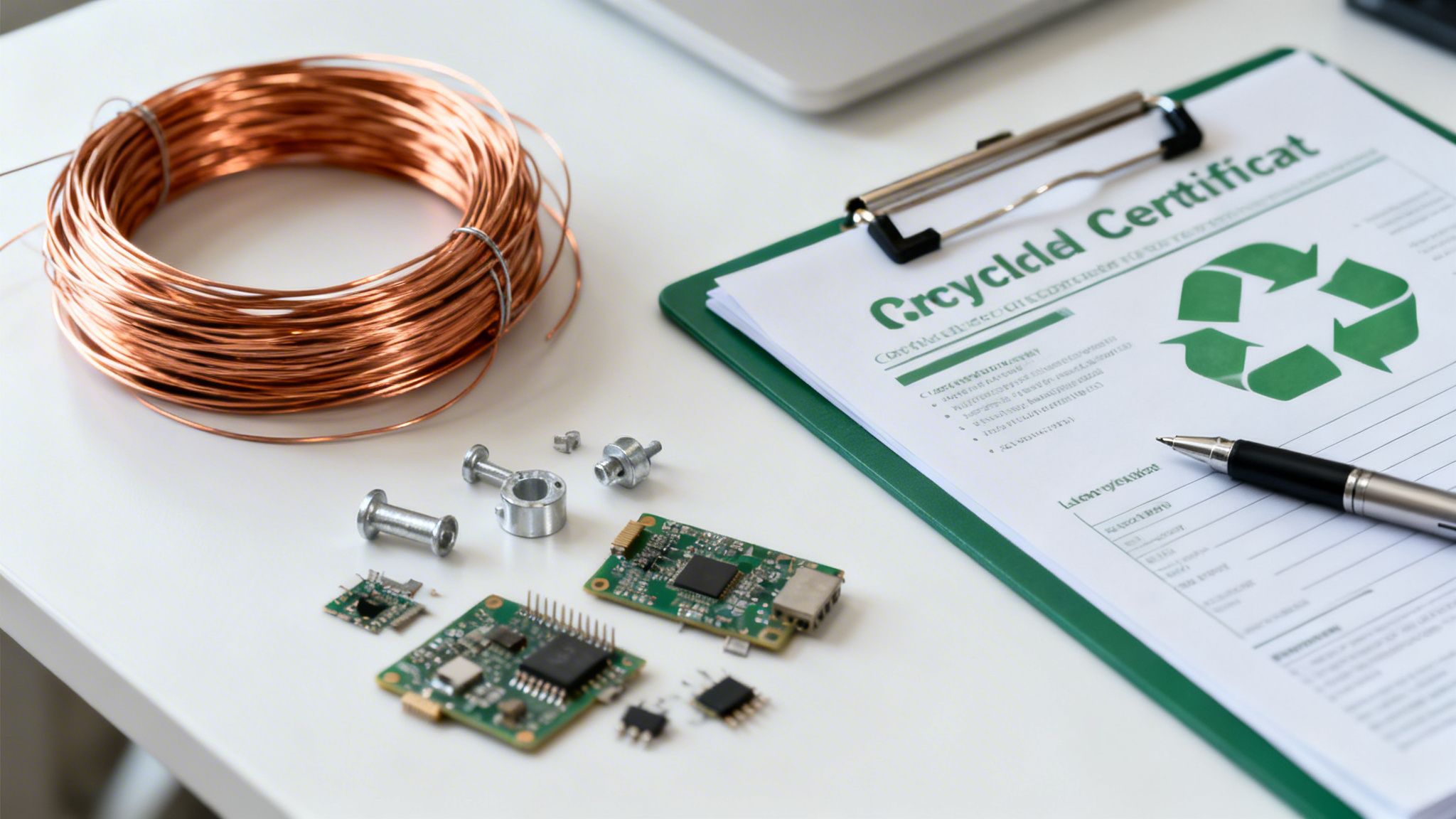
Many businesses look at a storeroom filled with old electronics and see a sunk cost—a compliance headache that just needs to vanish. But that perspective is a major missed opportunity. A professional e-waste recycling programme does more than just tick a compliance box; it can unlock real financial value and arm you with the documentation you need for total peace of mind.
If you’re thinking about "electronic waste near me" as just a disposal problem, you're ignoring the valuable resources still locked inside that equipment. When you partner with the right experts, those assets can often offset the recycling fees and, in some cases, even generate a new revenue stream for your company.
From Cost Centre to Value Recovery
Those obsolete electronics are a surprisingly rich source of commodities. Their circuit boards, wiring, and internal components are packed with materials that are always in high demand. It takes a specialist to properly dismantle these assets and segregate the different materials to get the best possible return.
The process starts with a detailed assessment of your e-waste to figure out its exact composition and potential yield. The most common recoverable materials include:
- Non-Ferrous Metals: Copper, aluminium, and brass are everywhere in electronics—from wiring and heat sinks to the equipment casings themselves.
- Precious Metals: You’ll find small but significant quantities of gold, silver, and platinum on circuit boards and inside connectors.
- Ferrous Metals: Don't forget the heavy stuff. Steel from server racks, equipment frames, and enclosures adds up quickly in weight and value.
After these materials are recovered and processed, their market value is calculated and credited back to your business. This transparent approach turns what you thought was a pure disposal cost into a clear financial return. It’s how you make your sustainability goals financially smart. For a deeper dive into what your other industrial scrap might be worth, our guide on how to sell scrap metal near me offers some great insights.
The Critical Role of Transparent Documentation
In the current regulatory climate, if you can’t prove you did it right, you might as well have not done it at all. It’s not enough to just have your e-waste collected. You absolutely need an auditable, unbroken paper trail confirming every single item was handled securely and in full compliance with South African law.
This is where professional documentation is non-negotiable. It’s your concrete proof of due diligence, protecting your business during internal audits, B-BBEE reporting, or an unexpected visit from regulators.
A Certificate of Destruction isn't just a piece of paper; it’s your legal shield. It proves that sensitive data was irretrievably destroyed, protecting you from the massive financial and reputational fallout of a data breach.
A Fully Auditable Trail from Start to Finish
A credible recycling partner provides a complete suite of documents, creating a full chain-of-custody record. This documentation is vital for proving you’ve met both your corporate sustainability targets and your legal obligations.
A comprehensive documentation package should always include these key items:
- Waste Transfer Notes: These are the initial documents that record the type and quantity of waste collected from your premises. This is the point where responsibility officially transfers to the recycler.
- Certificates of Destruction: For any device that held data, this certificate confirms the permanent and secure destruction of all information. It should ideally list serial numbers for precise, item-level tracking.
- Recycling and Safe Disposal Certificates: This is the final document. It confirms that all materials were processed according to environmental regulations and gives you the assurance that no hazardous components ended up in a landfill.
This level of detailed reporting gives you complete peace of mind. It shows your stakeholders and the authorities that your business is part of the solution, not the problem. This is critical, as South Africa’s e-waste plastic capture rate highlights the scale of the challenge—while informal recovery is high, only 14% of e-waste plastic is captured in documented, formal loops. The rest is often landfilled or openly burned, with serious environmental consequences. You can learn more about these findings on e-waste plastics.
Your E-Waste Management Questions, Answered
When businesses start searching for "electronic waste near me," they're often moving from identifying a problem to finding a practical solution. But that path can be cluttered with legal, security, and logistical questions. We get it. Here are some of the most common operational concerns we hear from industrial, commercial, and municipal clients, with clear, straightforward answers.
Is It a Legal Requirement to Recycle E-Waste in South Africa?
Yes, absolutely. It's not a recommendation; it's a legal mandate. The National Environmental Management: Waste Act (NEM:WA) explicitly prohibits sending any electronic waste to a landfill. Ignoring this can lead to some hefty penalties for your business.
On top of that, the Extended Producer Responsibility (EPR) regulations put the onus squarely on producers and importers to manage their products at the end of their life. For your business, this means you have a clear duty to ensure your old electronics go into a compliant recycling stream. This is where a certified recycler becomes essential—they provide the paper trail to prove you've met your legal obligations.
How Can I Be Sure Our Company's Sensitive Data Is Destroyed?
Data security is non-negotiable, and we treat it that way. A professional partner should provide a robust, auditable process that guarantees your information is gone for good. We tackle this with certified data destruction services, using two primary methods.
- Software-based Wiping: We use advanced software to overwrite storage media to strict international standards, making any data recovery completely impossible.
- Physical Destruction: This is the definitive end for data. We physically shred or degauss hard drives, SSDs, and other media, utterly obliterating them and the information they hold.
Once the job is done, we issue formal Certificates of Destruction. This document is your official proof that sensitive company and client data was securely destroyed before any hardware was recycled for materials.
A Certificate of Destruction isn't just a piece of paper; it’s your legal safeguard. It provides an official record of your due diligence against the enormous risks of a data breach from improperly handled equipment.
What Are the Costs of Professional E-Waste Recycling?
The cost of professional recycling isn't one-size-fits-all. It can depend on the amount and type of e-waste, where you're located, and whether you need specialised services like data destruction. But it's a mistake to look at it purely as an expense. Often, the process can be cost-neutral or even generate a rebate for your business.
Many electronics are packed with valuable commodities like copper, aluminium, and precious metals. A transparent partner will do a full assessment of these recoverable materials. The value is then used to offset any collection and processing fees. We provide clear, upfront quotes that break down all potential costs and the estimated value of rebates, so you see the complete financial picture from day one.
Our Facility Is Remote. Can You Still Collect Our E-Waste?
Yes. We operate nationwide across South Africa, and our real expertise lies in creating logistics solutions for industrial, construction, and municipal clients, no matter how remote their site is.
We’ve handled everything from massive factory cleanouts in distant industrial parks to clearing assets from demolition sites far from any city centre. Our team coordinates every single detail—from supplying the right on-site containers and managing site access to ensuring secure transport. Our goal is simple: to provide a seamless, efficient service that works for your operation, wherever you are.
For a partner that delivers compliant, secure, and value-driven e-waste solutions across South Africa, talk to D7 Capital Partners (Pty) Ltd. We provide comprehensive management services tailored to your industrial, commercial, or municipal needs. Find out more at https://d7capital.co.za.