Old laptops in a locked cabinet. Damaged printers behind the dispatch office. Obsolete handheld scanners, routers, server parts, extension leads, power supplies, and a pallet of mixed cables no one wants to touch.
Most facilities already have e-waste on site. They just don't account for it properly. It sits there as “old IT”, “maintenance scrap”, or “redundant stock”, when in practice it’s a combined materials, compliance, and cash issue.
That’s why e waste recycling for cash matters. Done badly, it creates legal exposure, data risk, and weak scrap returns. Done properly, it turns a messy back-room problem into a controlled recovery stream that supports both compliance and revenue.
The Untapped Revenue Stream in Your Storeroom
The usual trigger is simple. Finance wants space cleared. IT has completed an upgrade. Maintenance has removed control units and cabling from a plant area. Suddenly, one room becomes a holding zone for equipment nobody wants to sign off.
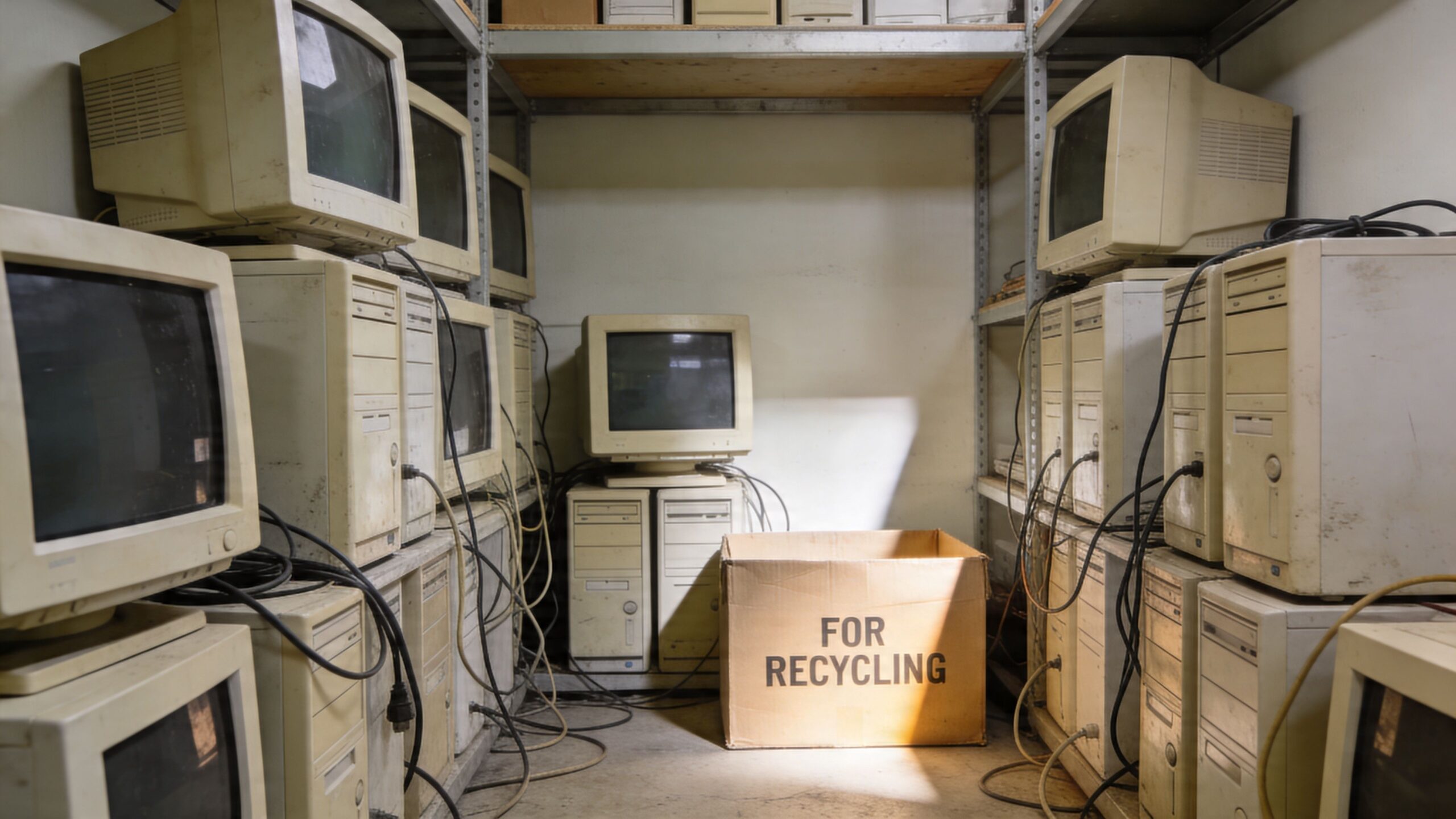
That stockpile isn’t just clutter. It contains recoverable metal value, and in South Africa the missed opportunity is unusually large. Africa has the lowest global formal e-waste collection and recycling rate at just 0.7% as of 2024. The 62 million tonnes of e-waste generated globally in 2022 contained an estimated USD 91 billion in raw materials, but only USD 19 billion was recovered through formal channels, according to the Global E-waste Monitor figures cited here.
What usually has value on site
A facility manager shouldn't think only about desktops and phones. The better approach is to look for any end-of-life electrical or electronic item that contains metal, boards, wiring, or recoverable components.
Common examples include:
- Office IT: desktops, laptops, monitors, docking stations, UPS units
- Network equipment: switches, routers, patch panels, telecom hardware
- Industrial electronics: control panels, drives, instrumentation, relays
- Peripheral scrap: chargers, transformers, power supplies, mixed copper cable
- Security systems: DVR units, access control hardware, cameras, alarm panels
Some of these items belong in an e-waste stream. Others also fit into broader non-ferrous recovery, especially where cable, aluminium housings, and stainless steel are mixed into a site clear-out. A broader view of recyclable materials helps when you’re separating value from junk, especially across mixed loads of electronic and metal waste, as outlined in this guide to common types of scrap metal you can recycle for cash.
Practical rule: If an item plugs in, stores data, carries current, or contains boards and cabling, don't send it out with general waste and don't let it sit indefinitely.
The financial case starts long before the recycler arrives. It starts with recognising that obsolete electronics are not dead stock. They’re unprocessed assets.
How to Identify and Prepare Your E-Waste Assets
The payout you get is shaped long before a load reaches a weighbridge. Most value is either protected or destroyed during sorting at your premises.
Mixed, wet, broken, or contaminated material usually trades down. Cleanly separated assets are easier to assess, safer to handle, and more likely to attract proper grading. That matters when your e-waste stream includes everything from office equipment to stripped server racks and decommissioned plant electronics.
Start with categories, not a pile
A simple internal sort works better than an overcomplicated system. Most commercial sites can separate e-waste into a few practical groups.
| E-Waste Category | Examples | Primary Valuable Materials |
|---|---|---|
| IT equipment | Desktops, laptops, servers, monitors | Copper, aluminium, circuit boards |
| Networking and telecoms | Routers, switches, modems, PABX equipment | Copper, aluminium, boards |
| Industrial electronics | PLCs, drives, HMIs, control panels, sensors | Copper, aluminium, boards, stainless steel |
| Power equipment | UPS units, power supplies, transformers, chargers | Copper, aluminium, steel |
| Small electronic accessories | Keyboards, mice, cables, adapters, docking stations | Copper, mixed metals, boards |
If your team needs a basic reference point on how the scrap trade separates metals and mixed streams, this breakdown of what scrap metals are helps frame the decision.
Prepare material so it keeps its value
The biggest operational mistake is treating all e-waste as one category. A server board load, mixed cable bin, and pallet of cracked monitors shouldn't travel or price the same way.
Use this checklist before collection:
- Keep complete units together: Whole laptops, desktops, and network gear are easier to identify and evaluate than loose mixed pieces.
- Separate loose cable: Copper-bearing cable often has its own value profile and shouldn't be buried under broken plastic housings.
- Remove obvious general waste: Cardboard, food waste, wood offcuts, and rubble lower handling efficiency and can affect the final assessment.
- Isolate damaged batteries and lamps: These need controlled handling and shouldn't be packed into ordinary mixed electronic loads.
- Label by origin: Mark loads by department, project, or site area so finance and compliance teams can track what left the premises.
A neat load doesn't only look better. It takes less time to process, causes fewer disputes at collection, and gives everyone a clearer record of what was recovered.
Handle hazardous components carefully
Not all electronics should be stacked the same way. Items with batteries, cracked screens, mercury-containing lamps, or leaking components need extra care. The correct move is separation, not improvisation.
A practical on-site setup usually includes:
- A secure cage or room for data-bearing equipment.
- A pallet zone for larger electronic hardware.
- Dedicated containers for loose cables and small mixed items.
- Clearly marked quarantine space for damaged or potentially hazardous units.
This doesn't require a complex internal waste programme. It requires discipline. The cleaner your segregation process, the easier it is to move from storage problem to saleable inventory.
Navigating South African Compliance and Data Security
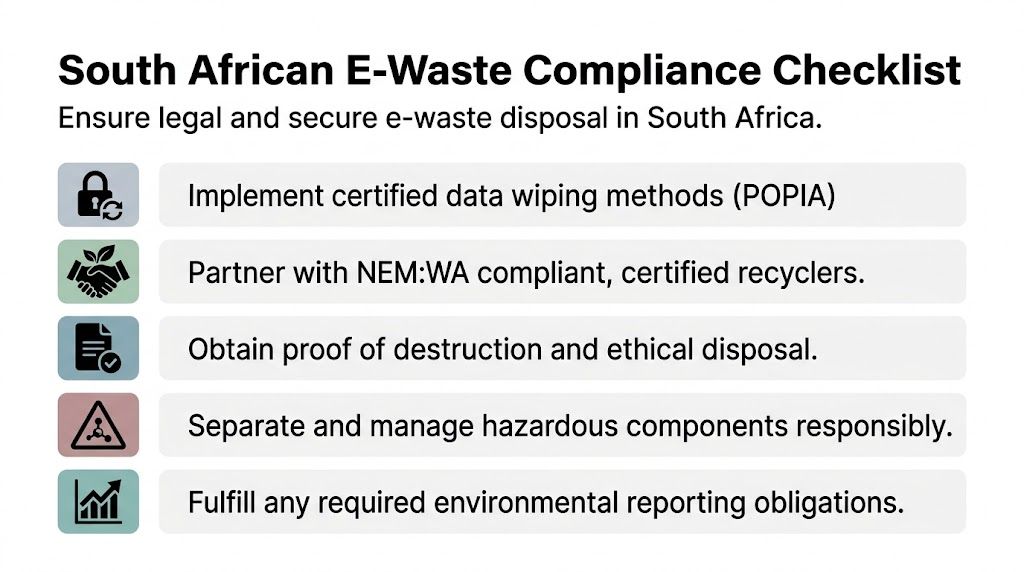
A cash offer means very little if the transaction creates legal exposure. In South Africa, e-waste disposal sits inside a real compliance framework, and many businesses still underestimate how quickly an informal collection can become a liability.
The first issue is environmental law. The second is data. The third is proof. If you can't show what left site, who took it, and how it was processed, you don't have a controlled disposal process.
What the legal risk looks like
The National Environmental Management Waste Act can impose fines up to R10 million for non-compliant waste activities. Only 12% of South Africa's 360,000 tonnes of annual e-waste is formally recycled, which means many organisations still hand material to operators who can't support a compliant paper trail, as noted in this summary on South African e-waste compliance risk.
That matters for facilities, factories, warehouses, public entities, and contractors. If your site generates the waste, your responsibility doesn't disappear when the truck leaves.
For teams managing broader industrial discards, compliant collection has to sit inside a larger waste-control process. This is the same operational logic used in metal waste management in Johannesburg, where traceability and correct handling matter as much as removal speed.
What to verify before any collection
A lot of managers focus only on the collection date and the payout. That's the wrong priority. Verify the recycler first.
Ask for:
- Waste handling credentials: You need confirmation that the operator is authorised to handle the relevant material stream.
- Collection records: The load should be documented clearly, including site details and the nature of the items removed.
- Destruction documentation: If devices contain data, insist on a certificate of destruction or equivalent proof of secure processing.
- Clear downstream process: You should know whether the load is dismantled, sorted, refurbished, or recovered for material value.
- Hazard handling procedure: Batteries, lamps, and damaged units shouldn't disappear into a mixed scrap channel.
If a buyer offers quick cash but avoids paperwork, that's not a convenience. It's a warning sign.
Data security is not a side issue
Most e-waste failures aren't dramatic. A company decommissions laptops, hands them over in bulk, and assumes the recycler will “wipe everything”. That assumption is where trouble starts.
A proper process separates data-bearing assets from ordinary electronic scrap. Hard drives, SSDs, servers, backup devices, multifunction printers, access control equipment, and CCTV recorders all need specific handling. Depending on your internal policy, that may mean software wiping, physical destruction, or both.
Use a simple decision standard:
| Asset type | Main risk | Better handling choice |
|---|---|---|
| Laptops and desktops | Stored user data | Secure wipe, then destruction if required |
| Servers and storage arrays | High-volume sensitive data | Controlled chain of custody and verified destruction |
| Printers and copiers | Cached documents and address books | Device memory clearing and proof of destruction |
| CCTV and access systems | Security footage and credentials | Secure removal and documented destruction |
Build a paper trail that finance and audit can use
The best e-waste system is the one your compliance officer, IT manager, and finance team can all sign off.
Keep these documents together:
- Internal asset list or disposal register
- Collection note
- Weighing or receiving confirmation
- Destruction certificate for relevant devices
- Invoice or settlement advice
That file turns a risky disposal event into a defendable business process. It also makes future clear-outs easier, because the procedure has already been tested.
Calculating the Cash Value of Your E-Waste
This is the question every site eventually asks. What is this stuff worth?
The answer depends less on the word “electronics” and more on what is inside the load, how cleanly it was sorted, and whether the buyer can grade and route the material properly.

The materials that drive price
Not all e-waste earns the same return. A pile of low-grade mixed peripherals doesn't price like copper cable, aluminium heat sinks, or high-grade server boards.
The strongest contributors to value are usually:
- Copper, often found in cabling, transformers, motors, and power supplies
- Aluminium, common in casings, frames, and heat dissipation components
- High-grade circuit boards, especially from servers and specialised equipment
- Recoverable mixed metals, where dismantling and grading improve the route to market
As of Q1 2026, typical South African e-waste payouts include copper at R80 to R110 per kg and aluminium at R25 to R35 per kg. High-grade circuit boards from servers can yield R5,000 to R15,000 per tonne, based on the pricing reference discussed in this South African e-waste payout overview.
What pushes a load up or down
A facility manager doesn't need to become a commodity trader, but you do need to understand what affects the final number.
Value usually improves when the load is:
- Sorted by type: copper cable separated from mixed electronic scrap
- Clean: less contamination from rubble, wood, plastic waste, and general refuse
- Traceable: listed and packed in a way that speeds up receiving and assessment
- Higher grade: server boards, telecom units, and heavy copper-bearing equipment often perform better than mixed office clutter
Value usually drops when the load is:
- Loose and mixed
- Damaged by weather
- Stuffed with general waste
- Collected with no inventory or separation
The same storeroom can produce two very different payouts. The difference is usually sorting discipline, not luck.
A quick visual explainer helps if your team needs to understand how inspection and grading affect recovery value:
Why informal offers often look simple but pay less
Informal buyers can seem attractive because they remove material fast and ask few questions. But convenience often hides weak grading. Mixed boards may be priced as low-value scrap. Copper may be bought as unprocessed mixed metal. Data-bearing items may leave site with no destruction proof at all.
A professional processor usually creates value in three ways:
- Better segregation and grading
- Access to stronger end-markets
- Ability to recover value beyond gross weight alone
That last point matters. A load with servers, drives, telecom equipment, and copper-rich components shouldn't be priced like a random pile of broken household electronics. The more accurate the classification, the more defensible the payout.
Streamlining Logistics with a Recycling Partner
The best e-waste programme is boring in the right way. Material is identified, packed, collected, weighed, documented, and removed without disrupting the site.
That doesn't happen when logistics are treated as an afterthought. It happens when collection is designed around how your facility operates.
Choose the collection model that fits the site
A once-off office clear-out needs a different approach from a manufacturing plant that generates electronic scrap every month. The wrong collection model creates congestion, storage risk, and lost value.
Common operating setups include:
- Ad hoc pickups: useful for relocations, refurbishments, and one-time storeroom clear-outs
- Scheduled collections: better for plants, depots, workshops, and larger sites with recurring electronic scrap
- Dedicated containers or cages: suitable where cabling, power units, and mixed electronic components arise continuously
- Project-based removal: practical for shutdowns, decommissions, and demolition-linked strip-outs
For teams that need full collection support rather than just pricing, this overview of scrap metal removal reflects the operational principles that make site clearances smoother and safer.
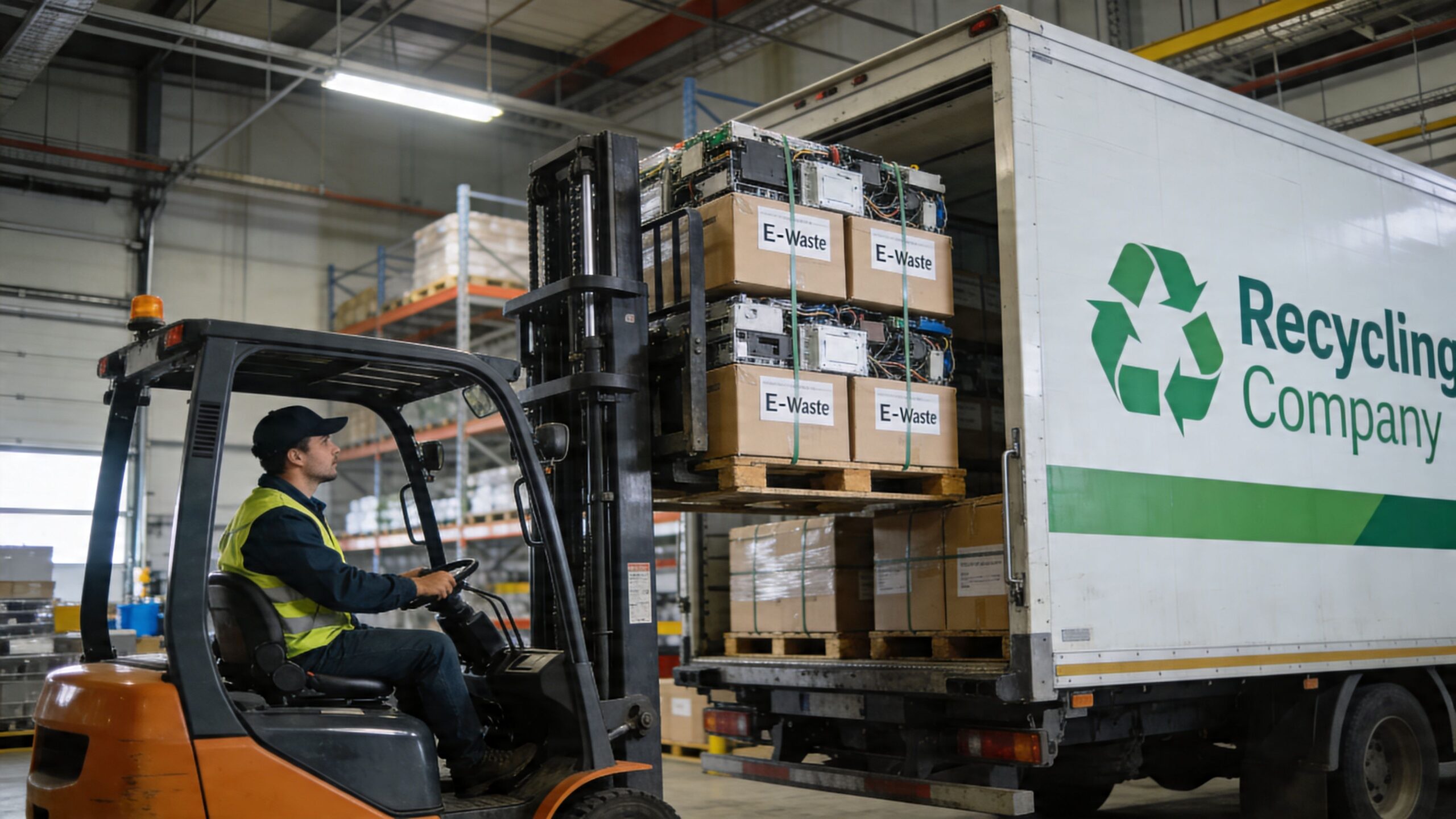
What a smooth handover looks like
A proper partner won't just ask, “How many pallets?” They’ll want to understand access, handling requirements, loading constraints, and any data-security controls around the material.
Expect a workable process to include:
- Site assessment so the collector understands volume, access points, and handling risks.
- Container or packing advice for loose cable, boxed electronics, palletised equipment, and sensitive assets.
- Safe transport planning for mixed loads, fragile items, and units with hazardous components.
- Receiving and reconciliation so your internal list can be matched to what was collected.
- Clear settlement and reporting after processing or weighing.
Logistics affects profit more than people think
Poor logistics erodes value. The team spends extra labour sorting at the last minute. Forklifts wait. Trucks are underfilled. Sensitive devices are mixed into the wrong load. Then the recycler spends time correcting avoidable mistakes, which often shows up in the final return.
The opposite is also true. Partnering with an efficient recycler can enable businesses to reach breakeven on their waste management programmes within 22 months by optimising recovery rates and using services like certified data destruction, according to this e-waste recycling market analysis.
Good logistics isn't only about moving waste off site. It's about protecting value at every handoff.
For most facilities, the winning model is simple. Make e-waste collection part of routine site operations, not a panic job triggered by lack of storage space.
Turning Your E-Waste Liability into a Cash Asset
Old electronics become expensive when they sit too long. They occupy secure space, create audit headaches, complicate data governance, and usually end up mixed with lower-value scrap.
The better move is to treat e-waste as a managed asset stream. Identify it early. Separate it properly. Keep hazardous and data-bearing items under control. Build a paper trail. Then sell into a process that can recover the full value.
That’s what makes e waste recycling for cash commercially useful in South Africa. It isn't just a clean-up exercise. It's a practical way to convert redundant equipment into revenue while reducing legal and operational risk.
For facility managers, the key decision isn't whether to remove e-waste. It’s whether to remove it casually or strategically.
Strategic removal pays better. It also stands up better when finance asks for recovery figures, when auditors ask for records, and when IT asks what happened to decommissioned assets.
If your site has a room, cage, or container full of obsolete electronics, you probably already have enough material to justify a formal assessment. The longer it sits, the harder it becomes to control and value properly.
If you want a practical assessment of your electronic scrap, collection setup, and recovery options, speak to D7 Capital Partners (Pty) Ltd. Their team supports South African businesses with compliant scrap removal, metal recovery, and waste management solutions that help turn stored e-waste into an organised, traceable cash asset.