Demolition cost per square metre South Africa searches produce quick numbers, but a reliable industrial budget needs a measured scope. This demolition cost per square metre South Africa guide provides a practical project-control baseline. Two buildings with the same floor area can have completely different costs because height, construction, access, hazardous materials, transport, salvage and the required end state are different.
This 2026 guide explains how contractors build a demolition estimate, when a per-square-metre benchmark is useful and which information clients should provide before comparing quotations.

What is the demolition cost per square metre South Africa?
Published South African consumer guides show very broad planning ranges, often around R150 to R800 per square metre for relatively straightforward low-rise demolition. That range is not a quotation and should not be applied blindly to factories, multi-storey structures, contaminated plants, confined sites or projects with specialist asbestos work.
For industrial demolition, the correct answer is a scoped site estimate. A basic rate may help test an early budget, but the contractor must price the actual structure, sequence, safety controls, loading, disposal and handover.
9 factors that change demolition cost
1. Structure and material
Brick, reinforced concrete, structural steel, timber and composite construction require different equipment, labour and sequencing. Heavy foundations and suspended slabs can dominate tonnage even when floor area is modest.
2. Height and stability
Multi-storey work, damaged structures and partial demolition need more engineering, access, protection and temporary support. A controlled top-down method is slower than clearing an isolated low-rise shell.
3. Site access
Machine reach, gate width, turning space, overhead services and truck routes affect productivity. Restricted urban or live industrial sites may require smaller plant, phased loading and more manual work.
4. Hazardous materials
Asbestos-containing materials, chemicals, contaminated soil, oils and refrigerants require survey, specialist handling and approved disposal. These items should be separated from the general demolition rate.
5. Safety and public protection
Engineering surveys, temporary works, scaffolding, hoarding, exclusion zones, traffic management, monitoring and specialist supervision are project resources. The structural demolition South Africa guide explains the wider process.
6. Rubble volume and destination
Floor area does not equal waste volume. Estimate concrete, brick, soil, steel, timber and mixed waste separately. Transport distance, load count, disposal fees and recycling routes all affect cost.
7. Dust, noise and vibration controls
Water suppression, monitoring, restricted hours and protection of neighbouring operations reduce impact but add resources. The right controls should be designed into the estimate, not treated as optional extras.
8. Required end state
“Demolish the building” may mean leave foundations, remove slabs, backfill voids, crush rubble, grade the site or provide a clean platform with service caps and survey records. Each end state carries different work.
9. Salvage and scrap value
Reusable equipment, structural steel, copper cable and non-ferrous metals can offset part of the project cost when ownership, grade and settlement are transparent. Do not assume a credit before a site audit and market assessment.
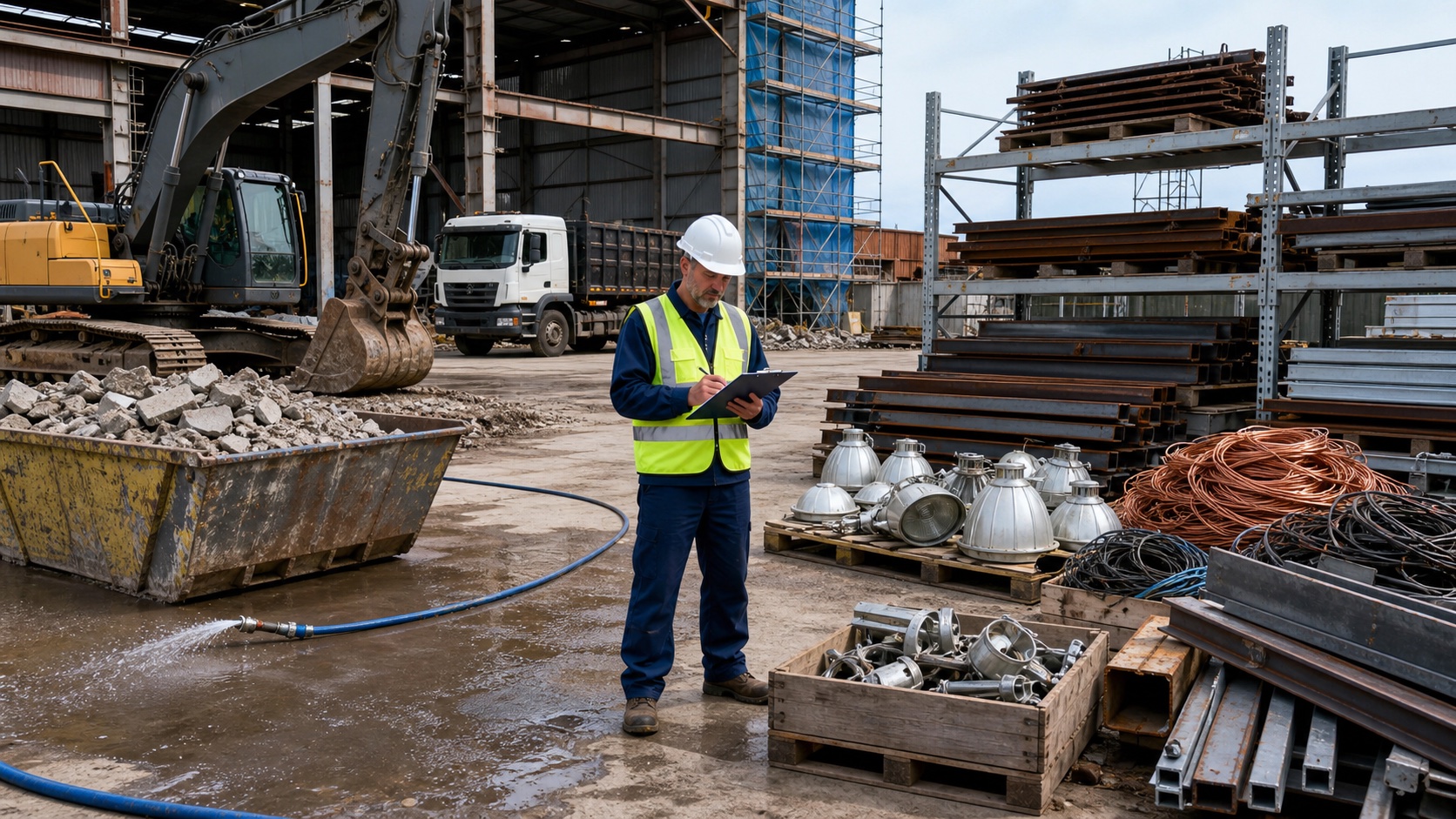
How a demolition estimate is built
| Estimate section | Typical content | Client input |
|---|---|---|
| Preliminaries | Supervision, site setup, permits, security and facilities | Programme and site rules |
| Engineering and safety | Surveys, method, temporary works, monitoring and protection | Drawings and building history |
| Production | Labour, plant, attachments, fuel and sequence | Scope and access windows |
| Material handling | Sorting, loading, containers, crushing and housekeeping | Required recovery targets |
| Transport and destinations | Truck cycles, recycling, treatment and disposal | Destination or reporting requirements |
| Credits | Agreed reusable assets and grade-based scrap value | Ownership and settlement rules |
| Close-out | Final clearing, evidence, inspection and handover | Defined end state |
Watch: preconstruction and cost certainty
What to include in a demolition quotation request
- Site address, access limits and working hours.
- Measured floor areas, heights, drawings and photographs.
- Construction type, alterations, damage and known hazards.
- Utility status and live neighbouring operations.
- Whether slabs, foundations and underground services stay or go.
- Required rubble, recycling and waste evidence.
- Ownership of scrap, equipment and reclaimed materials.
- Programme, milestones and final handover condition.
How to compare demolition quotes
Bring each quotation back to the same scope. Check exclusions for hazardous materials, permits, water, power, traffic control, disposal, foundations and VAT. Compare assumed quantities, destinations and salvage credits. A low headline rate is not cheaper if it excludes the work needed to reach the required end state.
Review the relevant industry and regulatory guidance before finalising scope. A demolition cost per square metre South Africa project should also be checked against site-specific legal, safety and environmental duties.
Build a comparable demolition pricing pack
Issue the same information to every tenderer: current drawings, structural type, dimensions, photographs, access routes, neighbouring constraints, service status, hazardous-material information, required end state and the programme. State who owns salvage, who pays disposal, whether crushing may occur on site and what evidence is required for every waste stream.
The demolition cost per square metre South Africa comparison should separate fixed preliminaries, demolition work, processing, transport, disposal, specialist hazards, temporary works and salvage credits. Ask bidders to list exclusions, quantity assumptions and provisional sums. A low headline rate can become expensive when concrete thickness, access, rubble distance or contamination differs from the assumption.
Use the demolition cost per square metre South Africa benchmark only after normalising scope. Compare safety methodology, programme, plant, reporting and commercial qualifications alongside price. The best decision is the offer that makes risk and assumptions visible, not simply the smallest number in one column.
Frequently asked questions
Is demolition always priced per square metre?
No. Contractors may use floor area as one benchmark, then price measured quantities, plant time, truck loads, specialist work and project preliminaries. Complex industrial projects are rarely captured by one rate.
Does scrap metal reduce demolition cost?
It can. The credit depends on ownership, grade, recoverable mass, preparation, access and market conditions. Keep the method transparent and match credits to weighbridge evidence.
Why do demolition quotes differ so much?
They may assume different scopes, methods, waste quantities, destinations and exclusions. Issue the same information and require a clear cost breakdown before comparing.
Can a contractor quote from photographs?
Photographs support an early indication, but a responsible final quote usually needs a site inspection and enough technical information to assess structure, hazards and logistics.
demolition cost per square metre South Africa: Practical Next Steps
The demolition cost per square metre South Africa clients see online is a starting signal, not a substitute for a scoped estimate. D7 Capital Partners provides structural demolition, scrap recovery and waste solutions for commercial and industrial sites. Contact D7 Capital Partners with your drawings, photographs, location and end-state requirements for a site-specific assessment.