

You’re probably dealing with one of two situations right now.
Either a yard, depot, plant, or municipal site has a line of damaged or end-of-life vehicles taking up space, tying up admin time, and creating risk. Or you’re on the buying side, looking at auto salvage for sale as a source of parts, ferrous feedstock, non-ferrous recovery, or dismantling stock, and the listings all seem simpler than the actual work on the ground.
In South Africa, auto salvage only looks straightforward from a distance. Up close, the value sits in documentation, category codes, dismantling sequence, fluid handling, parts grading, logistics, and what you can legally do with the unit once it lands in your yard. Buyers who treat salvage as “just scrap” usually overpay, miss recoverable value, or create compliance problems that follow them long after the truck leaves site.
Industrial buyers need a different lens. A salvage vehicle is not one thing. It’s a regulated asset, a bundle of recoverable materials, a possible parts bank, and, in some cases, a hazardous waste management job. The return depends on how well you assess all four.
The Untapped Value in South Africa's Auto Salvage Market
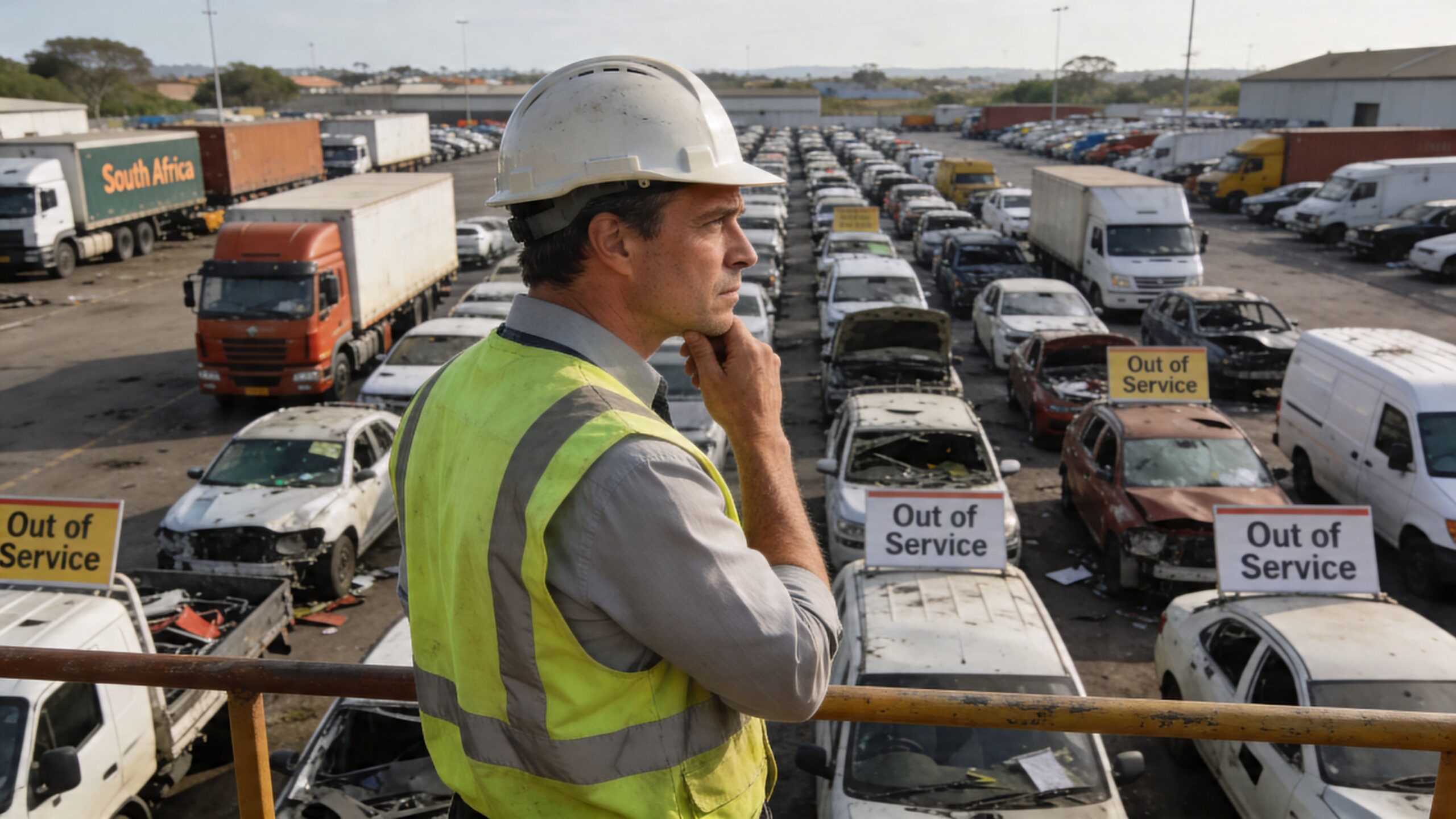
A lot of fleets get written off internally long before they’re processed properly. A bakkie with collision damage, a municipal sedan that’s reached the end of its service life, or a line of accident-damaged units from a contractor’s insurance disposal often gets treated as a storage headache first and a recovery opportunity second.
That’s the wrong order.
South Africa’s salvage economy is already large enough that industrial buyers can’t afford to ignore it. The national scrap metal market was valued at approximately R15 billion in 2023, and South Africa generated over 500,000 tonnes of automotive scrap in 2022, with auto salvage contributing 28% of the country’s ferrous scrap supply according to the figures cited at wifitalents.com.

Why industrial buyers should care
For a foundry, fabricator, or processor, salvage creates access to metal units that arrive in mixed but recoverable form. For a fleet operator, it offers cost recovery from vehicles that would otherwise sit idle. For a municipality, it’s a route to clear depots while keeping disposal aligned with transport and waste rules.
The important shift is this. You’re not buying a damaged car. You’re buying a recovery project with several value layers.
Those layers can include:
- Ferrous recovery: Body shell, structural steel, suspension elements, and other heavy sections.
- Non-ferrous uplift: Copper, aluminium, brass, lead, and stainless components where separation is done properly.
- Reusable assemblies: Engines, gearboxes, alternators, starters, panels, interior modules, and wheels where legality and condition allow.
- Operational benefit: Yard clearance, safer sites, and cleaner asset records.
Where value is won or lost
The biggest gains don’t come from chasing the cheapest unit. They come from buying the right category of salvage for the right downstream use.
A buyer harvesting parts for fleet support should not value stock the same way as a processor buying for shredder feed, and neither should behave like a municipal buyer clearing impounded or obsolete units. The commercial logic changes with every intended use.
Practical rule: If you can’t state the end use before you buy, you probably can’t price the salvage correctly.
That’s also why broad market awareness matters. The same industrial pressures affecting ferrous and non-ferrous supply affect salvage buying decisions too. The wider supply picture is reflected in D7 Capital’s overview of metal supply trends for 2025, especially if you’re procuring salvage as part of a larger raw material strategy.
Decoding Auto Salvage Categories and Terminology
Most mistakes in auto salvage for sale happen before the truck moves. They start with language.
A buyer sees “repairable”, “rebuilt”, “scrap”, “stripping”, or “accident damaged” and assumes the words mean roughly the same thing. They don’t. In practice, those labels affect what paperwork you need, whether the vehicle can return to the road, whether it should only be dismantled, and how aggressively you should price parts value.
Think of salvage codes like property zoning
A simple way to understand vehicle status is to think of it the way developers think about land. Two plots can look similar from the road, but one is zoned for development and the other isn’t. The same logic applies here.
A Code 2 vehicle is broadly the salvage equivalent of a used building that can still be occupied after appropriate work. It may be damaged, but it remains within the realm of repairable stock, subject to proper assessment and legal processes.
A Code 3 vehicle sits closer to a building that has already gone through a major restoration after serious damage. It has been rebuilt or reconstructed, and the buyer must pay close attention to both roadworthiness and documentation trail.
A Code 4 vehicle is different. That’s demolition stock. In practical salvage terms, it’s there for dismantling, material recovery, and lawful disposal. You do not price it as a future road car. You price it as parts stock, metals stock, or both.
The listing language that matters
When reading any lot or bulk disposal schedule, focus less on sales language and more on operational meaning.
Look for these details first:
- Vehicle identity: VIN, registration details, and any reference to deregistration status.
- Damage type: Frontal, side, rear, rollover, flood, fire, stripped, or mechanical.
- Completeness: Whether the engine, gearbox, ECU, wheels, seats, battery, catalytic converter, and airbags are still fitted.
- Intended disposal route: Parts sale, crush, export, or internal dismantling.
- Collection conditions: Whether the unit rolls, steers, brakes, or requires loading assistance.
If the seller can’t answer those points clearly, a new industrial buyer should slow down.
Salvage condition is never just about visible panel damage. The unseen value is usually in paperwork, driveline completeness, and whether the unit is intact enough to dismantle efficiently.
Buying for parts is not the same as buying for metal
A common error is mixing up parts-grade buying with scrap-grade buying.
If you’re buying for parts harvesting, you care about model commonality, interchangeability, damage pattern, and whether the high-demand assemblies survived the incident. A side impact unit may still carry a sound engine, gearbox, rear axle, and interior.
If you’re buying for scrap recovery, the questions are different. You want to know whether the shell is complete, whether contamination is manageable, how much non-metal content is still attached, and how difficult the load will be to process safely.
If you’re buying for fleet support, your strongest value may sit in repeated models. A damaged donor vehicle can keep multiple service vehicles on the road if the recovered parts match your installed fleet.
Why terminology affects downstream recovery
Salvage codes don’t just tell you what a vehicle is. They tell you what not to do with it.
That’s where many new buyers get trapped. They buy a unit because the headline price looks attractive, then discover it’s unsuitable for road use, badly stripped for parts work, or too contaminated to process efficiently.
A better buying habit is to classify every unit into one of three internal buckets before bidding:
| Buying intent | What you’re really purchasing | Main risk |
|---|---|---|
| Parts recovery | Usable assemblies and body components | Missing, damaged, or non-matching parts |
| Metal recovery | Ferrous and non-ferrous content | Overestimating clean yield |
| Mixed recovery | Parts first, shell later | Extra labour and storage time |
For buyers new to the material side, this overview of common recyclable scrap metal categories is useful because salvage vehicles often contain a mix of those grades in one unit.
Accurately Valuing Auto Salvage Beyond Scrap Weight
The fastest way to lose money in salvage is to price by gross weight alone.
Weight matters, but it’s only the floor. A damaged vehicle carries at least three value layers. First, the recoverable metal. Second, the assemblies and components you can remove and sell or use. Third, the speed at which those materials or parts convert into cash. That third layer is where many buyers still guess.
Pillar one is material recovery
Start with the shell as a materials package.
A typical mid-size sedan contains a ferrous-heavy structure with smaller but important non-ferrous pockets. The steel body gives you the base tonnage. The primary uplift often comes from copper-bearing wiring looms, aluminium components, wheels, radiators, and selected castings that can be separated cleanly.
Here’s a practical view of how a buyer might assess a standard unit before purchase.
| Material / Component | Estimated Weight / Quantity | Notes on Value & Recovery |
|---|---|---|
| Ferrous shell and structural sections | Majority of vehicle mass | Core base value. Recovery depends on contamination, attached plastics, and how complete the shell is. |
| Wiring loom | Moderate quantity | Copper-bearing content can justify careful stripping where labour is controlled. |
| Aluminium wheels and cast components | Varies by model and trim | Higher value than mixed shred. Best recovered separately and kept clean. |
| Battery | Single unit | Requires controlled handling and compliant storage before downstream processing. |
| Radiator and heat exchangers | Limited quantity | Worth separating when intact and not badly contaminated. |
| Catalytic converter and selected modules | Unit-based rather than weight-based | Can matter commercially, but only if still fitted and legally saleable. |
The exact mix changes sharply by model, accident type, and whether the vehicle was already stripped before disposal. That’s why experienced yards inspect completeness before they inspect paintwork.
Pillar two is component value
Parts value can exceed metal value on the right unit.
That’s especially true where the vehicle is common in local circulation and where assemblies interchange across multiple model years. Buyers looking at auto salvage for sale for operational use should ask a simple question first: “Which parts am I likely to move quickly?”
Examples of parts that often justify closer inspection include:
- Engine and gearbox assemblies: Valuable when impact damage hasn’t reached the driveline.
- Alternators, starters, and ECUs: Compact, recoverable items that can move faster than bulk material.
- Doors, mirrors, lights, and bumpers: Only worth strong money when the damage pattern leaves them intact.
- Wheels, seats, dashboards, and interior modules: Often overlooked, but useful in fleet support and refurbishment work.
A fire-damaged car may still have useful ferrous value but poor parts value. A rear-impact unit may be the opposite. That trade-off should shape your bid.
Pillar three is sales velocity
Not all salvage value is equal. Some value sits in stock for too long.
According to the figures cited in IAA’s article on industry trend data, predictive analytics, leveraging historical NaTIS crash data and local auction trends, can cut inventory holding costs by 40-50%. The same source states that yards using AI-driven interchange scouting achieve 50% faster turnarounds, increasing average salvage value per mid-size sedan from R25,000 to R38,000.
That changes how disciplined buyers assess stock. A unit with moderate gross value but fast-moving components can outperform a heavier unit that sits in the yard waiting for a buyer.
Operational test: Don’t just ask what the vehicle is worth. Ask how long each recoverable item will occupy space, labour, and capital.
A better pre-purchase checklist
Before you price a vehicle, score it across four practical questions:
- Is the paperwork clean enough to process confidently?
- Are the high-value assemblies still present?
- Will the shell deliver cleanly separable metal, or is it heavily contaminated?
- Can the likely outputs move quickly through your channels?
That’s a better method than bidding off photos and mass alone.
For buyers building a more disciplined valuation process, this scrap metal recycling guide is helpful because it frames recovery around grading and processing logic rather than just collection.
Navigating Sourcing and Legal Compliance in South Africa
The legal side is where new buyers usually discover that cheap salvage can become expensive very quickly.
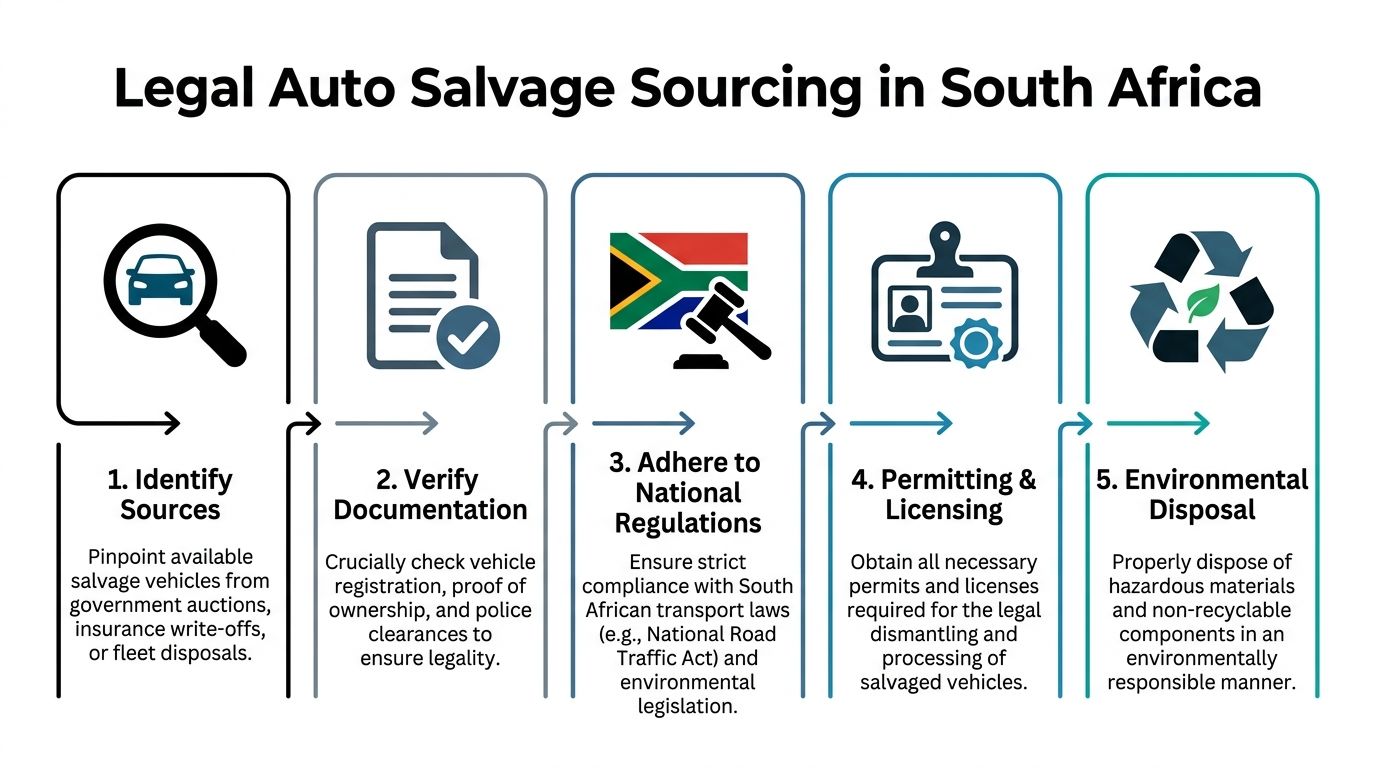
If you buy a damaged vehicle without verifying identity, status, and reporting requirements, you’re not just taking on a processing problem. You’re taking on title risk, fraud risk, disposal risk, and, in some cases, enforcement risk. In South Africa, that work has to start before payment, not after collection.
Start with document control
Every unit should be checked against its paper trail before you commit. That means registration details, proof of ownership, and a clear understanding of whether the vehicle is being sold for repair, dismantling, or destruction.
The most important discipline is matching the physical vehicle to the records. The VIN on the shell, windscreen area, plate locations, and supporting documents must align. If they don’t, stop the transaction until the discrepancy is resolved.

NaTIS reporting is not optional
The core compliance rule is straightforward. Under the National Road Traffic Act framework referenced in the cited material, yards must report vehicle data, including VIN and damage details, to the NaTIS system within 7 days, and that process reduces VIN cloning fraud. The same cited source states that VIN cloning fraud accounts for 15-20% of stolen vehicle recoveries, that over 70% of salvage vehicles require RTMS certification before resale or dismantling, and that non-compliance fines can exceed R100,000 per vehicle according to the figures cited at SalvageReseller’s referenced page.
That matters because the paperwork doesn’t sit outside the commercial process. It drives the commercial process.
If the VIN history is unclear, part matching becomes less reliable. If disposal intent is unclear, your downstream route can become unlawful. If reporting deadlines are missed, the risk is no longer theoretical.
A working compliance sequence
For industrial and municipal buyers, a practical sequence usually looks like this:
Verify identity before release
Match VIN, registration record, seller authority, and physical vehicle.Confirm legal status of the unit
Determine whether it’s road-return stock, rebuild stock, or dismantle-only stock.Record acquisition details immediately
Don’t wait until the vehicle arrives in the yard to clean up the admin.Capture damage classification accurately
Frontal, side, rear, rollover, flood, fire, or stripped condition affects both reporting and recovery planning.Assign the disposal route early
Crush, parts sale, export, or internal dismantling should be decided before processing begins.
Buyers who leave compliance to admin staff after the fact usually end up making operations decisions with incomplete records.
Why compliant sourcing improves value
Clean legal status doesn’t just reduce downside. It improves processing quality.
When the identity trail is solid, parts can be catalogued more confidently, records stand up better in audits, and buyers can separate saleable stock from destructive recovery stock without confusion. That reduces rework and prevents a lot of internal argument between yard, admin, and transport teams.
A few red flags worth taking seriously
Treat these as stop signs, not minor issues:
- Missing ownership proof: Especially on bulk disposals where several units are grouped together.
- VIN mismatch: Any difference between document VIN and vehicle VIN needs resolution before movement.
- Vague disposal language: “As is” doesn’t replace legal clarity.
- No clear status on deregistration: Dangerous if the unit is meant for dismantling only.
- Pressure to collect first and sort papers later: That usually means you’re taking on someone else’s problem.
For many industrial buyers, the best legal buying decision is the one you decline early. Salvage is only attractive when the record trail is strong enough to support the intended use.
Mastering Logistics and On-Site Processing
The purchase is only the beginning. Profit is made or lost in the yard, on the truck, and at the point of dismantling.
A badly planned collection can turn recoverable stock into damaged stock. A rushed dismantling job can contaminate metal, waste labour, and create environmental exposure. That’s why serious salvage operators treat logistics as part of valuation, not as an afterthought.
Recovery starts on site, not in the processor’s yard
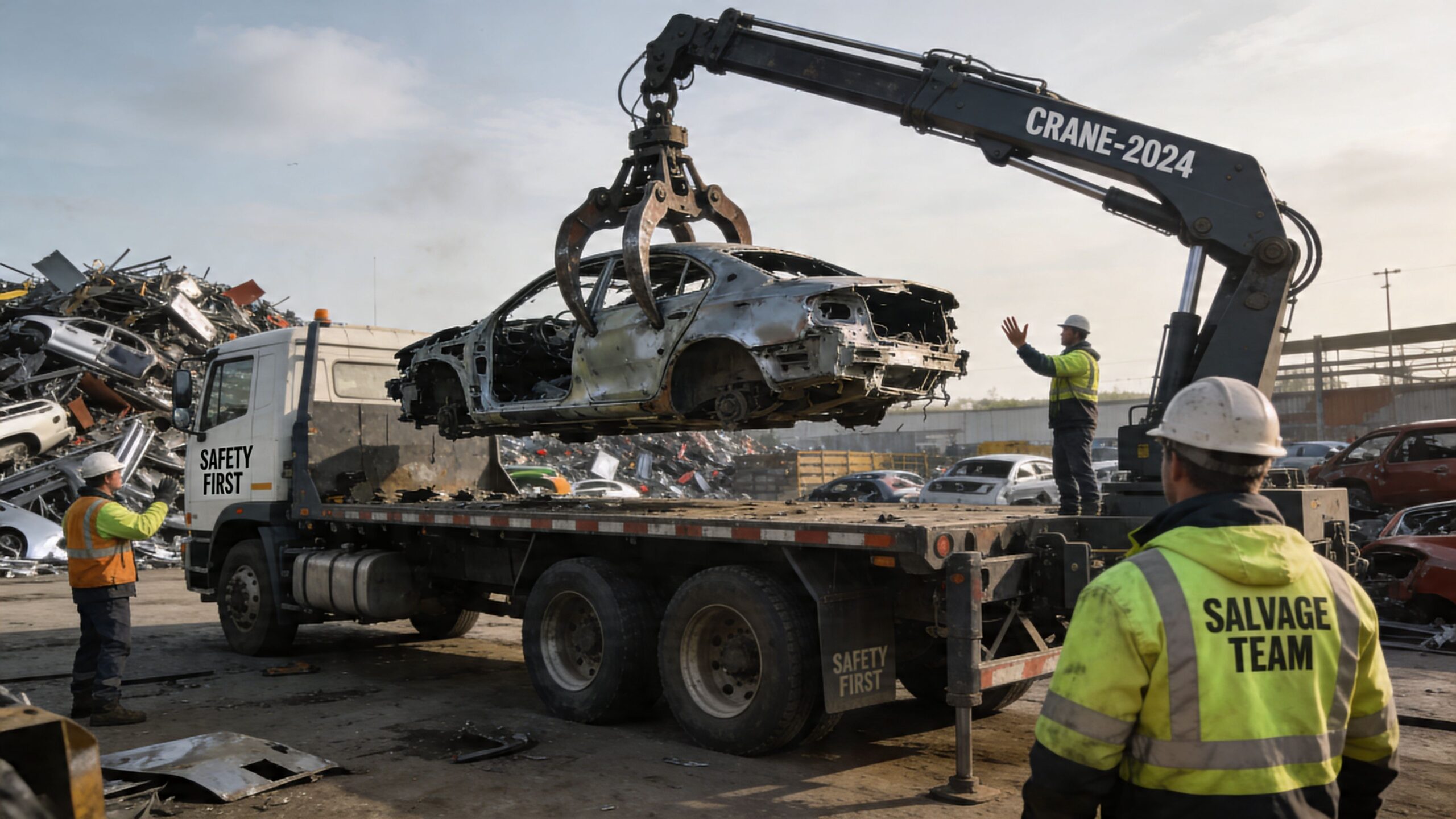
The first on-site inspection should answer three things fast. Does the vehicle roll or need mechanical loading? Is there leakage or visible hazard? Is the unit complete enough to justify careful dismantling, or should it move as bulk recovery stock?
That early call affects equipment selection. Some loads suit rollback recovery. Others need crane support, forklifts, skates, or staged loading because the wheels are locked, the steering is damaged, or the vehicle is buried in a mixed scrap area.
For contractors and municipalities, integrated removal matters. If vehicle salvage sits inside a bigger clearing or decommissioning job, the transport team must coordinate with site safety, access control, and waste segregation from the start. That’s one reason many industrial clients use specialist scrap metal removal support instead of trying to fold vehicle recovery into a general transport scope.
Dismantling sequence matters
Professional processing follows a controlled order. That order protects workers, preserves value, and limits contamination.
A practical dismantling sequence often includes:
- Fluid removal first: Fuel, oil, coolant, brake fluid, and other liquids should come out before cutting or crushing.
- Battery isolation and removal: Particularly important where lithium-containing systems or damaged electrical components are involved.
- Airbag and pyrotechnic awareness: Teams must identify undeployed systems before stripping interiors or front-end assemblies.
- Parts harvesting before shell reduction: Once the shell is crushed or cut aggressively, many recoverable assemblies lose value.
- Material segregation at source: Ferrous, aluminium, copper-bearing items, wheels, batteries, and mixed waste should not all land in one pile.
A salvage yard that separates value streams early usually recovers more and spends less time fixing avoidable contamination later.
Circular economy rules have changed the job
The current operating environment is stricter than the old “strip and crush” model. The cited material notes that South Africa’s 2025 Waste Act amendments mandate 60% recycling rates for automotive shredder residue, and that proper dismantling and processing of 120,000 tons of annual auto scrap can yield R2.5 billion in metals like copper and aluminium, while also requiring management of the 40% of salvage autos containing hazardous e-waste such as lithium cells, according to the figures cited at upickpartsla.com.
That has real operational consequences.
You can’t treat every end-of-life vehicle as a simple ferrous unit anymore. Some loads carry electronics, battery systems, modules, and contaminated mixed waste that require more careful handling and storage. Municipal and industrial sites should build this into their removal planning before the first collection date is set.
Video example of yard handling
The handling side is easier to understand when you watch how equipment, spacing, and loading discipline affect recovery speed and safety.

What works and what doesn’t
The gap between efficient and inefficient salvage operations is rarely dramatic. It’s usually a series of small decisions.
What works:
- Pre-booked collection windows: Reduces standing time and site congestion.
- Tagged vehicles on site: Prevents loading the wrong unit in mixed disposal environments.
- Dedicated hazard zones: Keeps drained fluids, batteries, and e-waste out of general scrap flow.
- Separate bins or bays for material classes: Supports cleaner downstream grading.
What doesn’t:
- Mixed loading without identification
- Cutting before draining
- Stacking damaged vehicles too early
- Assuming every unit should be stripped to the same depth
A burnt shell, a stripped taxi, and a hail-damaged fleet sedan should not go through the same process. The best operators adjust labour depth to the likely recovery profile of each class of stock.
Your Partner in Maximising Salvage Recovery Value
Most industrial buyers don’t struggle because they can’t find auto salvage for sale. They struggle because the work doesn’t end when they find it.
A practical salvage project often starts with a simple instruction. Clear these vehicles. Remove the scrap. Dispose of the damaged units. Recover what you can. Keep the site compliant. Deliver clean material. But once the work begins, that simple instruction becomes a chain of linked decisions.
One municipal depot may have obsolete fleet vehicles mixed with stripped accident units and a few derelict trucks parked for years. A factory may have end-of-life forklifts, accident-damaged bakkies, and loose scrap from a broader decommissioning. A demolition contractor may need all of that moved while structural work continues around it.
In those environments, salvage value doesn’t come from one service. It comes from coordination.
What an integrated salvage job looks like
The strongest results usually come from treating the job as one controlled recovery stream rather than several disconnected tasks.
That means the team handling removal also understands material segregation. The people assessing the vehicles understand the difference between parts stock and shred stock. The transport plan fits the site access conditions. The yard receiving the material can process ferrous and non-ferrous outputs to recognised trade specifications. And the compliance record follows the load from pickup to final processing.
That integrated model is where specialised operators stand apart from ad hoc collectors.
A practical example from the field
Take a common industrial scenario. A site manager inherits a yard with collision-damaged fleet vehicles, old service vans, and a few units that were kept “for spares” but never properly catalogued. On paper, it looks like a disposal problem. On the ground, it’s four jobs:
- identify legal status,
- separate recoverable components,
- remove and store hazardous materials correctly,
- and turn the remainder into saleable grades.
If different contractors handle each stage without one recovery plan, value leaks out quickly. The parts team strips inconsistently. The transporter damages recoverable stock during loading. Fluids are handled too late. Ferrous and non-ferrous streams get mixed. Admin trails behind the physical movement of vehicles.
An experienced salvage and metals operator closes those gaps by planning the sequence before the first unit moves.
The best recovery jobs feel uneventful on site. That’s usually a sign that the paperwork, transport plan, dismantling logic, and material offtake were aligned properly before work started.
Why grading capability matters
Once a vehicle has been dismantled correctly, the output still has to meet buyer expectations.
That matters for local mills, foundries, fabricators, and international buyers who aren’t purchasing “car scrap” in the abstract. They’re buying defined material streams. Ferrous grades such as HMS 1 & 2, black bales, cast iron, and manganese-bearing material need consistent preparation. Non-ferrous streams such as copper, aluminium, brass, lead, zinc, and stainless steel need controlled separation if they’re going to realise proper value.
Salvage expertise crosses over into broader scrap metal capability. The operator needs to understand not just vehicle dismantling, but also downstream preparation to tradeable standards such as ISRI 201, 204, 236, 238, PNS, and related specifications used in the market.
The advantage of combined demolition, waste, and salvage capability
A lot of large salvage opportunities don’t arrive as neat rows of auction cars.
They arrive inside shutdowns, depot clear-outs, tenant exits, structural strip-outs, or industrial demolition projects. In those settings, the salvage operator has to work around plant equipment, site restrictions, mixed waste, and safety controls. A provider that only knows how to collect vehicles often struggles when the job includes steel structures, factory scrap, embedded machinery, and environmental controls in the same scope.
That’s why end-to-end capability matters for industrial and municipal clients. One team can coordinate site clearing, selective demolition, scrap recovery, transport, segregation, and final processing without handing off risk between multiple vendors.
What a strong partner should bring
If you’re appointing a salvage specialist, look for practical capability rather than sales language.
A strong partner should be able to provide:
- Documented compliance discipline: Clean acquisition, reporting, and disposal records.
- Operational yard experience: Not just buying knowledge, but actual processing capability.
- Ferrous and non-ferrous expertise: Recovery isn’t only about heavy steel.
- On-site logistics support: Loading, lifting, access planning, and removal from difficult sites.
- Waste management awareness: Especially where batteries, fluids, and electronic waste are involved.
- Specification-based supply: Material prepared to recognised grades for serious downstream buyers.
Those points matter whether the job is a once-off fleet disposal or an ongoing industrial recovery programme.
When buyers, contractors, and municipalities want one operator that can recover value, manage risk, and handle the broader site realities around auto salvage, D7 Capital Partners (Pty) Ltd brings together scrap metal recycling, structural demolition, waste management, compliant logistics, and specification-based ferrous and non-ferrous processing. If you need a practical partner to turn vehicle liabilities and mixed industrial scrap into organised, recoverable value, get in touch with the team and discuss your site, volumes, and recovery goals.
- The Untapped Value in South Africa's Auto Salvage Market
- Decoding Auto Salvage Categories and Terminology
- Accurately Valuing Auto Salvage Beyond Scrap Weight
- Navigating Sourcing and Legal Compliance in South Africa
- Mastering Logistics and On-Site Processing
- Your Partner in Maximising Salvage Recovery Value